
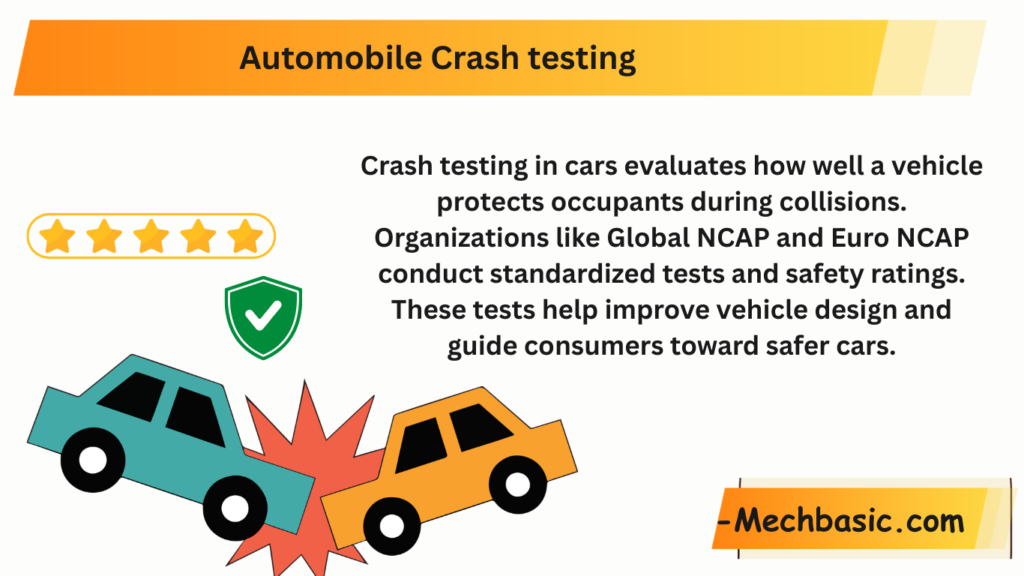
Crash testing in cars evaluates how well a vehicle protects occupants during collisions.
Organizations like Global NCAP and Euro NCAP conduct standardized tests and safety ratings.
These tests help improve vehicle design and guide consumers toward safer cars.
In this article :
Crash testing
Crash testing is how cars are scientifically evaluated for safety before they go on sale. It combines controlled crashes, sensors, and strict protocols to measure how well a vehicle protects occupants.
What is crash testing?
Crash testing is the process of:
- Deliberately crashing vehicles under controlled conditions
- Measuring forces, injuries, and structural behavior
- Rating safety for consumers and regulators
Crash testing is based on principles like kinetic energy—the energy a moving car carries must be safely managed during impact.
Types of crash tests
1. Frontal crash test
- Most common and critical
- Simulates head-on collisions
Types:
- Full frontal (100% width into a wall)
- Offset frontal (partial overlap—more realistic)
👉 Measures:
- Head, chest, and leg injuries
- Seat belt & airbag performance
2. Side impact test
- Simulates another vehicle hitting from the side
Methods:
- Moving barrier hits the car
- Pole test (car hits a narrow object)
👉 Focus:
- Head protection
- Door and pillar strength
3. Rear impact test
- Simulates being hit from behind
👉 Focus:
- Whiplash injuries
- Seat and headrest design
4. Rollover test
- Evaluates stability and roof strength
👉 Measures:
- Likelihood of rolling over
- Roof crush resistance
5. Pedestrian safety test
- Simulates impact with a person
👉 Checks:
- Head and leg injury risk
- Hood (bonnet) design
Crash test dummies (ATDs)
Instead of humans, engineers use Anthropomorphic Test Devices (ATDs):
- Built to mimic human body structure
- Equipped with sensors
Measure:
- Head acceleration
- Chest compression
- Neck forces
- Leg injuries
What gets measured?
Sensors inside the car and dummies record:
- Speed and deceleration
- Force on body parts
- Airbag deployment timing
- Seat belt tension
These relate to concepts like impulse:
- Spreading force over time reduces injury
Major crash testing organizations
Global bodies
- Global NCAP
- Focus: emerging markets (including India)
- Euro NCAP
- Very strict standards
- NHTSA
- Government agency in the USA
- IIHS
- Independent US safety body
Safety ratings
1. Star ratings (0–5 stars)
- Used by Global NCAP, NHTSA
- 5 stars = highest safety
2. Detailed scoring
Includes:
- Adult occupant protection
- Child occupant protection
- Pedestrian safety
- Safety assist features
What happens during a crash test?
- Car is prepared with sensors
- Dummies are placed inside
- Vehicle is accelerated to a set speed
- Crash occurs (into barrier or object)
- High-speed cameras record everything
- Data is analyzed for injuries and structure
What engineers learn
Crash tests help improve:
- Crumple zones
- Airbags
- Seat belts
- Vehicle structure
Limitations
- Tests simulate common crashes, not all real-world scenarios
- Real accidents vary in:
- Speed
- Angle
- Vehicle types
Why crash testing matters
Without crash testing:
- Cars would be far less safe
- Safety features wouldn’t evolve
👉 Modern safety improvements are largely due to crash test data
Conclusion:
Crash testing:
- Simulates real accidents in a controlled way
- Measures how the car protects people
- Provides safety ratings for buyers
- Drives improvements in vehicle design
Other courses:





