
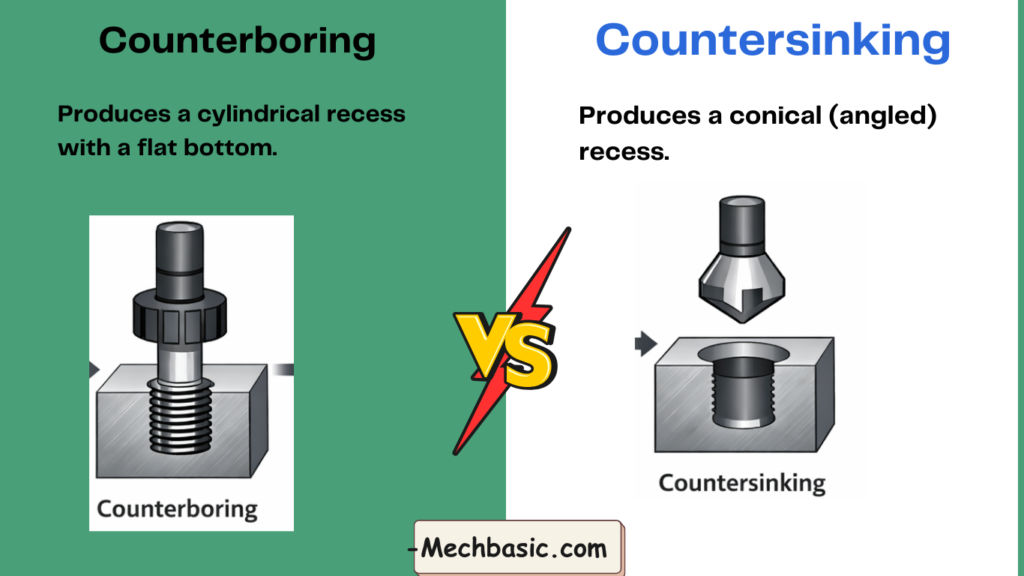
Counterboring and countersinking are machining operations used to modify the top portion of a drilled hole so that fasteners can be properly seated. Counterboring creates a flat-bottom cylindrical recess for bolt or cap screw heads, while countersinking produces a conical recess for countersunk screws to sit flush with the surface. Both processes improve assembly, safety, and appearance of mechanical components.
In this article:
Counterboring vs Countersinking
1. Shape of the Recess
- Counterboring:
Produces a cylindrical recess with a flat bottom. - Countersinking:
Produces a conical (angled) recess.
2. Purpose
- Counterboring:
Used to allow bolt heads, socket head screws, or cap screws to sit flush or below the surface. - Countersinking:
Used to allow countersunk screws to sit flush with the surface and to remove sharp edges or burrs.
3. Type of Fastener Used
- Counterboring:
Hex bolts, socket head cap screws, and washer-based fasteners. - Countersinking:
Flat-head or countersunk screws.
4. Bottom of the Hole
- Counterboring:
Has a flat bottom, suitable for flat-headed fasteners. - Countersinking:
Has no flat bottom; the bottom follows a conical angle.
5. Cutting Tool Used
- Counterboring:
Counterbore tool (often with a pilot for alignment). - Countersinking:
Countersink cutter with standard angles such as 60°, 82°, 90°, or 120°.
6. Accuracy Requirement
- Counterboring:
Requires precise depth control to seat the fastener properly. - Countersinking:
Depth control is important but less critical than counterboring.
7. Applications
- Counterboring:
Engine blocks, machine frames, structural components. - Countersinking:
Sheet metal work, aerospace parts, furniture, general assemblies.
8. Appearance
- Counterboring:
Fastener head is hidden inside a straight-walled recess. - Countersinking:
Fastener head blends smoothly with the surface.
9. Cost and Time
- Counterboring:
Slightly more time-consuming due to depth accuracy. - Countersinking:
Faster operation, often used for finishing.
Summary Table
| Feature | Counterboring | Countersinking |
|---|---|---|
| Recess shape | Cylindrical | Conical |
| Bottom | Flat | Angled |
| Fastener type | Bolt / Cap screw | Countersunk screw |
| Tool | Counterbore | Countersink |
| Accuracy | High | Moderate |
| Common use | Heavy assemblies | Light & flush finishes |
Other courses:





