
Countersinking is a machining operation used to create a conical recess at the mouth of a hole. It is performed so that countersunk screw heads sit flush or below the surface of the workpiece. This process also helps in removing burrs and improving the appearance and safety of the component.
In this article:
Countersinking
Countersinking is a machining operation in which the entrance of a pre-drilled hole is enlarged in a conical shape to allow a tapered-head screw or fastener to sit flush with or below the surface of the workpiece.
It is one of the most common finishing operations in mechanical assembly, metalworking, and woodworking.
1. Definition
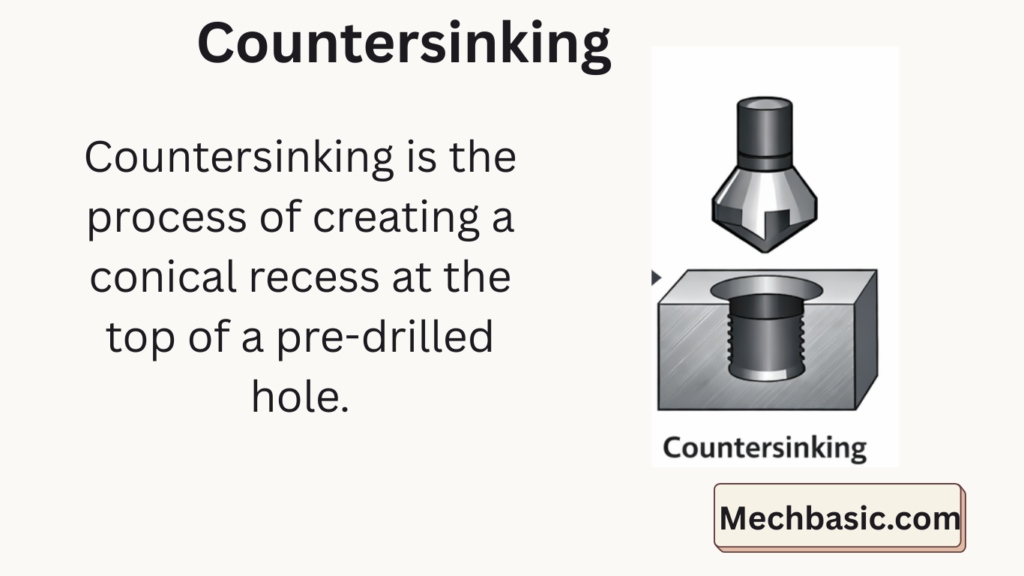
Countersinking is the process of creating a conical recess at the top of a pre-drilled hole.
- The angle of the conical recess usually matches the taper of the screw head (common angles: 82°, 90°, 100°, 120°).
- It ensures the screw fits flush with the surface, improving appearance and reducing stress.
2. Purpose of Countersinking
- Allow flat-head or tapered screws to sit flush with the surface
- Reduce stress concentration around the screw head
- Improve aesthetic appearance of the assembly
- Prevent protruding fasteners that may interfere with moving parts
3. Machines Used
- Drill press / pillar drill
- Milling machine
- CNC machining center
- Handheld drills (with portable countersink tool)
- Lathes (for rotational workpieces)
4. Tools Used
a) Countersink Cutter
- Conical cutting edges designed to match screw head angles
- Can be single-lip or multi-flute
- Common materials: HSS, carbide, cobalt-coated
b) Types of Countersink Tools
| Type | Description | Use |
|---|---|---|
| Tapered Countersink | Standard conical cutter | Flush-head screws |
| Combination Drill & Countersink | Drill tip with countersink | One-pass operation |
| Adjustable Countersink | Diameter can be adjusted | Different fastener sizes |
| Spot-Facing / Countersink | Small shallow recess | Surface preparation |
5. Process Steps
- Pre-drill Hole
- Hole for screw shank or bolt must be drilled first
- Tool Selection
- Select countersink cutter matching the screw head angle
- Workpiece Setup
- Clamp firmly to prevent vibration
- Align tool axis with the pre-drilled hole
- Cutting Parameters
- RPM: Moderate, depending on material
- Feed: Light and steady
- Lubricant/Coolant: Recommended for metals
- Countersinking Operation
- Insert cutter into pre-drilled hole
- Remove material in a conical shape
- Ensure proper depth for flush screw seating
- Finishing
- Deburr edges for smooth finish
- Check alignment and angle of the recess
6. Cutting Parameters
| Material | Cutting Speed (m/min) | Feed per Rev (mm) | Coolant |
|---|---|---|---|
| Steel | 20–40 | 0.05–0.2 | Oil / Emulsion |
| Aluminum | 50–80 | 0.1–0.3 | Minimal |
| Brass / Copper | 30–60 | 0.05–0.2 | Oil |
| Plastics | 15–30 | 0.05–0.15 | None |
Depth Control: Depth of conical recess = screw head height + small clearance (typically 0.1–0.2 mm)
7. Advantages of Countersinking
- Allows flush or recessed fasteners
- Improves assembly appearance and safety
- Reduces stress concentration at the hole surface
- Simple and fast to perform
- Works for both metal and wood applications
8. Limitations
- Requires pre-drilled hole
- Depth must be carefully controlled to prevent overcutting
- Not suitable for very thick materials if depth exceeds cutter length
- Limited to tapered fasteners
9. Applications
- Mechanical assemblies with flat-head screws
- Woodworking: flush screw heads in furniture
- Automotive and aerospace: flush fasteners in panels
- Machine frames and structural components
10. Countersinking vs Counterboring
| Feature | Countersinking | Counterboring |
|---|---|---|
| Hole Bottom | Conical | Flat |
| Purpose | Flush tapered-head screws | Flush socket-head screws / bolts |
| Tool | Conical cutter | Flat-bottomed cutter with pilot |
| Depth | Matches screw head | Matches bolt head height |
| Applications | Screws (tapered) | Bolts, socket-head fasteners |
11. Best Practices
- Select correct angle cutter to match screw head
- Clamp workpiece rigidly
- Use light feed and proper speed
- Apply coolant or lubricant for metals
- Deburr edges for smooth assembly
Countersinking is widely used in precision assemblies, woodworking, and structural components where fasteners must be flush with the surface for aesthetics and functionality.
Other courses:





