
Counterboring is a machining operation used to enlarge the upper portion of an existing hole to a specific diameter with a flat bottom. It is mainly done to allow the head of a bolt or screw to sit flush or below the surface of the workpiece. Counterboring is commonly used in mechanical assemblies where a smooth and neat surface finish is required.
In this article:
Counterboring :
Counterboring is a machining process used to enlarge the top portion of an existing hole to create a flat-bottomed recess. This recess allows the head of a bolt, screw, or fastener to sit flush with or below the surface of the workpiece.
It is commonly used in mechanical assembly, tooling, and structural applications where a clean surface finish around fasteners is required.
1. Definition
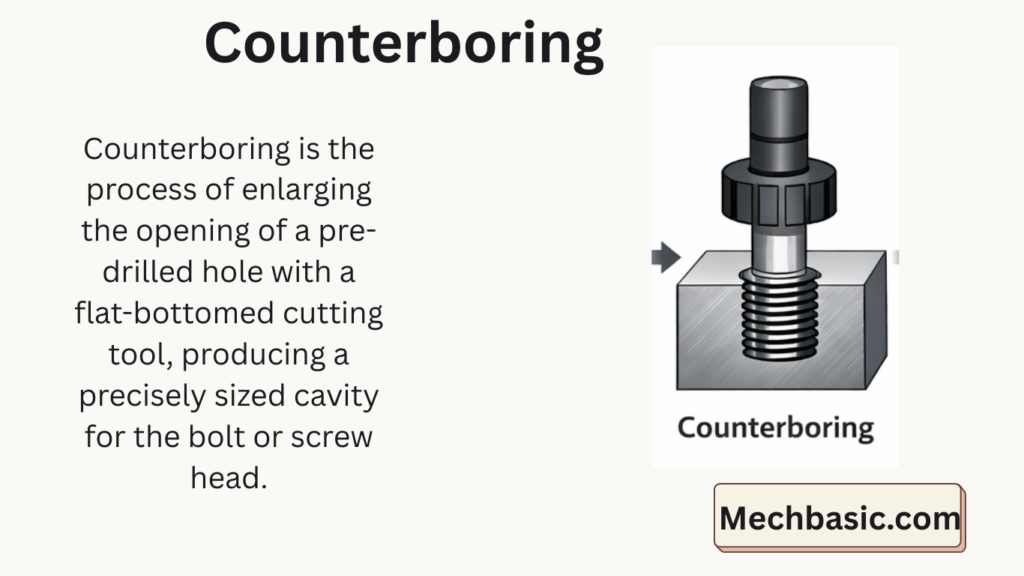
Counterboring is the process of enlarging the opening of a pre-drilled hole with a flat-bottomed cutting tool, producing a precisely sized cavity for the bolt or screw head.
- The original hole diameter remains for the bolt shank.
- The counterbore ensures the fastener sits flush or recessed.
2. Purpose of Counterboring
- Allow socket head screws, bolts, or fasteners to sit flush with the surface.
- Provide accurate seating for machine screws or dowels.
- Reduce stress concentration at the surface.
- Improve assembly appearance and safety by preventing protrusions.
3. Machines Used
- Drill press / pillar drill
- Milling machine (for precise alignment)
- CNC machining center
- Lathe (for rotational parts, counterboring on a face)
4. Tools Used
a) Counterbore Cutter
- Flat-bottomed cutting edges with pilot or guide
- Pilot diameter matches the pre-drilled hole to guide the tool
- Common materials: HSS, carbide, cobalt-coated
b) Types of Counterbores
| Type | Description | Use |
|---|---|---|
| Standard Counterbore | Flat-bottomed with pilot | Flush bolt heads |
| Screwdriver Recess / Spot-Faced | Small recess to seat screw heads | Light assembly or thin plates |
| Adjustable Counterbore | Diameter can be changed | Different fastener sizes |
5. Process Steps
- Pre-drill Hole
- Hole for bolt or screw shank is drilled first
- Tool Selection
- Choose counterbore cutter with pilot matching the pre-drilled hole
- Workpiece Setup
- Clamp firmly to prevent vibration
- Align counterbore axis with pre-drilled hole
- Cutting Parameters
- RPM: Lower than drilling due to larger diameter
- Feed: Moderate and steady
- Lubricant/coolant: Recommended for metals
- Counterboring Operation
- Cutter guided by pilot enters the hole
- Flat-bottomed recess is machined to required depth and diameter
- Finishing
- Remove burrs
- Check depth and diameter of counterbore
6. Cutting Parameters
| Material | Cutting Speed | Feed | Coolant |
|---|---|---|---|
| Steel | 20–30 m/min | 0.05–0.2 mm/rev | Oil or emulsion |
| Aluminum | 50–80 m/min | 0.1–0.3 mm/rev | Minimal / air |
| Brass / Copper | 30–50 m/min | 0.05–0.2 mm/rev | Oil |
| Plastics | 15–25 m/min | 0.05–0.15 mm/rev | None |
Depth Control: Typically depth of recess = bolt head height + clearance (0.1–0.2 mm)
7. Advantages
- Creates flush or recessed fasteners
- Produces flat-bottomed holes for proper seating
- Improves assembly appearance and safety
- Maintains hole alignment using pilot
- Minimal material removal compared to boring
8. Limitations
- Requires pre-drilled hole
- Depth limited by tool length and workpiece thickness
- Requires accurate alignment
- Not suitable for curved or irregular surfaces
9. Applications
- Mechanical assemblies with socket head screws or bolts
- Automotive and aerospace fasteners
- Tooling and jigs where precision bolt seating is required
- Machine parts and structural frames
- Woodworking and furniture assembly (metal inserts)
10. Counterboring vs Countersinking
| Feature | Counterboring | Countersinking |
|---|---|---|
| Hole Bottom | Flat | Conical |
| Purpose | Seat bolt head flush | Seat tapered screw head |
| Tool | Counterbore cutter with pilot | Countersink cutter (conical) |
| Fasteners | Bolts, socket head screws | Wood screws, flat-head screws |
| Material Removal | Moderate | Less than counterboring |
11. Best Practices
- Use a pilot to guide the cutter and maintain alignment
- Clamp workpiece rigidly to prevent chatter
- Use coolant/lubricant for metals
- Ensure proper depth control for flush seating
- Deburr edges after operation
Counterboring is widely used wherever mechanical fasteners must sit flush or below the surface, ensuring both functional and aesthetic quality in assemblies.
Other courses:





