
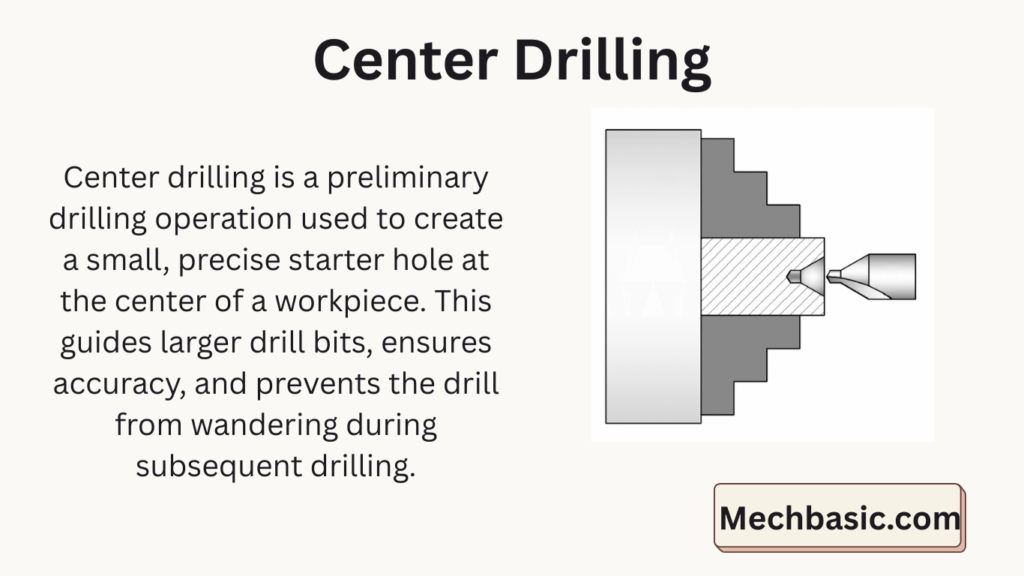
Center drilling is a preliminary drilling operation used to create a small, precise starter hole at the center of a workpiece. This guides larger drill bits, ensures accuracy, and prevents the drill from wandering during subsequent drilling.
In this article:
- Center Drilling
- 1. Definition
- 2. Purpose of Center Drilling
- 3. Machine Tools Used
- 4. Center Drill (Tool Used)
- 5. Types of Center Drills
- 6. Process Steps
- 7. Cutting Parameters
- 8. Importance in Drilling Operations
- 9. Accuracy and Surface Finish
- 10. Common Defects and Causes
- 11. Advantages
- 12. Limitations
- 13. Applications
- 14. Center Drilling vs Spot Drilling
Center Drilling
1. Definition
Center drilling is a machining operation used to produce a short, accurate conical hole at the center of a workpiece. It is mainly performed to:
- Accurately locate the center before drilling
- Provide a seat for lathe centers to support long workpieces
It is usually the first operation before drilling, turning between centers, or deep-hole drilling.
2. Purpose of Center Drilling
- Prevents drill wandering
- Ensures positional accuracy
- Provides support for turning between centers
- Improves tool life and surface finish
- Helps in alignment of holes
3. Machine Tools Used
- Drill press
- Lathe machine
- CNC machining center
- Milling machine
4. Center Drill (Tool Used)
A center drill is a short, rigid cutting tool with two distinct sections.
Parts of a Center Drill
- Pilot (Small Diameter Tip)
- Starts the hole accurately
- Countersink (Conical Portion)
- Forms a chamfer or center seat
- Shank
- Held in the chuck
Typical Angles
- 60° → Standard lathe center
- 90° / 120° → Chamfering and spotting
- Combined drill & countersink tool
5. Types of Center Drills
| Type | Description | Use |
|---|---|---|
| Type A | Pilot + 60° cone | General purpose |
| Type B | Pilot + 60° cone + safety chamfer | Prevents damage |
| Type C | Larger cone angle | Heavy-duty |
| Type R | Rounded countersink | Stress reduction |
6. Process Steps
- Workpiece Setup
- Clamp in vice or chuck
- Tool Alignment
- Center drill aligned with spindle axis
- Speed Selection
- Lower RPM than twist drill
- Cutting Operation
- Pilot enters material
- Conical section forms the center hole
- Depth Control
- Drilled just enough for:
- Drill location OR
- Lathe center support
- Drilled just enough for:
- Tool Retraction
- Withdraw carefully to avoid breakage
7. Cutting Parameters
- Speed: Low to medium (rigid but brittle tool)
- Feed: Light feed to prevent snapping the pilot
- Coolant: Optional for shallow holes, recommended for steel
8. Importance in Drilling Operations
- Twist drills are long and flexible
- Without center drilling:
- Drill may walk or shift
- Hole position error occurs
- Center drilling ensures true starting point
9. Accuracy and Surface Finish
- Very high positional accuracy
- Provides smooth conical seat
- Improves accuracy of subsequent drilling or turning
10. Common Defects and Causes
| Defect | Cause | Prevention |
|---|---|---|
| Broken center drill | Excess feed | Light feed |
| Oversized center hole | Too much depth | Proper depth control |
| Chatter marks | High speed | Reduce RPM |
| Off-center hole | Poor alignment | Proper setup |
11. Advantages
- High accuracy
- Simple and fast
- Prevents drill deflection
- Essential for turning between centers
12. Limitations
- Shallow holes only
- Brittle tool tip
- Not suitable for deep drilling
13. Applications
- Pre-drilling operation
- Lathe work (shaft machining)
- CNC machining
- Precision mechanical components
- Aerospace and automotive parts
14. Center Drilling vs Spot Drilling
| Feature | Center Drilling | Spot Drilling |
|---|---|---|
| Purpose | Center + support | Drill location only |
| Angle | 60° | 90°–120° |
| Depth | Shallow | Shallow |
| Lathe use | Yes | No |
Other courses:





