
Brazing is a metal-joining process where a filler metal is melted and flowed into the joint without melting the base metals.
It uses temperatures above 450 °C, with capillary action pulling the filler into the gap.
Brazing produces strong, precise joints and is commonly used for plumbing, HVAC, and metal fabrication.
In this article:
Here’s a detailed explanation of brazing, covering its principles, types, materials, advantages, disadvantages, and applications:
1. Definition of Brazing
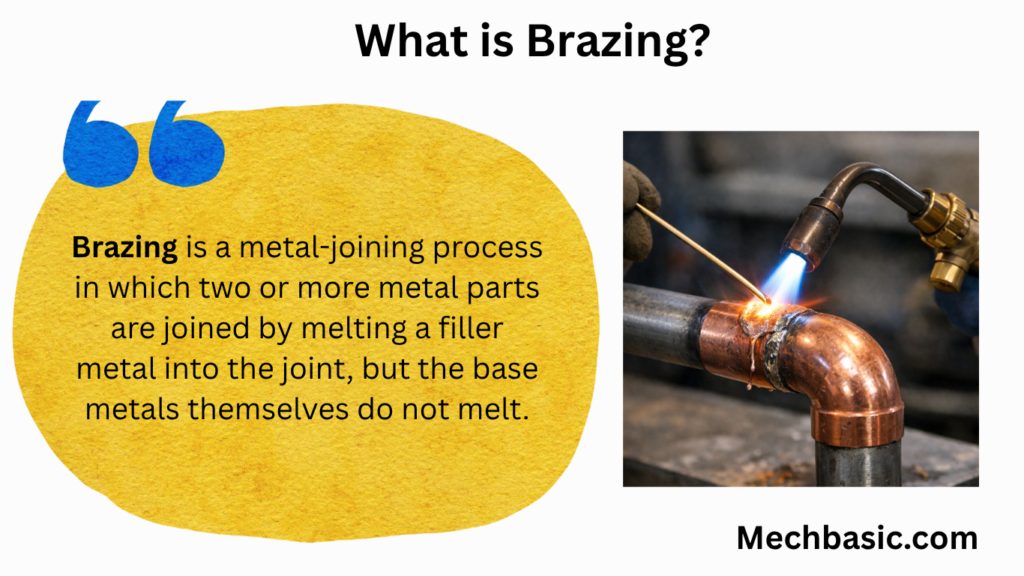
Brazing is a metal-joining process in which two or more metal parts are joined by melting a filler metal into the joint, but the base metals themselves do not melt.
- The filler metal has a lower melting point than the base metals.
- Capillary action allows the molten filler to flow into the gap between the metals and solidify, creating a strong joint.
- Brazing is similar to soldering but typically occurs at higher temperatures (above 450°C / 840°F).
2. Principle of Brazing
- Surface Preparation
- Clean, oxide-free surfaces are essential for good adhesion.
- Common cleaning methods: chemical cleaning, mechanical abrasion, or flux application.
- Flux Application
- Flux prevents oxidation of the base metal and helps the filler metal flow into the joint.
- Heating
- Heat is applied to the base metals, not the filler.
- The filler metal melts, flows into the joint by capillary action, and solidifies.
- Cooling
- The joint cools, forming a strong metallurgical bond without melting the base metals.
Capillary action is crucial; the filler metal draws itself into narrow gaps, creating a uniform bond.
3. Temperature Ranges
- Brazing Temperature: Typically 450°C to 1200°C (840°F to 2190°F) depending on filler and base metal.
- Lower-Temperature Brazing (<450°C) is usually called soldering, often using lead, tin, or silver alloys.
- High-temperature brazing may involve copper, silver, or nickel-based alloys.
4. Filler Materials
- Copper and Copper Alloys – Most common for steel, brass, and copper joints.
- Silver Alloys – Provide high strength, low melting temperature, excellent for thin or dissimilar metals.
- Aluminum Alloys – Special fluxes and fillers required for aluminum brazing.
- Nickel Alloys – High-temperature brazing, corrosion-resistant applications.
5. Types of Brazing
a) Torch Brazing
- Hand-held torch heats the joint.
- Flexible and suitable for small or repair work.
b) Furnace Brazing
- Parts are placed in a controlled-atmosphere furnace (e.g., nitrogen or hydrogen).
- Provides uniform heating, ideal for mass production.
c) Induction Brazing
- Electromagnetic induction heats the joint locally.
- Fast, precise, and energy-efficient.
d) Dip Brazing
- Parts are dipped into molten filler metal or flux bath.
- Mostly used for small components and uniform coating.
6. Advantages of Brazing
- No Melting of Base Metal
- Minimal distortion, suitable for thin or delicate components.
- Strong Joints
- Often stronger than soldered joints and sometimes as strong as welded joints.
- Dissimilar Metals Can Be Joined
- Copper to steel, aluminum to copper, etc.
- Smooth Surface Finish
- Minimal surface oxidation or discoloration.
- Versatility
- Can join complex geometries, thin sheets, tubes, and intricate assemblies.
- No Filler Metal Restrictions
- Wide variety of alloys available for different temperature and strength requirements.
7. Disadvantages of Brazing
- Lower Strength than Welding
- Not suitable for high-stress structural applications in some cases.
- Requires Clean Surfaces
- Oxides, oil, or dirt reduce joint quality.
- Temperature Limitations
- Base metals must withstand brazing temperatures.
- Flux Residue
- Some fluxes require cleaning after brazing to prevent corrosion.
- Not Always Suitable for Thick Metals
- Capillary action works best with thin gaps (<0.5 mm); large gaps reduce joint strength.
8. Applications of Brazing
- HVAC and Refrigeration: Copper tube assemblies, air-conditioning systems.
- Automotive Industry: Radiators, brake tubes, fuel lines.
- Aerospace: Dissimilar metal assemblies, turbine components.
- Electronics: Heat sinks, connectors.
- Jewelry Making: Joining precious metals.
- Tool and Die Industry: Attaching carbide tips to steel tools.
9. Comparison with Welding and Soldering
| Process | Base Metal | Filler Metal | Temperature | Joint Strength | Distortion |
|---|---|---|---|---|---|
| Brazing | Not melted | Melted, lower MP | 450–1200°C | High, good for thin sheets | Minimal |
| Welding | Melted | Filler may be added | >1200°C (varies) | Very high | High, may distort |
| Soldering | Not melted | Melted, low MP | <450°C | Low | Minimal |
Conclusion
- Brazing joins metals without melting the base metal, using molten filler.
- Suitable for thin sheets, complex assemblies, and dissimilar metals.
- Provides strong, neat joints but may be weaker than full welding in structural applications.
- Surface preparation, flux, and proper heating are critical for success.
- Common in HVAC, automotive, aerospace, electronics, and jewelry.
Other courses:





