
Blind drilling is a drilling operation used to create a hole that does not pass completely through the workpiece. The hole has a specified depth and is commonly used where the bottom surface must remain intact for strength or design requirements.
In this article:
- Blind Drilling (Manufacturing Process)
- 1. Definition
- 2. Purpose of Blind Drilling
- 3. Machines Used
- 4. Tools Used
- 5. Hole Bottom Shape
- 6. Process Steps
- 7. Cutting Parameters
- 8. Chip Removal (Critical in Blind Drilling)
- 9. Coolant and Lubrication
- 10. Accuracy and Depth Control
- 11. Common Problems and Defects
- 12. Advantages
- 13. Limitations
- 14. Applications
- 15. Blind Drilling vs Through Drilling (Summary)
Blind Drilling (Manufacturing Process)
1. Definition
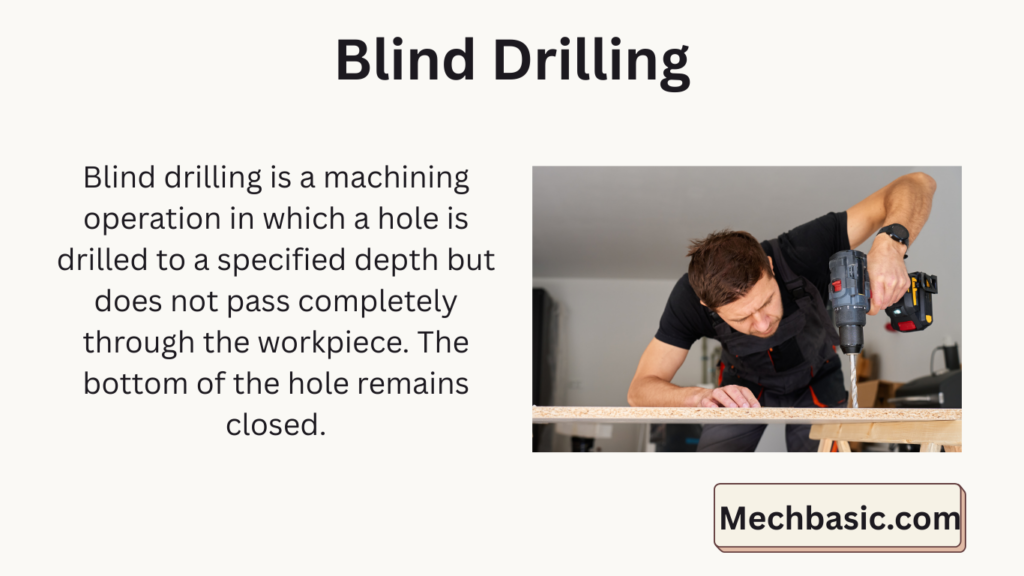
Blind drilling is a machining operation in which a hole is drilled to a specified depth but does not pass completely through the workpiece. The bottom of the hole remains closed.
2. Purpose of Blind Drilling
Blind holes are used when:
- A through hole is not allowed due to design or strength requirements
- Threads are required (tapping)
- Parts must have a clean external surface on one side
- Accurate depth control is needed for assemblies
3. Machines Used
Blind drilling can be performed on:
- Drill press (bench, pillar, radial)
- CNC machining centers
- Lathe machines
- Hand drilling machines (low precision)
4. Tools Used
a) Drill Bits
- Twist drill (most common)
- Carbide drill (hard materials, high speed)
- Flat-bottom drill (for near-flat bottoms)
b) Supporting Tools
- Center drill / Spot drill – ensures accuracy
- Depth stop – controls drilling depth
- Vernier depth gauge – depth measurement
- Coolant system
5. Hole Bottom Shape
Due to drill geometry:
- Standard twist drill creates a conical bottom
- Cone angle ≈ 118° or 135°
- Flat bottom holes require:
- End milling
- Special flat-bottom drills
6. Process Steps
- Marking and Center Punching
- Prevents drill wandering
- Workpiece Clamping
- Firmly held in vice or fixture
- Depth Setting
- Using:
- Mechanical depth stop
- Digital readout (CNC)
- Peck count method
- Using:
- Parameter Selection
- Spindle speed
- Feed rate
- Coolant
- Drilling Operation
- Drill advances to required depth
- Chips removed via flutes
- Depth Control
- Operator or CNC stops feed before breakthrough
- Tool Retraction
- Smooth withdrawal to avoid surface damage
7. Cutting Parameters
a) Spindle Speed (RPM)
RPM=π×D1000×V
Where:
- V = cutting speed (m/min)
- D = drill diameter (mm)
b) Feed Rate
- Lower feed than through drilling
- Prevents bottom damage and tool breakage
8. Chip Removal (Critical in Blind Drilling)
- Chips accumulate at hole bottom
- Common methods:
- Peck drilling (step-by-step drilling)
- High-pressure coolant
- Poor chip evacuation causes:
- Overheating
- Inaccurate depth
- Broken drills
9. Coolant and Lubrication
- Essential for blind drilling
- Reduces:
- Heat
- Chip welding
- Tool wear
- Cutting oil preferred for steel
- Emulsion coolant for aluminum
10. Accuracy and Depth Control
- Depth tolerance: ±0.05 mm (manual)
- CNC machines achieve ±0.01 mm
- Measured using:
- Depth gauge
- Probe (CNC)
11. Common Problems and Defects
| Problem | Cause | Prevention |
|---|---|---|
| Incorrect depth | Poor depth stop setting | Use gauge/DRO |
| Drill breakage | Chip clogging | Use peck drilling |
| Poor surface finish | Dull tool / no coolant | Sharp tool, coolant |
| Tapered hole | Tool deflection | Rigid setup |
12. Advantages
- Maintains part strength
- Clean external surface
- Suitable for threaded holes
- Precise depth control possible
13. Limitations
- Chip evacuation difficult
- Bottom is not flat (with standard drills)
- More tool wear than through drilling
14. Applications
- Threaded holes (bolts, screws)
- Hydraulic and pneumatic components
- Automotive engine blocks
- Mold and die manufacturing
- Aerospace structural parts
15. Blind Drilling vs Through Drilling (Summary)
| Aspect | Blind Drilling | Through Drilling |
|---|---|---|
| Hole type | Closed at bottom | Passes through |
| Depth control | Critical | Not critical |
| Chip removal | Difficult | Easy |
| Burr formation | Minimal | Exit burrs |
Other courses:





