
Here is a clear, detailed explanation of Battery Electric Vehicles (BEVs):
In this article:
Battery Electric Vehicles (BEVs): In Detail
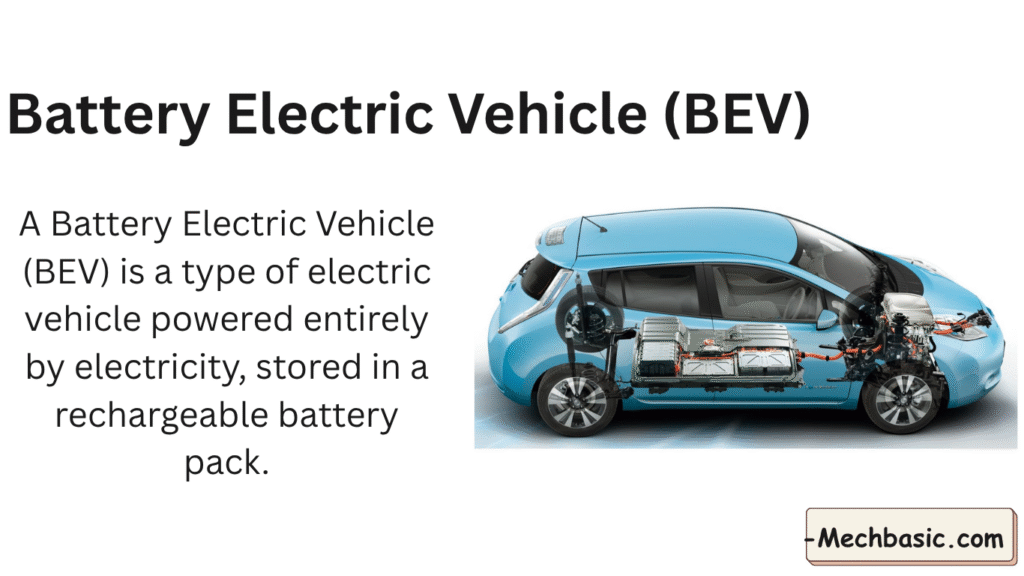
A Battery Electric Vehicle (BEV) is a type of electric vehicle powered entirely by electricity, stored in a rechargeable battery pack. Unlike hybrid or plug-in hybrid vehicles, BEVs contain no internal combustion engine (ICE), no fuel tank, and no exhaust system. They run solely on electric motors.
1. How a BEV Works
A BEV consists of several key components:
1.1 Battery Pack
- The main energy source of the vehicle.
- Common chemistries: Li-ion (Li-NMC, LFP, Li-NCA).
- Determines the driving range (e.g., 40 kWh → ~200 km; 100 kWh → ~500+ km).
1.2 Electric Motor(s)
- Converts electrical energy into mechanical energy.
- Types: Permanent Magnet Synchronous Motor (PMSM), Induction Motor.
- Highly efficient (85–95% vs. 20–30% for ICE engines).
1.3 Inverter
- Converts DC from the battery → AC for the motor.
- Controls motor speed and torque.
1.4 Onboard Charger
- Converts AC from home charger → DC for battery storage.
1.5 Battery Management System (BMS)
- Monitors voltage, temperature, health.
- Protects the battery against overcharging, overheating, and deep discharge.
1.6 Regenerative Braking
- Recovers energy when decelerating.
- Sends energy back to the battery.
2. Charging BEVs
Charging levels:
Level 1 (Slow AC charging)
- 120V/230V household socket.
- 1–2 kW power.
- Charging time: 10–20 hours.
Level 2 (Fast AC charging)
- Wall-mounted charger.
- 7–22 kW.
- Charging time: 4–8 hours.
DC Fast Charging
- 50 kW to 350 kW chargers.
- 20–80% in 15–40 minutes.
- Uses CCS/CHAdeMO/NACS standards depending on region.
3. Advantages of BEVs
3.1 Environmental Benefits
- Zero tailpipe emissions.
- Lower lifecycle emissions (especially with renewable electricity).
3.2 Lower Operating Costs
- Electricity cheaper than gasoline.
- Less maintenance: no oil changes, fewer moving parts.
3.3 Performance Benefits
- Instant torque (faster acceleration).
- Smooth, quiet operation.
3.4 Energy Efficiency
- 70–90% efficient, far superior to ICE vehicles.
4. Limitations & Challenges
4.1 Range Anxiety
- Limited driving range vs. ICE vehicles.
- Improving with higher-capacity batteries.
4.2 Charging Infrastructure
- Availability varies by region.
- Long-distance travel requires planning.
4.3 Charging Time
- Slower than fueling ICE cars (though fast charging helps).
4.4 Battery Degradation
- Batteries lose capacity over time.
- Typical loss: 2–3% per year.
4.5 Higher Upfront Cost
- Batteries contribute ~30–40% of vehicle cost.
- Prices are decreasing over time.
5. Battery Technologies in BEVs
Current Chemistries
- NMC: high energy density, common in long-range EVs.
- LFP: lower cost, safer, longer lifespan, lower energy density—popular in mass-market EVs (e.g., Tesla standard-range).
Future Technologies
- Solid-state batteries
- Sodium-ion batteries
- Silicon-anode lithium batteries
6. Future of BEVs
Trends include:
- Faster charging (800V architectures).
- Cheaper batteries (below $80/kWh soon).
- Increasing range (600–1,000 km expected).
- Better recycling & second-life applications.
- More renewable-powered EV grids.
Summary
A Battery Electric Vehicle (BEV):
- Runs entirely on electricity.
- Stores energy in a large rechargeable battery.
- Uses electric motors and sophisticated electronics for propulsion.
- Has low running costs, high efficiency, and zero tailpipe emissions.
- Faces challenges like charging time, infrastructure, and battery degradation.
Other courses:





