
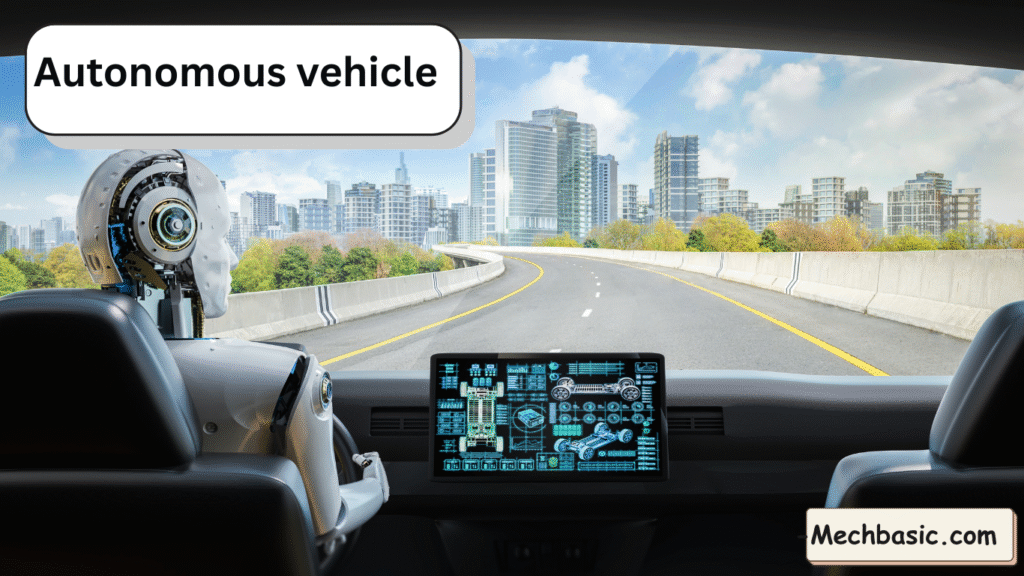
An autonomous vehicle (AV)—also called a self-driving car or driverless vehicle—is a vehicle capable of sensing its environment and navigating without (or with minimal) human input. AVs combine advanced sensors, AI algorithms, mapping, and control systems to move safely and efficiently on roads.
Below is a complete, detailed explanation covering how they work, levels, technologies, challenges, benefits, and real-world status.
In this article:
- 1. What Is an Autonomous Vehicle?
- 2. Levels of Autonomy (SAE Levels 0–5)
- 3. Core Technologies Behind Autonomous Vehicles
- 4. Communication Systems
- 5. Advantages of Autonomous Vehicles
- 6. Challenges and Limitations
- 7. Real-World Status of Autonomous Vehicles Today
- 8. Future of Autonomous Vehicles
- Final Summary
- Is tesla autonomous?
1. What Is an Autonomous Vehicle?
An autonomous vehicle is a car, truck, shuttle, or drone-like machine that:
- perceives its environment using sensors
- decides how to move using artificial intelligence
- controls steering, braking, acceleration automatically
- communicates with surroundings (other cars, traffic lights)
Unlike traditional cars, AVs can perform driving tasks without human intervention depending on their autonomy level.
2. Levels of Autonomy (SAE Levels 0–5)
The Society of Automotive Engineers (SAE) defines six levels:
| Level | Name | Description | Examples |
|---|---|---|---|
| 0 | No Automation | Human does all driving | Regular cars |
| 1 | Driver Assistance | Single assist system: cruise control or lane-keep | Toyota TSS, Honda Sensing |
| 2 | Partial Automation | Car steers + controls speed; driver monitors | Tesla Autopilot, Mercedes Distronic |
| 3 | Conditional Automation | Car drives itself; human backup when requested | Audi A8 Traffic Jam Pilot (limited) |
| 4 | High Automation | Car drives itself in specific areas; no driver needed | Waymo, Cruise robotaxis |
| 5 | Full Automation | Works everywhere, no steering wheel required | Theoretical—no vehicle has reached Level 5 |
Today’s real-world systems are mostly Level 2, and small fleets operate at Level 4.
3. Core Technologies Behind Autonomous Vehicles
An AV works like a human driver:
- Eyes = sensors
- Brain = AI computer
- Muscles = steering/brake/acceleration control
1. Sensors
AVs use a combination of:
LIDAR
- Laser scans environment in 3D
- Excellent for depth and mapping
- Used by Waymo, Cruise
RADAR
- Detects distance and speed of objects
- Works in fog, rain
- Used in ADAS and AVs
Cameras
- High-resolution vision
- Essential for traffic signs, lights, lanes
- Used heavily by Tesla
Ultrasonic Sensors
- Short-range detection (parking)
GPS + IMU
- High-precision localization
- Tracks movement and orientation
A combination of these gives 360° awareness.
2. Perception (What the car “sees”)
The AV must interpret sensor data to identify:
- Cars
- Pedestrians
- Cyclists
- Animals
- Traffic lights/signs
- Road markings
- Lane boundaries
- Obstacles
- Road edges and curbs
AI and computer vision classify objects, track movement, and predict behavior.
3. Localization (Where the car is)
AVs use:
- High-definition maps (HD maps)
- GPS
- Sensor fusion
- LIDAR-based SLAM (Simultaneous Localization and Mapping)
Accuracy: within 2–10 cm.
4. Planning (What the car should do next)
Algorithms decide:
- Speed
- When to brake
- How to change lanes
- How to merge into traffic
- How to handle intersections
- How to avoid obstacles
This is similar to human decision-making.
5. Control (Executing the decision)
Electronic control units send commands to:
- Throttle
- Brakes
- Steering
Ensuring smooth and safe movement.
4. Communication Systems
AVs use:
V2X (Vehicle-to-Everything)
Includes:
- V2V (vehicle-to-vehicle)
- V2I (vehicle-to-infrastructure, like traffic lights)
- V2P (vehicle-to-pedestrian)
- V2G (vehicle-to-grid)
Allows early detection of hazards and better coordination.
5. Advantages of Autonomous Vehicles
Safety
- 90% of accidents caused by human error
- AVs eliminate drunk, distracted, and fatigued driving
Improved Traffic Flow
- Smoother acceleration
- Efficient routing
- Reduced congestion
Reduced Emissions
- Optimized driving reduces fuel use
- Most AVs are electric
Mobility for the Disabled & Elderly
- Independent travel for people who can’t drive
Economic Benefits
- Reduced insurance costs
- Lower logistics costs (autonomous trucks)
Efficient Parking
- Self-parking
- Drop-off and pickup without human input
6. Challenges and Limitations
Technical Challenges
- Handling unpredictable human behavior
- Poor weather conditions affecting sensors
- Complex urban environments
- Edge cases (rare, unexpected events)
Ethical Issues
- Decision-making in unavoidable crash scenarios
- Responsibility for accidents
Regulatory Barriers
- Laws vary by country
- Safety standards not uniform
Public Trust Issues
- Fear of malfunction
- Concerns about job loss (drivers)
Cybersecurity Risks
- AVs must be protected from hacking
- Secure communication is essential
7. Real-World Status of Autonomous Vehicles Today
Level 2:
Common in many cars:
- Tesla, Hyundai, BMW, Mercedes, Volvo, Ford, Toyota
Level 3:
Limited availability (low-speed traffic jam autonomy):
- Mercedes Drive Pilot (legal in Nevada, California)
Level 4:
Operational in specific geofenced areas:
- Waymo (USA)
- Cruise (limited operations after incidents)
- Baidu Apollo Go (China)
Level 5:
Not achieved yet.
Predicted many years away due to complexity of full autonomy.
8. Future of Autonomous Vehicles
Experts predict:
- 2025–2030: Expansion of Level 4 robotaxis
- 2030–2040: Commercial autonomous trucks
- 2040+: Possible Level 5 autonomy
Huge advances in AI and sensor fusion are accelerating progress.
Final Summary
An autonomous vehicle is a self-driving system that uses:
- Sensors (LIDAR, cameras, radar)
- AI perception and decision-making
- Precision mapping
- V2X communication
- Automated controls
Levels range from 0 to 5, with today’s cars mostly at Level 2 and limited Level 4 robotaxis.
AVs promise safer roads, reduced congestion, and greater mobility, but face challenges including weather, regulation, ethics, and AI reliability.
Is tesla autonomous?
No — Tesla is not fully autonomous. Its “Full Self-Driving (Supervised)” (FSD) still requires an alert driver; it’s an advanced driver-assist system, not true Level 5 autonomy.
Other courses:





