
Not exactly — tail lights and parking lights are related but not the same. Here’s a detailed explanation:
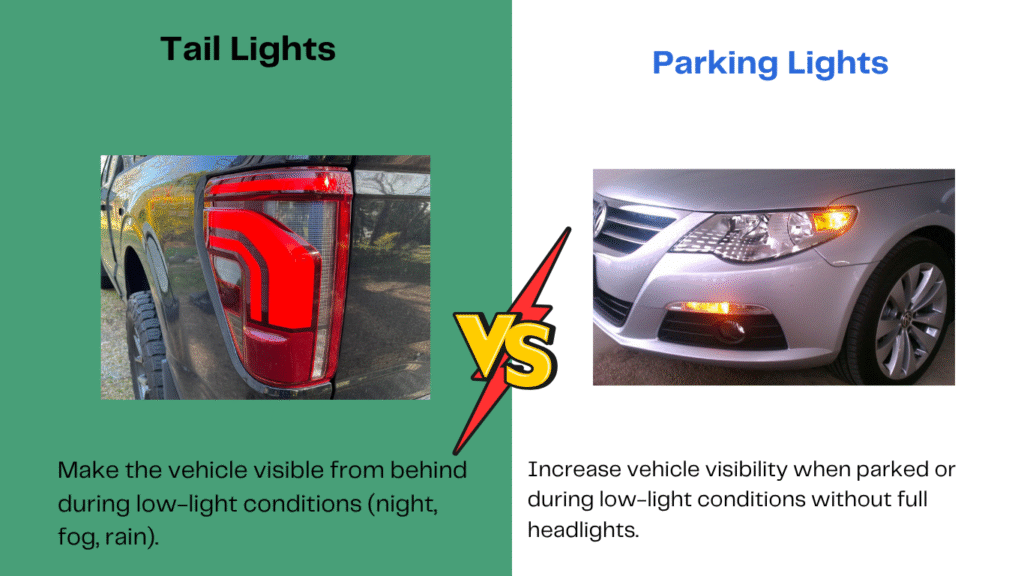
1. Tail Lights
Purpose:
- Make the vehicle visible from behind during low-light conditions (night, fog, rain).
- Turn on automatically when headlights or parking lights are on.
Key Features:
- Emit red light.
- Usually brighter than parking lights but dimmer than brake lights.
- Located in the rear light cluster.
2. Parking Lights (Side / Position Lights)
Purpose:
- Increase vehicle visibility when parked or during low-light conditions without full headlights.
- Often used in urban areas or when the vehicle is stationary.
Key Features:
- Emit dim red light at the rear and dim white/amber at the front.
- Can be turned on independently of headlights.
- Also called position lights.
3. Key Differences
| Feature | Tail Lights | Parking Lights |
|---|---|---|
| Purpose | Make vehicle visible while driving | Make vehicle visible when parked or in low light |
| When On | Automatically with headlights or parking lights | Can be used independently of headlights |
| Brightness | Dim red (rear) but brighter than parking lights | Dimmer than tail lights |
| Location | Rear light cluster | Front (white/amber) and rear (red) |
| Function | Safety during driving | Safety when stationary or low light conditions |
4. Summary
- Tail lights = rear red lights for driving visibility.
- Parking lights = dim lights for visibility when parked or in low-light conditions, sometimes also called position lights.
- Tail lights usually turn on with parking lights, but parking lights can operate independently.
💡 Tip:
In modern cars, the tail lights and parking lights often share the same bulbs, but the intended function and brightness differ.
Other courses:





