
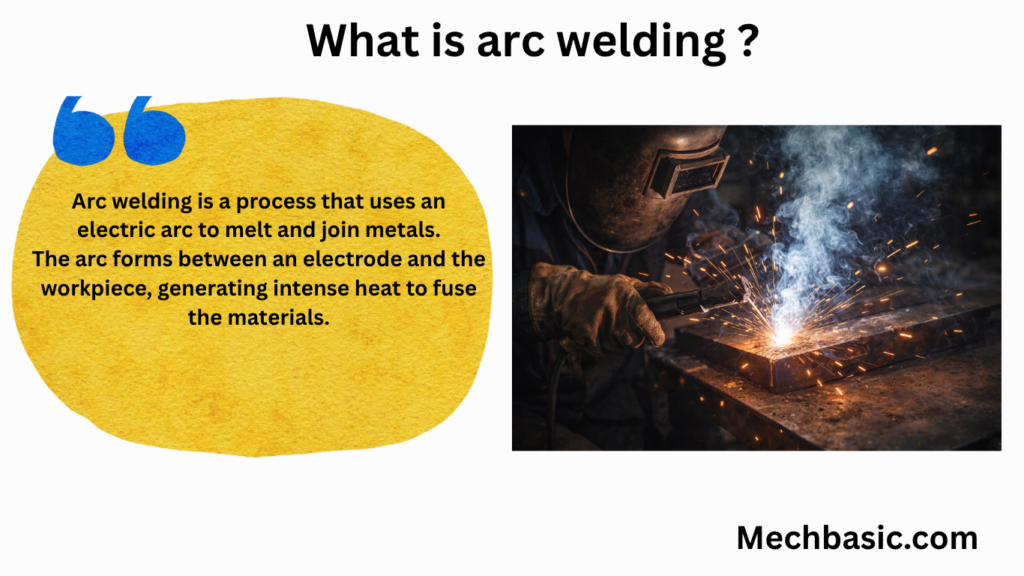
Arc welding is a process that uses an electric arc to melt and join metals.
The arc forms between an electrode and the workpiece, generating intense heat to fuse the materials.
It is widely used in construction, fabrication, and industrial applications for strong, durable welds.
In this article:
Here’s a detailed breakdown of arc welding, covering its types, working principle, equipment, advantages, disadvantages, and applications.
1. Definition
Arc welding is a welding process that joins metals using an electric arc between an electrode and the base metal to melt and fuse the materials together. The heat of the arc is extremely high, often 3,000–20,000°C, enough to melt most metals.
- The term “arc” comes from the electric arc, which is a continuous discharge of electricity through the air.
- The electrode may be consumable (melts and forms part of the weld) or non-consumable.
2. Working Principle
- Electric Circuit Formation
- Welding machine connects the electrode and the base metal to a power source.
- A potential difference creates current flow.
- Arc Initiation
- The welder strikes the electrode against the base metal (like striking a match) or uses a touch-start method.
- An electric arc forms, ionizing the air gap.
- Melting
- The intense heat melts the base metal and, if consumable, the electrode.
- Molten metal forms a weld pool that solidifies to create the joint.
- Shielding (Optional but Important)
- Many arc welding processes use shielding gas or flux to prevent contamination by oxygen or nitrogen.
3. Types of Arc Welding
| Type | Electrode | Shielding | Notes |
|---|---|---|---|
| SMAW (Shielded Metal Arc Welding / Stick Welding) | Consumable coated electrode | Flux coating creates gas and slag shield | Simple, portable, works outdoors, good for thick materials |
| GMAW (Gas Metal Arc Welding / MIG) | Consumable wire electrode | Inert gas (argon/CO₂) | Semi-automatic, clean weld, fast, low skill requirement |
| FCAW (Flux-Cored Arc Welding) | Tubular wire with flux inside | Flux or shielding gas | High deposition rate, can weld outdoors |
| GTAW (Gas Tungsten Arc Welding / TIG) | Non-consumable tungsten | Inert gas (argon/helium) | High precision, clean welds, thin metals |
| SAW (Submerged Arc Welding) | Consumable wire | Covered by granular flux | High deposition rate, deep penetration, mostly automated |
4. Equipment Needed
- Power Source: AC, DC, or both depending on the process.
- Electrode: Consumable or non-consumable.
- Ground Clamp: Completes the electric circuit.
- Protective Gear: Welding helmet, gloves, flame-resistant clothing.
- Shielding: Flux or inert gas to prevent oxidation.
5. Advantages of Arc Welding
- Can weld most metals including steel, stainless steel, aluminum.
- Strong joints with deep penetration.
- Portable (especially SMAW).
- Can weld in various positions: flat, horizontal, vertical, overhead.
- Compatible with automated and robotic systems (GTAW, SAW).
6. Disadvantages / Hazards
- Fumes and gases → respiratory hazards.
- UV/IR radiation → eye and skin damage.
- Electric shock risk.
- Requires skill for high-quality welds (especially TIG).
- Not always suitable for very thin metals without distortion.
- Sparks and hot slag → fire hazard.
7. Applications
Arc welding is used in a wide range of industries:
- Construction – structural steel frames, bridges.
- Shipbuilding – hulls and bulkheads.
- Automotive – frames, chassis, and exhaust systems.
- Aerospace – TIG welding for aircraft components.
- Pipeline & Oil Industry – long runs of welded pipes.
- Manufacturing & Fabrication – machinery, tanks, and pressure vessels.
Summary
- Arc welding: Joins metals using heat from an electric arc.
- Key types: SMAW (stick), MIG/GMAW, TIG/GTAW, FCAW, SAW.
- Strengths: High strength, versatile, widely used industrially.
- Risks: Fumes, UV/IR radiation, burns, electric shock.
- Best suited for: Steel, stainless steel, aluminum, thick and structural metals.
Other courses:





