
Advanced Driver Assistance Systems (ADAS) are technologies integrated into modern vehicles to enhance safety, improve driving comfort, and reduce the likelihood of human error—the primary cause of most road accidents.
ADAS uses a combination of sensors, cameras, radar, lidar, and sophisticated software to monitor the vehicle’s surroundings, assist the driver in making decisions, and sometimes take corrective action automatically.
In this article:
1. Definition of ADAS
ADAS (Advanced Driver Assistance Systems) are electronic systems in vehicles designed to increase driving safety and reduce accidents by assisting the driver in the driving and parking process.
They use a combination of sensors, cameras, radar, lidar, and software algorithms to monitor the environment around the vehicle and provide warnings or automated interventions.
Goal:
- Reduce human errors
- Prevent collisions
- Make driving easier and safer
ADAS is considered a key step toward autonomous driving (Level 2–Level 5 automation).
2. Core Components of ADAS
- Sensors
- Cameras: Detect lane markings, traffic signs, pedestrians, vehicles.
- Radar: Measures distance and speed of surrounding vehicles; works in low visibility.
- Lidar: Laser-based distance measurement; creates 3D mapping of surroundings.
- Ultrasonic sensors: Used for parking, obstacle detection at low speeds.
- GPS & Map Data: Assists navigation-based ADAS features.
- Electronic Control Unit (ECU)
- Processes all sensor inputs.
- Makes real-time decisions (e.g., apply brakes, adjust steering, alert driver).
- Actuators
- Control vehicle functions based on ECU decisions.
- Examples: Steering motor (lane keeping), brakes (AEB), throttle (adaptive cruise).
- Human-Machine Interface (HMI)
- Provides alerts to the driver (visual, audio, haptic feedback).
- Examples: dashboard icons, steering wheel vibration, beeps.
3. Types of ADAS Features
ADAS can be divided into passive assistance (warnings) and active assistance (interventions):
A. Passive/Warning Systems
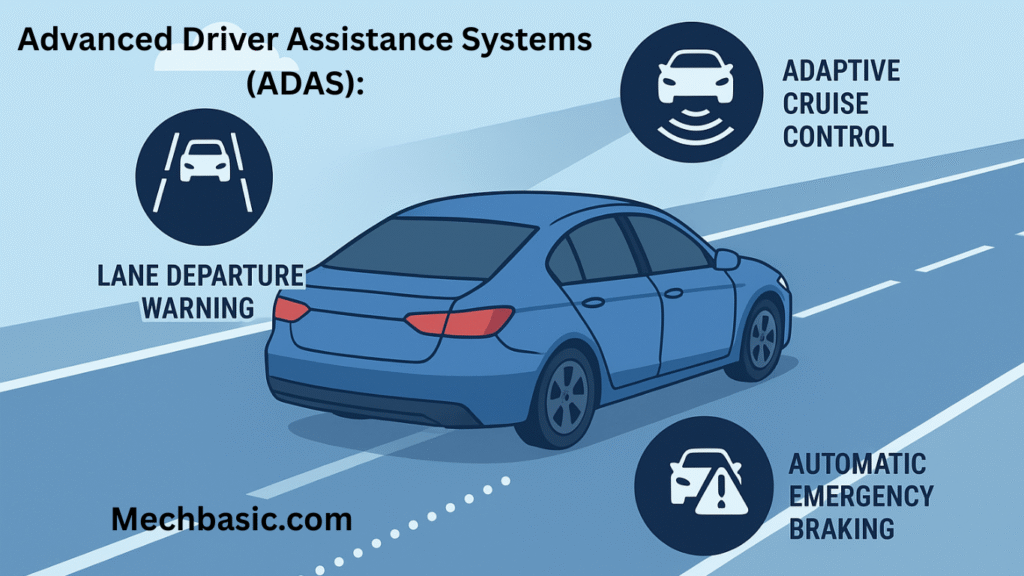
- Lane Departure Warning (LDW): Alerts driver if car drifts from lane unintentionally.
- Forward Collision Warning (FCW): Warns driver of imminent front collision.
- Blind Spot Detection (BSD): Detects vehicles in blind spots; alerts via lights or sound.
- Traffic Sign Recognition (TSR): Reads speed limits, no-entry signs, warns driver.
- Driver Attention Monitoring: Alerts driver if drowsiness or distraction detected.
B. Active/Intervention Systems
- Lane Keeping Assist (LKA): Actively corrects steering to stay in lane.
- Automatic Emergency Braking (AEB): Applies brakes to avoid or reduce collision.
- Adaptive Cruise Control (ACC): Maintains safe distance from vehicle ahead automatically.
- Parking Assistance: Automated parking using cameras and sensors.
- Automatic High Beam / Headlamp Control: Switches between high and low beam based on traffic.
4. Levels of Automation and ADAS
ADAS is closely related to vehicle automation:
| Level | Automation | Relation to ADAS |
|---|---|---|
| Level 0 | No automation | Only warnings; basic ADAS like LDW, FCW |
| Level 1 | Driver Assistance | Single task automation (ACC or LKA) |
| Level 2 | Partial Automation | Multiple ADAS features working together (ACC + LKA) |
| Level 3 | Conditional Automation | Car can handle driving in certain conditions; driver must intervene when alerted |
| Level 4 | High Automation | Car can drive itself in specific areas; ADAS acts autonomously |
| Level 5 | Full Automation | Fully autonomous; ADAS is fully integrated |
Most current ADAS in India is Level 1–Level 2.
5. How ADAS Works (Step-by-Step Example: Lane Keeping + ACC)
- Sensors detect lanes, vehicles, obstacles.
- ECU processes sensor data and determines if the vehicle is drifting or too close to another vehicle.
- Driver alerts are triggered if warning-only (haptic/audio/visual).
- If active system: steering torque or braking is applied to correct the trajectory.
- Continuous monitoring ensures the vehicle stays safe in real time.
6. Benefits of ADAS
- Reduces accidents caused by human error (~90% of crashes are human-error related).
- Reduces driver fatigue during long trips.
- Improves reaction time in emergency situations.
- Assists in low-visibility conditions (rain, fog, night driving).
- Provides a foundation for future autonomous vehicles.
7. Limitations of ADAS
- Sensors can fail in adverse weather (fog, heavy rain, snow).
- Lane keeping requires well-marked roads.
- Adaptive systems may struggle in city traffic or unstructured roads.
- Drivers may over-rely on ADAS and become inattentive.
- Only semi-autonomous: driver must remain alert at all times.
8. Examples of ADAS in Indian Cars
- Honda City / Amaze: Honda Sensing – LKA, ACC, FCW, AEB.
- MG Astor: Level 2 ADAS – lane keep, adaptive cruise, collision warning.
- Mahindra XUV 3XO: ADAS including lane-keeping, adaptive cruise, auto braking.
- Tata Nexon EV 45: Lane departure warning, AEB, traffic sign recognition.
- Hyundai Creta / Venue: Blind-spot monitoring, lane assist, high-beam assist.
Summary
ADAS is a set of smart safety technologies that assist drivers with warnings or interventions to prevent accidents, reduce fatigue, and improve road safety. It combines sensors, cameras, radar, software, and actuators to provide both passive and active assistance, and is a critical step toward autonomous driving.
FAQ Section:
1. What is ADAS?
ADAS (Advanced Driver Assistance Systems) refers to vehicle technologies designed to assist drivers, improve safety, and reduce the chance of accidents using sensors, cameras, and intelligent software.
2. Which vehicles have ADAS features?
Many modern cars—from economy to luxury models—include basic ADAS features like lane keeping or emergency braking. Higher-end vehicles often include more advanced systems.
3. How do ADAS systems detect obstacles or lanes?
They use sensors (radar, ultrasonic), cameras, and sometimes lidar to perceive the environment. Data is processed by onboard computers to identify vehicles, pedestrians, and road markings.
4. Is ADAS the same as autonomous driving?
No. ADAS assists the driver but still requires human control. Autonomous driving involves the vehicle making decisions independently, though ADAS is a stepping stone toward autonomy.
5. Does ADAS work in bad weather?
Performance may be reduced in heavy rain, fog, snow, or if sensors/cameras are obstructed. System alerts typically warn the driver when sensors are impaired.
6. Do ADAS systems require calibration?
Yes. After events like windshield replacement, bumper repair, suspension work, or collisions, ADAS sensors must be recalibrated to ensure accuracy and safety.
7. Can ADAS prevent all accidents?
No system can prevent all crashes, but ADAS significantly reduces the likelihood and severity of accidents by assisting with warnings, braking, and steering support.
8. What are the most common ADAS features?
Popular features include Adaptive Cruise Control, Automatic Emergency Braking, Lane Departure Warning, Lane Keeping Assist, Blind Spot Detection, and Parking Assistance.
9. Are ADAS features always active?
Some systems operate continuously (like AEB readiness), while others—like lane keeping or adaptive cruise—must be activated by the driver.
10. Can ADAS be turned off?
Most ADAS features can be disabled through the vehicle’s settings if preferred, although it’s generally recommended to keep them on for safety.
Other courses:





