
Adaptive Cruise Control (ACC) is an advanced version of traditional cruise control.
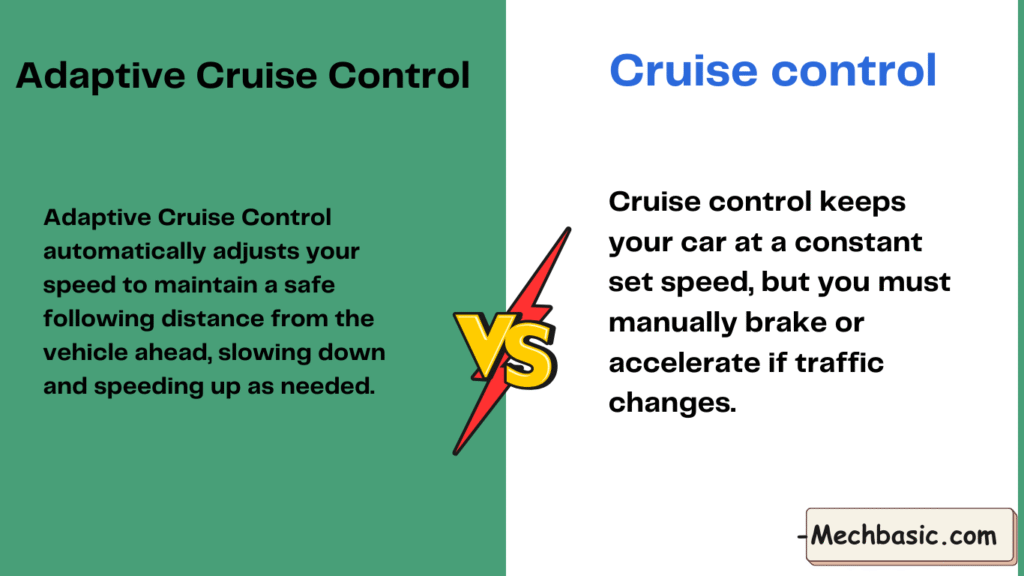
- Cruise control keeps your car at a constant set speed, but you must manually brake or accelerate if traffic changes.
- Adaptive Cruise Control automatically adjusts your speed to maintain a safe following distance from the vehicle ahead, slowing down and speeding up as needed.
Cruise control maintains speed; adaptive cruise control maintains speed and distance, offering more automation and safety.
In this article:
Difference Between Adaptive Cruise Control (ACC) and Cruise Control (CC)
Cruise Control and Adaptive Cruise Control are both systems designed to make driving easier by maintaining a set speed.
However, ACC is a much more advanced system that adds automatic distance control and braking functions.
1. Basic Definition
Cruise Control (CC)
A system that keeps the vehicle at a constant speed set by the driver, without automatic adjustments.
Adaptive Cruise Control (ACC)
An advanced system that keeps the vehicle at a constant speed but also adjusts speed automatically to maintain a safe distance from vehicles ahead.
2. How Each System Works
Cruise Control
- Driver sets speed (e.g., 80 km/h)
- Vehicle maintains that speed
- Driver must brake or accelerate manually
- Works mainly on empty highways
Adaptive Cruise Control
Uses radar, cameras, or lidar to detect traffic ahead.
- Maintains set speed
- Automatically slows down or speeds up
- Maintains safe following distance
- Can brake automatically
- Can sometimes bring the car to a full stop (Stop-and-Go systems)
3. Key Differences
| Feature | Cruise Control (CC) | Adaptive Cruise Control (ACC) |
|---|---|---|
| Speed Control | Maintains set speed | Maintains set speed + adjusts automatically |
| Distance Control | No | Yes (Automatic following distance) |
| Sensors Used | None | Radar, Cameras, Lidar |
| Automatic Braking | No | Yes |
| Can Stop Car Completely | No | Yes (in stop-and-go ACC) |
| Works in Traffic | Poorly | Excellent |
| Safety Level | Basic | High |
| Driver Attention Required | High | Moderate but still required |
4. Sensors Used
Cruise Control:
- Does not use sensors
- Only uses engine and throttle control
Adaptive Cruise Control:
Uses multiple sensors:
- Radar sensors (primary)
- Camera sensors
- Lidar sensors (in premium models)
- Ultrasonic sensors for slow-speed operation
ACC is deeply integrated with:
- Braking system
- Powertrain
- Steering assistance (in some cars with lane centering)
5. Safety Features
Cruise Control:
- No obstacle detection
- No automatic braking
- No response to traffic
Adaptive Cruise Control:
- Detects vehicles ahead
- Reduces speed automatically
- Maintains safe distance
- Works with Automatic Emergency Braking (AEB)
- Improves highway safety
6. Comfort and Convenience
Cruise Control:
- Best suited for constant-speed highway driving
- Not helpful in traffic or variable-speed roads
Adaptive Cruise Control:
- Useful in highways and city traffic
- Handles stop-and-go traffic
- Reduces driver fatigue
- Smoother acceleration and braking
7. Driving Conditions
Cruise Control:
- Works well only in light traffic
- Driver must take manual control often
- Not ideal for rain, fog, or hills
Adaptive Cruise Control:
- Works in most weather conditions (light rain, fog)
- Automatically adjusts uphill/downhill speeds
- May struggle in heavy rain or snow if sensors are blocked
8. Cost and Availability
Cruise Control:
- More common in older or budget vehicles
- Cheaper and simpler system
Adaptive Cruise Control:
- Common in modern vehicles
- Higher cost due to advanced sensors and software
- Often available in mid-to-high trim levels
9. Driver Responsibility
Even though ACC is advanced:
- The driver must stay alert
- Hands must remain on the steering wheel
- ACC is not autonomous driving
Cruise Control requires even more attention because it cannot react to traffic.
Summary :
- Cruise Control keeps a constant speed but cannot detect traffic or brake automatically.
- Adaptive Cruise Control keeps speed AND automatically adjusts distance using radar/cameras, and can brake or accelerate on its own.
- ACC is much safer, smarter, and more useful in real-world traffic.
Other courses:





