
Casting is a manufacturing process in which molten metal is poured into a mold to produce a desired shape.
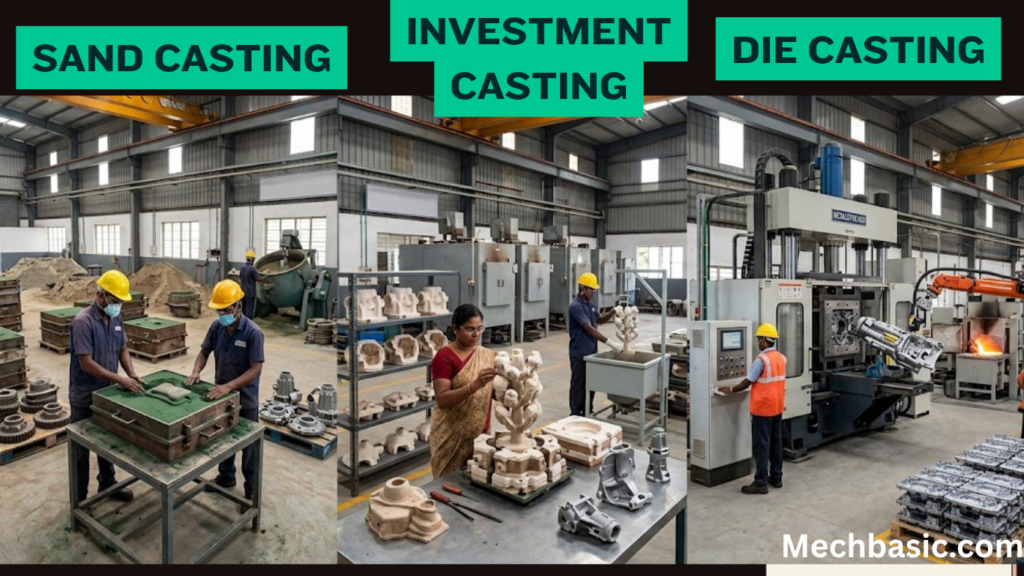
Common casting methods include sand casting, investment casting, and die casting, each suited for different applications.
These processes are widely used to produce strong, accurate, and complex metal components.
In this article:
- Understanding Casting Processes: Sand, Investment, and Die Casting
- What is Casting?
- Basic Steps in the Casting Process
- Common Casting Materials
- Sand Casting
- Investment Casting
- Die Casting
- Comparison of Sand, Investment, and Die Casting
- Quality Considerations
- Common Casting Defects
- Applications by Industry
- Choosing the Right Casting Process
- Future Trends in Casting
- Advantages and Limitations Summary
- Frequently Asked Questions (FAQs)
- Conclusion
Understanding Casting Processes: Sand, Investment, and Die Casting
Introduction
Casting is one of the oldest and most widely used manufacturing processes, involving the pouring of molten metal into a mold cavity where it solidifies into the desired shape. From ancient bronze tools to modern aircraft engine components, casting has played a crucial role in manufacturing. Today, it is extensively used in industries such as automotive, aerospace, construction, heavy machinery, marine, power generation, and consumer products.
Casting is ideal for producing components with complex shapes, internal cavities, and large dimensions that may be difficult or expensive to manufacture using machining or forging. Among the many casting methods available, sand casting, investment casting, and die casting are the most commonly used, each offering unique advantages for specific applications.
This guide explains these three casting processes in detail, compares their characteristics, and highlights their industrial applications.
What is Casting?
Definition
Casting is a manufacturing process in which molten metal is poured into a specially designed mold cavity. After cooling and solidification, the casting is removed, cleaned, and, if necessary, machined to achieve the required dimensions and surface finish.
Basic Steps in the Casting Process
Although different casting methods vary, the general steps include:
- Pattern design and fabrication.
- Mold preparation.
- Melting the metal.
- Pouring molten metal into the mold.
- Cooling and solidification.
- Removing the casting from the mold.
- Cleaning and finishing.
- Inspection and testing.
Common Casting Materials
Casting processes can use a wide range of materials, including:
- Cast iron
- Carbon steel
- Stainless steel
- Aluminum alloys
- Copper alloys
- Brass
- Bronze
- Magnesium alloys
- Zinc alloys
- Nickel-based superalloys
The choice of material depends on the required mechanical properties, corrosion resistance, weight, and operating conditions.
Sand Casting
Definition
Sand casting is a casting process in which molds are made from specially prepared sand. The mold is broken after solidification to remove the casting, making it an expendable mold process.
It is one of the oldest and most versatile casting techniques.
Sand Casting Process
Step 1: Pattern Making
A pattern, slightly larger than the final product to account for shrinkage, is produced from wood, plastic, or metal.
Step 2: Mold Preparation
The pattern is placed inside a molding box (flask), and sand mixed with binders is compacted around it to form the mold cavity.
Step 3: Pattern Removal
The pattern is carefully removed, leaving a cavity with the desired shape.
Step 4: Core Placement
If internal cavities are required, sand cores are positioned inside the mold.
Step 5: Pouring
Molten metal is poured through the sprue into the mold cavity.
Step 6: Cooling
The molten metal solidifies as it cools.
Step 7: Shakeout
The sand mold is broken to remove the casting.
Step 8: Finishing
The casting undergoes:
- Removal of gates and risers
- Grinding
- Surface cleaning
- Heat treatment (if required)
- Machining
Advantages of Sand Casting
- Low tooling cost.
- Suitable for large components.
- Can produce complex shapes.
- Wide range of castable metals.
- Economical for low- and medium-volume production.
Limitations of Sand Casting
- Rougher surface finish.
- Lower dimensional accuracy.
- Slower production rate.
- Mold is destroyed after each casting.
- More post-processing required.
Applications
- Engine blocks
- Pump housings
- Machine tool bases
- Pipe fittings
- Agricultural equipment
- Heavy machinery components
Investment Casting
Definition
Investment casting, also called the lost-wax process, uses disposable wax patterns coated with ceramic material to produce highly accurate and detailed metal components.
Investment Casting Process
Step 1: Wax Pattern Production
Wax patterns are created using injection molds.
Step 2: Pattern Assembly
Multiple wax patterns are attached to a central wax sprue to form a “tree.”
Step 3: Ceramic Coating
The wax assembly is repeatedly dipped into ceramic slurry and coated with fine sand until a thick shell forms.
Step 4: Wax Removal
The ceramic shell is heated, melting and draining the wax, leaving a hollow cavity.
Step 5: Metal Pouring
Molten metal is poured into the ceramic shell.
Step 6: Cooling
The metal solidifies inside the ceramic mold.
Step 7: Shell Removal
The ceramic shell is broken away to reveal the casting.
Step 8: Finishing
The casting is cleaned, gates are removed, and any required machining or polishing is performed.
Advantages of Investment Casting
- Excellent dimensional accuracy.
- Superior surface finish.
- Capable of producing intricate shapes.
- Minimal machining required.
- Suitable for complex internal geometries.
Limitations of Investment Casting
- Higher tooling costs.
- Longer production cycle.
- Limited size compared to sand casting.
- More expensive than sand casting for simple parts.
Applications
- Turbine blades
- Medical implants
- Firearm components
- Jewelry
- Aerospace parts
- Precision valves
Die Casting
Definition
Die casting is a permanent mold casting process in which molten metal is injected into a hardened steel die under high pressure.
It is ideal for producing high volumes of precise, repeatable parts.
Die Casting Process
Step 1: Die Preparation
The steel die is cleaned and lubricated.
Step 2: Die Closing
The die halves are clamped tightly.
Step 3: Metal Injection
Molten metal is injected into the die cavity under high pressure.
Step 4: Solidification
The metal cools rapidly due to the steel die.
Step 5: Die Opening
The die opens after solidification.
Step 6: Casting Ejection
Ejector pins remove the finished component.
Step 7: Trimming
Excess material such as flash, runners, and gates is removed.
Types of Die Casting
Hot Chamber Die Casting
Suitable for low-melting-point metals:
- Zinc
- Magnesium
- Lead
Cold Chamber Die Casting
Used for higher-melting-point alloys:
- Aluminum
- Brass
- Copper alloys
Advantages of Die Casting
- Excellent surface finish.
- High dimensional accuracy.
- Fast production cycle.
- High repeatability.
- Thin-walled components possible.
- Minimal machining.
Limitations of Die Casting
- High tooling cost.
- Economical only for large production volumes.
- Limited to certain alloys.
- Size limitations compared to sand casting.
Applications
- Automotive transmission housings
- Electronic enclosures
- Power tool housings
- Appliance components
- Camera bodies
- Consumer electronics
Comparison of Sand, Investment, and Die Casting
| Feature | Sand Casting | Investment Casting | Die Casting |
|---|---|---|---|
| Mold Type | Expendable sand mold | Ceramic shell | Permanent steel die |
| Surface Finish | Fair | Excellent | Excellent |
| Dimensional Accuracy | Moderate | Very High | High |
| Tooling Cost | Low | Medium–High | High |
| Production Volume | Low to Medium | Low to Medium | High |
| Part Complexity | Good | Excellent | Good |
| Maximum Part Size | Very Large | Small to Medium | Small to Medium |
| Typical Materials | Most metals | Most metals | Mainly non-ferrous alloys |
| Machining Requirement | High | Low | Low |
Quality Considerations
To ensure high-quality castings, manufacturers control:
- Mold design
- Pouring temperature
- Cooling rate
- Gating and riser design
- Venting
- Material composition
- Solidification behavior
Proper process control minimizes defects and improves consistency.
Common Casting Defects
Porosity
Small voids caused by trapped gases or shrinkage.
Shrinkage Cavities
Voids formed due to insufficient molten metal during solidification.
Cold Shut
Occurs when two streams of molten metal fail to fuse properly.
Misrun
The mold cavity is not completely filled before solidification.
Sand Inclusion
Loose sand particles become embedded in the casting.
Flash
Thin excess metal forms at the mold parting line.
Also Read : 20 Casting Defects you need to know
Applications by Industry
Automotive
- Engine blocks
- Cylinder heads
- Transmission cases
- Brake components
Aerospace
- Turbine blades
- Structural brackets
- Landing gear components
Medical
- Surgical instruments
- Orthopedic implants
- Dental restorations
Construction
- Pipe fittings
- Valves
- Heavy equipment parts
Consumer Products
- Cookware
- Decorative hardware
- Appliance housings
Choosing the Right Casting Process
| Requirement | Recommended Process |
|---|---|
| Large, heavy parts | Sand Casting |
| High precision and intricate details | Investment Casting |
| High-volume production | Die Casting |
| Low tooling cost | Sand Casting |
| Best surface finish | Investment Casting or Die Casting |
| Thin-walled components | Die Casting |
| Wide material compatibility | Sand Casting |
Future Trends in Casting
Modern casting technologies are evolving with:
- Computer simulation of mold filling and solidification.
- 3D-printed sand molds and cores.
- Vacuum-assisted die casting.
- Automated pouring and handling systems.
- AI-based defect prediction.
- Sustainable molding materials.
- Digital twins for process optimization.
- Increased recycling of casting alloys.
These advancements improve efficiency, quality, and environmental sustainability.
Advantages and Limitations Summary
| Process | Advantages | Limitations |
|---|---|---|
| Sand Casting | Low cost, versatile, large parts | Lower accuracy, rougher finish |
| Investment Casting | Excellent accuracy, fine details | Higher cost, slower production |
| Die Casting | High speed, excellent finish, repeatability | High tooling cost, limited alloy selection |
Frequently Asked Questions (FAQs)
1. What is casting?
Casting is a manufacturing process in which molten metal is poured into a mold cavity, allowed to solidify, and then removed to produce the desired shape.
2. What is the difference between sand casting and investment casting?
Sand casting uses expendable sand molds and is suitable for larger, less complex parts, while investment casting uses ceramic molds formed around wax patterns to produce highly accurate and intricate components with excellent surface finishes.
3. Why is die casting suitable for mass production?
Die casting uses reusable steel dies and high-pressure metal injection, enabling rapid production cycles, excellent repeatability, and consistent quality, making it economical for large production volumes.
4. Which casting process provides the best surface finish?
Investment casting and die casting generally provide much smoother surface finishes than sand casting, often reducing the need for extensive machining or polishing.
5. Which metals are commonly used in die casting?
Die casting typically uses non-ferrous alloys such as aluminum, zinc, magnesium, and certain copper-based alloys due to their suitable melting temperatures and flow characteristics.
6. What are the common defects in castings?
Common casting defects include porosity, shrinkage cavities, cold shuts, misruns, sand inclusions, and flash. Proper mold design and process control help minimize these defects.
7. Which casting process is best for large components?
Sand casting is the preferred choice for large and heavy components because it has relatively low tooling costs and can accommodate large mold sizes.
8. Why is investment casting also called the lost-wax process?
Because the wax pattern used to create the mold is melted and removed before molten metal is poured into the ceramic shell, leaving a cavity in the exact shape of the final part.
9. How does casting compare with machining?
Casting is ideal for producing complex shapes and near-net-shape components with minimal material waste, while machining provides superior dimensional accuracy and surface finish but often removes a significant amount of material.
10. What is the future of casting technology?
The future of casting includes automation, AI-assisted process optimization, 3D-printed molds and cores, digital twin technology, advanced simulation software, and more sustainable materials and manufacturing practices.
Conclusion
Casting remains one of the most versatile and economical manufacturing processes for producing metal components across a wide range of industries. Sand casting offers flexibility and low tooling costs for large or low-volume parts, investment casting provides exceptional accuracy and surface finish for complex geometries, and die casting enables rapid, high-volume production of precise components with excellent repeatability. Selecting the appropriate casting process depends on factors such as part size, complexity, material, production volume, cost, and quality requirements. As casting technology continues to advance through automation, digital simulation, and sustainable practices, it will remain a cornerstone of modern manufacturing and mechanical engineering.
Other courses:





