
Hydraulics use pressurized liquids, while pneumatics use compressed air to transmit power and control machines.
They are widely used in manufacturing, construction equipment, automation, and material handling systems.
Both systems provide efficient, reliable, and precise motion control in industrial applications.
In this article:
- Hydraulics and Pneumatics in Industrial Applications
- What is Fluid Power?
- What is Hydraulics?
- Working Principle of Hydraulics
- Basic Components of a Hydraulic System
- Types of Hydraulic Systems
- Advantages of Hydraulics
- Limitations of Hydraulics
- Industrial Applications of Hydraulics
- What is Pneumatics?
- Working Principle of Pneumatics
- Basic Components of a Pneumatic System
- Types of Pneumatic Cylinders
- Advantages of Pneumatics
- Limitations of Pneumatics
- Industrial Applications of Pneumatics
- Hydraulic vs. Pneumatic Systems
- Safety Considerations
- Modern Trends
- Applications in Industry 4.0
- Career Opportunities
- Advantages of Fluid Power Systems
- Challenges
- Summary Table
- Frequently Asked Questions (FAQs)
- Conclusion
Hydraulics and Pneumatics in Industrial Applications
Hydraulics and pneumatics are two important branches of fluid power engineering used to transmit and control power through fluids. Hydraulics uses pressurized liquids (usually hydraulic oil), while pneumatics uses compressed air or gases. Both systems are widely employed in manufacturing, construction, transportation, mining, agriculture, aerospace, and automation industries.
These technologies enable machines to perform tasks such as lifting heavy loads, moving equipment, controlling robotic systems, operating machine tools, and automating production lines. Hydraulics is preferred for applications requiring high force and precise control, whereas pneumatics is commonly used where speed, cleanliness, and simplicity are important.
What is Fluid Power?
Definition
Fluid power is the use of pressurized fluids (liquids or gases) to generate, transmit, and control mechanical power.
Fluid power systems are classified into:
- Hydraulic systems
- Pneumatic systems
What is Hydraulics?
Definition
Hydraulics is the branch of engineering that uses pressurized incompressible liquids to transmit force and motion.
Hydraulic systems usually use mineral oil or specially formulated hydraulic fluids because liquids are nearly incompressible, allowing efficient transmission of large forces.
Working Principle of Hydraulics
Hydraulic systems operate according to Pascal’s Law.
Pascal’s Law
It states:
Pressure applied to a confined fluid is transmitted equally in all directions throughout the fluid.
This principle enables a small input force to produce a much larger output force.
Basic Components of a Hydraulic System
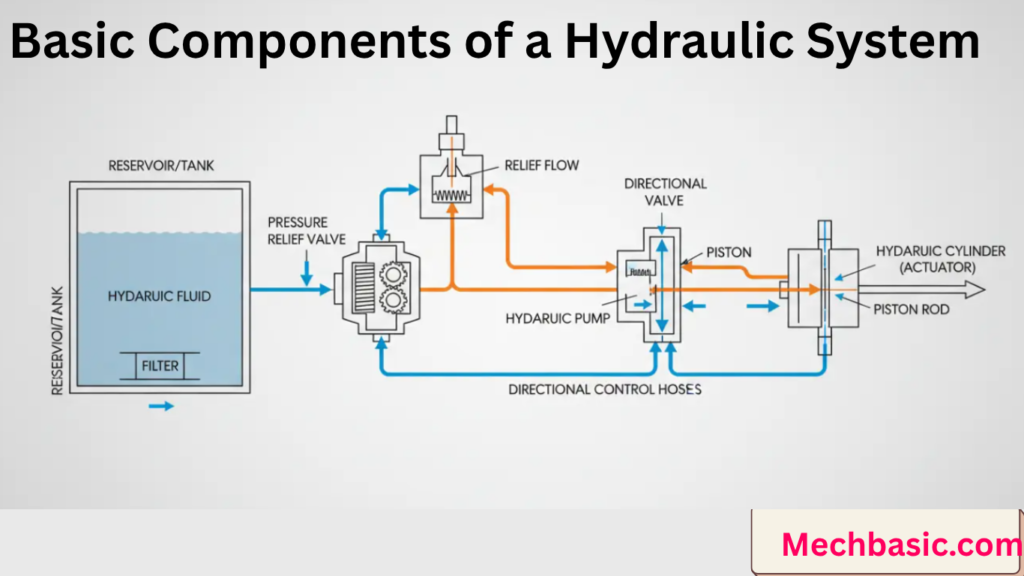
1. Hydraulic Reservoir
Stores hydraulic fluid.
Functions:
- Fluid storage
- Cooling
- Air separation
- Contaminant settling
2. Hydraulic Pump
Converts mechanical energy into hydraulic energy.
Common types:
- Gear pump
- Vane pump
- Piston pump
3. Hydraulic Fluid
Functions:
- Power transmission
- Lubrication
- Cooling
- Corrosion protection
- Sealing
4. Control Valves
Regulate:
- Flow
- Pressure
- Direction
Types:
- Directional control valves
- Pressure relief valves
- Flow control valves
- Check valves
5. Hydraulic Cylinder
Converts hydraulic energy into linear mechanical motion.
Applications:
- Lifting
- Pressing
- Clamping
6. Hydraulic Motor
Converts hydraulic energy into rotary motion.
Applications:
- Conveyor systems
- Winches
- Industrial machinery
7. Pipes and Hoses
Transport hydraulic fluid between system components.
8. Filters
Remove contaminants from hydraulic fluid to improve system reliability and component life.
Types of Hydraulic Systems
Also read: Types of Hydraulic Systems
Open-Loop Hydraulic System
Fluid returns directly to the reservoir after completing its work.
Applications:
- Agricultural machinery
- Excavators
- Presses
Closed-Loop Hydraulic System
Fluid circulates continuously between the pump and actuator.
Applications:
- Hydrostatic transmissions
- Industrial machinery
- Mobile equipment
Advantages of Hydraulics
- High power output
- Smooth and precise control
- High force multiplication
- Compact system design
- Reliable overload protection
- Suitable for heavy-duty applications
Limitations of Hydraulics
- Oil leakage
- Higher maintenance requirements
- Environmental concerns due to fluid spills
- Sensitivity to contamination
- Higher initial cost
Industrial Applications of Hydraulics
Construction Equipment
Examples:
- Excavators
- Bulldozers
- Cranes
- Backhoe loaders
Hydraulics provide the force required for lifting and digging operations.
Manufacturing
Used in:
- Hydraulic presses
- Injection molding machines
- CNC machine tools
- Metal forming equipment
Automotive Industry
Applications include:
- Hydraulic brakes
- Power steering
- Vehicle lifts
- Press machines
Aerospace
Hydraulic systems operate:
- Landing gear
- Flight control surfaces
- Cargo doors
- Aircraft brakes
Marine Industry
Used for:
- Steering systems
- Deck cranes
- Winches
- Hatch covers
What is Pneumatics?
Definition
Pneumatics is the branch of engineering that uses compressed air or gases to transmit and control power.
Compressed air is generated using air compressors and distributed through pipelines to pneumatic devices.
Working Principle of Pneumatics
Compressed air stores potential energy.
When released, the air expands and performs mechanical work by moving actuators or rotating motors.
Basic Components of a Pneumatic System
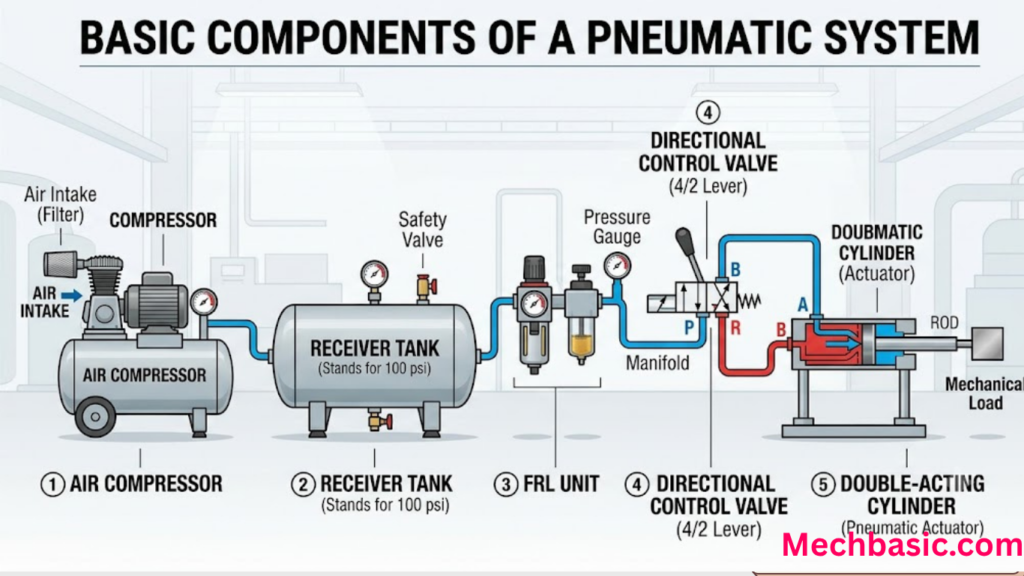
1. Air Compressor
Produces compressed air.
Common types:
- Reciprocating compressor
- Rotary screw compressor
- Centrifugal compressor
2. Air Receiver Tank
Stores compressed air and stabilizes system pressure.
3. Air Filters
Remove:
- Dust
- Moisture
- Oil particles
4. Pressure Regulator
Maintains the required air pressure.
5. Lubricator
Adds a controlled amount of lubricant to the compressed air when required by certain components.
6. Directional Control Valves
Control airflow direction.
7. Pneumatic Cylinders
Convert compressed air into linear motion.
Applications:
- Clamping
- Pushing
- Lifting light loads
8. Pneumatic Motors
Convert compressed air into rotary motion.
9. Air Hoses and Pipelines
Distribute compressed air throughout the system.
Types of Pneumatic Cylinders
Single-Acting Cylinder
Uses compressed air in one direction with a spring return.
Double-Acting Cylinder
Uses compressed air for both extension and retraction, providing greater control.
Advantages of Pneumatics
- Clean operation
- Safe in hazardous environments
- Fast response
- Simple design
- Low maintenance
- Lightweight components
- No risk of oil contamination
Limitations of Pneumatics
- Lower force compared to hydraulics
- Air leakage
- Less precise positioning due to air compressibility
- Higher energy consumption for air compression
Industrial Applications of Pneumatics
Manufacturing Automation
Used for:
- Pick-and-place systems
- Assembly lines
- Packaging
- Material handling
Food Industry
Applications include:
- Packaging machines
- Filling systems
- Sorting equipment
Compressed air is clean and suitable for hygienic environments.
Pharmaceutical Industry
Used in:
- Medicine packaging
- Tablet handling
- Filling machines
Textile Industry
Applications include:
- Loom control
- Fabric handling
- Automatic cutting
Robotics
Pneumatic actuators provide rapid movement for robotic grippers and lightweight automation tasks.
Hydraulic vs. Pneumatic Systems
| Feature | Hydraulics | Pneumatics |
|---|---|---|
| Working Fluid | Hydraulic oil | Compressed air |
| Fluid Compressibility | Incompressible | Compressible |
| Force Output | Very high | Moderate |
| Operating Pressure | High | Lower |
| Precision | High | Moderate |
| Speed | Moderate | High |
| Cleanliness | Oil leakage possible | Clean operation |
| Maintenance | Higher | Lower |
| Typical Applications | Heavy machinery, presses | Automation, packaging, robotics |
Safety Considerations
Hydraulic Systems
- Inspect hoses regularly.
- Prevent oil leaks.
- Replace contaminated fluid.
- Do not exceed pressure ratings.
- Wear appropriate personal protective equipment (PPE).
Pneumatic Systems
- Release system pressure before maintenance.
- Inspect hoses for leaks.
- Use clean, dry compressed air.
- Secure loose air hoses.
- Avoid directing compressed air at people.
Modern Trends
Electro-Hydraulic Systems
Combine electronic controls with hydraulic actuators for greater precision and automation.
Smart Pneumatic Systems
Use sensors and controllers to monitor:
- Pressure
- Flow
- Temperature
- Air consumption
IoT Integration
Industrial Internet of Things (IIoT) enables:
- Remote monitoring
- Predictive maintenance
- Real-time diagnostics
Artificial Intelligence
AI helps optimize:
- Energy consumption
- Maintenance schedules
- Fault detection
- System efficiency
Applications in Industry 4.0
Hydraulic and pneumatic systems are integrated with:
- PLCs (Programmable Logic Controllers)
- SCADA systems
- Industrial robots
- Smart sensors
- Automated production lines
- Digital twins
This integration supports smart manufacturing and predictive maintenance.
Career Opportunities
Professionals with hydraulic and pneumatic expertise can work as:
- Hydraulic Engineer
- Pneumatic Systems Engineer
- Automation Engineer
- Maintenance Engineer
- Manufacturing Engineer
- Industrial Equipment Designer
- Field Service Engineer
- Robotics Engineer
- Fluid Power Specialist
Advantages of Fluid Power Systems
- High power density
- Smooth motion control
- Reliable operation
- Easy automation
- Flexible system design
- Long service life with proper maintenance
Challenges
- Energy losses
- Component wear
- Fluid contamination
- Air leakage
- Noise from compressors
- Skilled maintenance requirements
Summary Table
| Aspect | Hydraulics | Pneumatics |
|---|---|---|
| Energy Medium | Pressurized liquid | Compressed air |
| Power Capacity | High | Moderate |
| Speed | Moderate | High |
| Accuracy | High | Moderate |
| Cost | Higher | Lower |
| Maintenance | More demanding | Simpler |
| Best Applications | Heavy-duty machinery | High-speed automation |
Frequently Asked Questions (FAQs)
1. What is the main difference between hydraulics and pneumatics?
Hydraulics use pressurized liquids, providing high force and precise control, while pneumatics use compressed air, offering faster operation and cleaner systems but with lower force output.
2. What is Pascal’s Law?
Pascal’s Law states that pressure applied to a confined fluid is transmitted equally in all directions, forming the basis of hydraulic systems.
3. Why are hydraulic systems used in heavy machinery?
Hydraulic systems can generate very high forces, making them ideal for equipment such as excavators, cranes, presses, and loaders.
4. Why are pneumatic systems popular in automation?
Pneumatic systems are fast, simple, clean, and cost-effective, making them well suited for packaging, assembly, material handling, and robotic applications.
5. What are the main components of a hydraulic system?
The main components include:
- Reservoir
- Hydraulic pump
- Hydraulic fluid
- Valves
- Hydraulic cylinders or motors
- Filters
- Pipes and hoses
6. What are the main components of a pneumatic system?
A pneumatic system typically consists of:
- Air compressor
- Air receiver tank
- Filters
- Pressure regulator
- Lubricator (when required)
- Valves
- Pneumatic cylinders or motors
- Air pipelines
7. Which industries use hydraulics and pneumatics?
Common industries include:
- Manufacturing
- Automotive
- Aerospace
- Construction
- Agriculture
- Mining
- Food processing
- Pharmaceuticals
- Logistics
- Robotics
8. What role does IoT play in fluid power systems?
IoT enables real-time monitoring of pressure, temperature, flow, and equipment condition, supporting predictive maintenance and improved system performance.
9. What are the common causes of hydraulic system failure?
Common causes include fluid contamination, oil leaks, worn seals, overheating, clogged filters, incorrect fluid selection, and poor maintenance.
10. What is the future of hydraulics and pneumatics?
The future includes electro-hydraulic systems, smart pneumatic devices, AI-driven diagnostics, IoT-based monitoring, digital twins, energy-efficient designs, and deeper integration with Industry 4.0, making fluid power systems more intelligent, reliable, and sustainable.
Conclusion
Hydraulics and pneumatics are fundamental technologies in modern industry, providing efficient and reliable methods of transmitting power through fluids. Hydraulics excels in applications requiring high force, precision, and heavy-duty performance, while pneumatics is ideal for fast, clean, and cost-effective automation tasks. As industries adopt Industry 4.0 technologies, fluid power systems are evolving with smart sensors, IoT connectivity, artificial intelligence, and predictive maintenance capabilities. A solid understanding of hydraulic and pneumatic principles enables engineers to design, operate, and maintain advanced industrial systems that are safe, efficient, and adaptable to future manufacturing needs.
Other courses:





