
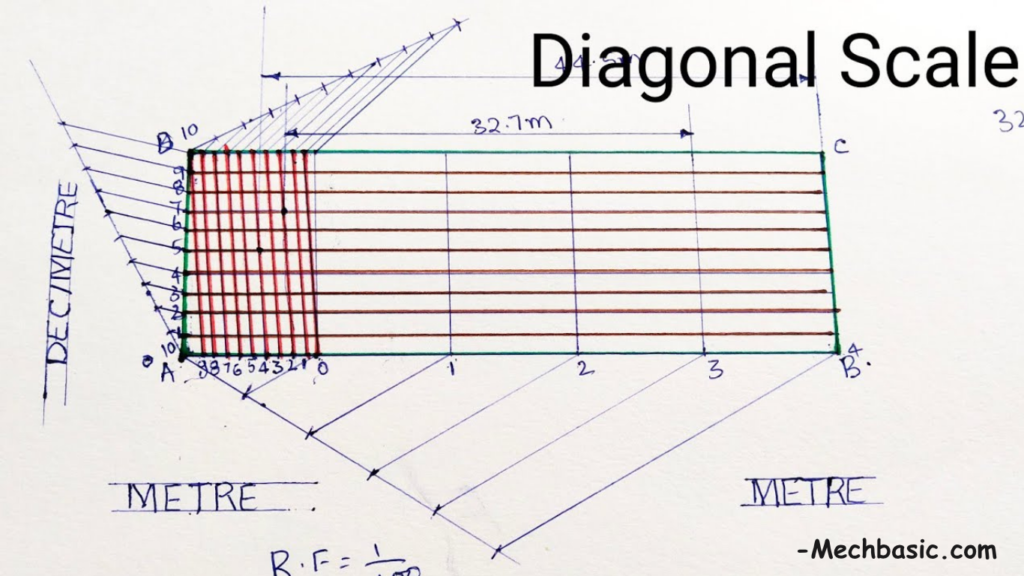
A diagonal scale is a scale used to measure three units or a unit and two of its subdivisions accurately.
It is based on the principle of similar triangles and diagonal lines.
Diagonal scales are commonly used in engineering drawings for precise measurements.
In this article:
- Diagonal Scale in Engineering Drawing
- What is a Diagonal Scale?
- Definition
- Purpose of a Diagonal Scale
- Principle of Diagonal Scale
- Representative Fraction (R.F.)
- Components of a Diagonal Scale
- Construction of a Diagonal Scale
- Reading a Diagonal Scale
- Why Diagonal Scales Are More Accurate
- Applications of Diagonal Scale
- Advantages of Diagonal Scale
- Limitations of Diagonal Scale
- Plain Scale vs Plane Scale vs Diagonal Scale
- FAQ Section
- Importance in Engineering Drawing
- Conclusion
Diagonal Scale in Engineering Drawing
Introduction
A Diagonal Scale is an advanced scale used in engineering drawing to measure three units or a unit and two successive subdivisions accurately.
It is more precise than a Plain Scale and Plane Scale because it can measure very small distances using the principle of similar triangles.
Examples:
- Kilometers, hectometers, and decameters
- Meters, decimeters, and centimeters
- Feet, inches, and fractions of inches
Diagonal scales are widely used in:
- Engineering Graphics
- Surveying
- Mapping
- Civil Engineering
- Mechanical Engineering
What is a Diagonal Scale?
A diagonal scale is a scale that enables measurement of:
A unit, its subdivision, and a further subdivision.
For example:
- 1 meter
- 0.1 meter (decimeter)
- 0.01 meter (centimeter)
Thus, it provides much higher accuracy than a plane scale.
Definition
A diagonal scale is defined as:
“A scale used to read three successive units by employing the principle of similar triangles.”
Purpose of a Diagonal Scale
The main purposes are:
- Measure small distances accurately
- Represent large dimensions on small drawings
- Obtain precise readings
- Read units, subdivisions, and sub-subdivisions
Principle of Diagonal Scale
The diagonal scale is based on the principle of similar triangles.
Principle
If parallel lines cut two intersecting lines, the corresponding segments are proportional.
This principle allows a very small division to be obtained without physically dividing a line into extremely tiny parts.
Representative Fraction (R.F.)
The construction of a diagonal scale begins with the Representative Fraction.
Formula
Where:
- Drawing Length = Length on paper
- Actual Length = Real-world length
Components of a Diagonal Scale
1. Main Scale
Represents the primary unit.
Examples:
- Kilometers
- Meters
- Feet
2. Subdivisions
Represent smaller units.
Examples:
- Hectometers
- Decimeters
- Inches
3. Diagonal Lines
Used to obtain even smaller subdivisions.
These diagonals provide the third level of measurement.
4. Vertical Divisions
Divide the scale height into equal parts.
These divisions work with diagonals to provide accurate readings.
Construction of a Diagonal Scale
Step 1: Determine the R.F.
Example:
R.F. = 1/1000Step 2: Determine Maximum Length
Example:
Maximum distance = 50 mStep 3: Calculate Scale Length
Using:
Length of Scale = R.F. × Actual Length
Convert:
50 m = 50000 mmThen:
Length = 1/1000 × 50000= 50 mmStep 4: Draw Main Scale
Draw a rectangle of length:
50 mmStep 5: Divide Main Scale
Suppose:
5 divisionsEach division represents:
10 mStep 6: Subdivide First Main Division
Divide into:
10 equal partsEach part represents:
1 mStep 7: Draw Vertical Lines
Construct a rectangle above the first division.
Divide its height into:
10 equal partsStep 8: Draw Diagonals
Join:
- Bottom left corner
- Top right corner
Draw parallel diagonals.
These diagonals produce smaller subdivisions.
Reading a Diagonal Scale
Suppose we need to read:
23.7 mThe reading consists of:
Main Scale
20 mSubdivision
3 mDiagonal Reading
0.7 mTotal:
23.7 mWhy Diagonal Scales Are More Accurate
A plane scale can measure:
- Units
- Subunits
A diagonal scale can measure:
- Units
- Subunits
- Smaller fractions of subunits
This increases accuracy significantly.
Applications of Diagonal Scale
Civil Engineering
Used for:
- Building plans
- Site layouts
- Highway designs
Surveying
Used for:
- Land measurement maps
- Topographic maps
Mechanical Engineering
Used for:
- Machine layouts
- Precision engineering drawings
Architecture
Used for:
- Floor plans
- Elevations
- Sections
Cartography
Used for:
- Geographic maps
- Route planning
Advantages of Diagonal Scale
High Accuracy
Measures very small fractions.
Easy Reading
Provides direct measurements.
Better Precision
More accurate than plain and plane scales.
Widely Used
Suitable for engineering and surveying.
No Complex Instruments Needed
Only drawing instruments are required.
Limitations of Diagonal Scale
More Complex Construction
Requires careful drafting.
Time Consuming
More steps than plain scales.
Larger Space Required
Occupies more drawing area.
Reading Errors Possible
If diagonals are drawn inaccurately.
Plain Scale vs Plane Scale vs Diagonal Scale
| Feature | Plain Scale | Plane Scale | Diagonal Scale |
|---|---|---|---|
| Units Measured | One unit and fraction | Unit and subunit | Unit and two subdivisions |
| Accuracy | Low | Medium | High |
| Construction | Simple | Moderate | Complex |
| Precision | Limited | Better | Excellent |
| Engineering Use | Basic | Intermediate | Advanced |
FAQ Section
1. What is a Diagonal Scale?
A diagonal scale is a scale used to measure three successive units accurately using the principle of similar triangles.
2. Why is it called a Diagonal Scale?
Because diagonal lines are used to obtain smaller subdivisions and improve measurement accuracy.
3. What principle is used?
The principle of similar triangles.
4. Where is it used?
- Engineering drawing
- Surveying
- Mapping
- Civil engineering
- Mechanical engineering
Importance in Engineering Drawing
Diagonal scales are important because they:
- Increase dimensional accuracy
- Allow precise measurements
- Reduce scaling errors
- Improve engineering drawing quality
- Help represent large dimensions accurately
Conclusion
A Diagonal Scale is a highly accurate engineering drawing scale used to measure a unit and two successive subdivisions. It is constructed using the Representative Fraction (R.F.) and operates on the principle of similar triangles. Compared with plain and plane scales, diagonal scales offer superior precision and are widely used in engineering graphics, surveying, mapping, civil engineering, and mechanical design. Because of their ability to read very small measurements accurately, diagonal scales are considered one of the most important scales in engineering drawing.
Other courses:





