
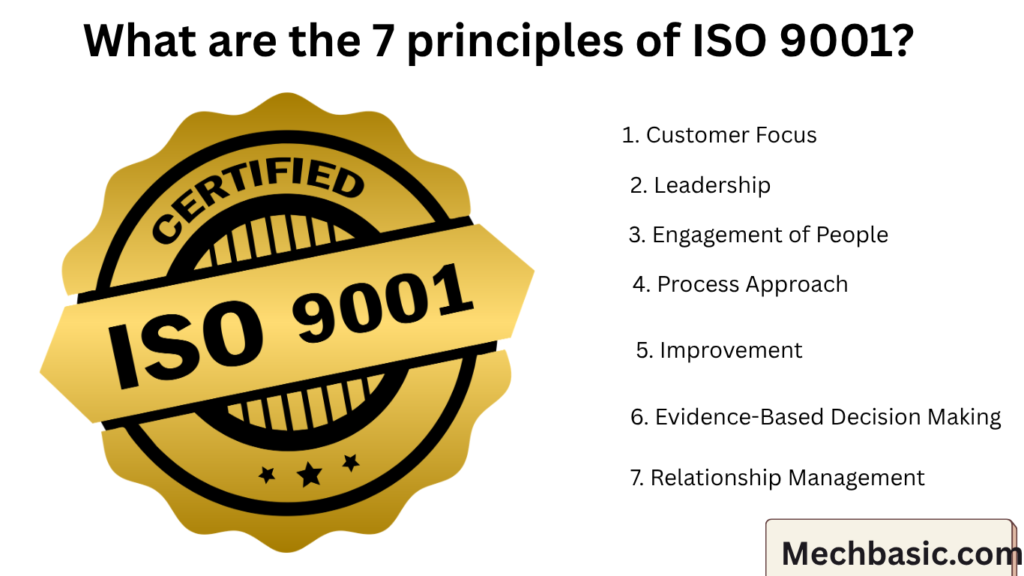
The 7 principles of ISO 9001 are customer focus, leadership, engagement of people, process approach, improvement, evidence-based decision making, and relationship management.
They guide organizations in building an effective quality management system.
These principles help improve performance, consistency, and customer satisfaction.
In this article:
7 Principles of ISO 9001 (Quality Management Principles)
ISO 9001 is an international standard for a Quality Management System (QMS). It is based on 7 key principles that help organizations consistently deliver quality products and improve customer satisfaction.
These principles are the foundation of ISO 9001:2015.
1. Customer Focus
Definition
The main purpose of quality management is to meet customer needs and exceed expectations.
Key idea
“Quality is defined by the customer.”
What organizations do
- Identify customer requirements
- Collect feedback regularly
- Improve products based on complaints and suggestions
- Ensure customer satisfaction
Example
A mobile company improves battery life and camera quality based on customer feedback.
Benefits
✔ Higher customer satisfaction
✔ Customer loyalty
✔ Better market reputation
2. Leadership
Definition
Top management must establish unity and direction in the organization.
Key idea
Strong leadership drives quality success.
What leaders do
- Set clear quality objectives
- Provide resources
- Create a quality culture
- Encourage employee participation
Example
A factory manager introduces a “zero defect” policy and ensures training for all employees.
Benefits
✔ Clear direction
✔ Motivated workforce
✔ Better coordination
3. Engagement of People
Definition
All employees at every level must be involved in quality improvement.
Key idea
“Quality is everyone’s responsibility.”
What happens
- Employees participate in improvement activities
- Teams solve problems together
- Workers suggest process improvements
Example
Machine operators report small defects early, preventing major breakdowns.
Benefits
✔ Better teamwork
✔ Faster problem solving
✔ Improved efficiency
4. Process Approach
Definition
Work activities are managed as processes that transform inputs into outputs.
Key idea
“Good processes produce good results.”
What organizations do
- Identify all processes
- Monitor inputs, outputs, and performance
- Reduce variation
- Standardize operations
Example
In manufacturing, controlling machining speed and tool wear ensures consistent product size.
Benefits
✔ Consistent quality
✔ Reduced defects
✔ Improved efficiency
5. Improvement
Definition
Organizations must continuously improve their processes, products, and systems.
Key idea
“There is always room for improvement.”
What is done
- Continuous improvement (Kaizen)
- Root cause analysis
- Corrective and preventive actions (CAPA)
Example
Reducing machine setup time from 30 minutes to 20 minutes improves productivity.
Benefits
✔ Higher efficiency
✔ Lower cost
✔ Better quality
6. Evidence-Based Decision Making
Definition
Decisions must be based on data, facts, and analysis, not assumptions.
Key idea
“If you cannot measure it, you cannot improve it.”
Tools used
- SPC charts
- Histograms
- Pareto analysis
- Check sheets
Example
Using defect data to identify the most frequent production error and fix it first.
Benefits
✔ Accurate decisions
✔ Reduced risk
✔ Better problem-solving
7. Relationship Management
Definition
Organizations must manage relationships with suppliers and stakeholders effectively.
Key idea
Quality depends on strong external and internal relationships.
Who is included
- Suppliers
- Customers
- Employees
- Partners
Example
A manufacturer works closely with suppliers to ensure raw material quality is consistent.
Benefits
✔ Stable supply chain
✔ Better material quality
✔ Long-term partnerships
Summary Table
| ISO Principle | Focus | Outcome |
|---|---|---|
| Customer Focus | Customer needs | Satisfaction |
| Leadership | Direction and support | Stability |
| Engagement of People | Employee involvement | Participation |
| Process Approach | Process control | Consistency |
| Improvement | Continuous improvement | Growth |
| Evidence-Based Decision Making | Data analysis | Accuracy |
| Relationship Management | Supplier & stakeholder relations | Stability |
How the 7 Principles Work Together
- Leadership sets direction
- Employees execute and improve work
- Processes are controlled for consistency
- Data is used for decisions
- Continuous improvement drives progress
- Suppliers and customers are managed well
- Customer satisfaction remains the final goal
Real-Life Example: ISO 9001 in Manufacturing
A company producing machine components applies ISO 9001:
- Customer complaints analyzed (Customer focus)
- Management sets quality targets (Leadership)
- Workers trained and involved (Engagement)
- Production process standardized (Process approach)
- Defects reduced continuously (Improvement)
- SPC charts used for decisions (Evidence-based)
- Supplier quality monitored (Relationship management)
Result:
✔ Better quality products
✔ Lower defect rate
✔ Strong customer trust
Conclusion
The 7 principles of ISO 9001 are Customer Focus, Leadership, Engagement of People, Process Approach, Improvement, Evidence-Based Decision Making, and Relationship Management. These principles ensure that organizations maintain a strong quality management system, improve continuously, make data-driven decisions, and achieve high customer satisfaction through consistent and reliable processes.
Other courses:





