
Brush electroplating is a process where a metal coating is applied using a brush or pad connected to a power source.
The plating solution is supplied through the brush and applied directly to the surface.
It is used for repair work, selective plating, and coating specific areas.
In this article:
- Brush electroplating
- Definition
- Principle of brush electroplating
- Main components of a brush electroplating setup
- Working process of brush electroplating
- Metals commonly used in brush electroplating
- Applications of brush electroplating
- Advantages of brush electroplating
- Disadvantages of brush electroplating
- Comparison: Brush vs Tank electroplating
- Conclusion
Brush electroplating
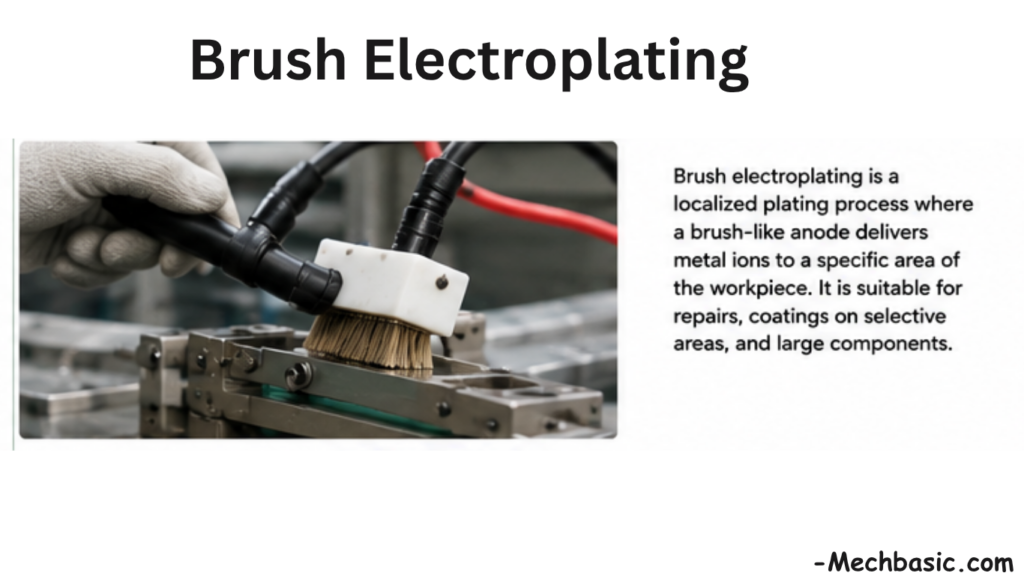
Brush electroplating (also called selective electroplating or tampon electroplating) is a specialized electroplating process in which a brush or absorbent pad soaked with electrolyte solution is moved over a specific area of a workpiece while electric current deposits a metal coating.
Unlike tank electroplating, the object does not need to be immersed in a plating bath. The coating is applied only where required, making this process ideal for localized repair, selective coating, and maintenance work.
Definition
Brush electroplating is an electroplating process in which a metal coating is deposited onto selected areas of a workpiece using a handheld brush, electrolyte solution, and direct current.
Principle of brush electroplating
Brush electroplating also works on the principle of electrolysis.
During the process:
- The workpiece acts as the cathode
- The brush acts as the anode
- The brush is covered with an absorbent material soaked in electrolyte
- Electric current causes metal ions to move and deposit on the workpiece surface
As the brush moves continuously over the area, metal builds up layer by layer.
Main components of a brush electroplating setup
1. Brush or plating tool
The brush is usually made of:
- Graphite
- Stainless steel
- Conductive materials
It is covered with:
- Felt
- Cotton
- Absorbent fabric
Functions:
- Carries electrolyte
- Transfers current
- Applies coating locally
2. Electrolyte solution
Contains dissolved metal salts.
Examples:
- Nickel solution
- Copper solution
- Gold solution
- Silver solution
- Zinc solution
Function:
Provides metal ions for coating.
3. Workpiece (cathode)
The component to be coated acts as the cathode.
Examples:
- Shafts
- Machine parts
- Mold surfaces
- Aircraft components
Connected to the negative terminal.
4. DC power supply
Provides direct current for electrolysis.
Voltage and current are adjusted according to coating requirements.
5. Connecting cables
Provide electrical connection between the power source and system components.
Working process of brush electroplating
Step 1: Surface preparation
The workpiece surface is cleaned thoroughly.
Contaminants removed include:
- Grease
- Oil
- Oxides
- Dirt
- Rust
Methods:
- Degreasing
- Mechanical polishing
- Chemical cleaning
Surface preparation is critical for good adhesion.
Step 2: Masking (if needed)
Areas that should not be plated are covered.
Materials used:
- Tape
- Protective coatings
- Masks
Purpose:
Ensure only selected regions are plated.
Step 3: Electrolyte application
The absorbent brush is soaked in electrolyte solution.
Step 4: Current application
Direct current is switched on.
At the anode:
M → M⁺ + e⁻
At the cathode:
M⁺ + e⁻ → M
Metal ions deposit on the workpiece.
Step 5: Brush movement
The operator moves the brush continuously over the target area.
Purpose:
- Uniform coating
- Avoid overheating
- Maintain even deposition
Step 6: Rinsing and finishing
After plating:
- Surface is rinsed
- Dried
- Polished if required
Metals commonly used in brush electroplating
Examples:
- Nickel
- Copper
- Gold
- Silver
- Zinc
- Chromium
- Tin
- Cadmium
Selection depends on application requirements.
Applications of brush electroplating
Repair and maintenance
Used to repair:
- Worn shafts
- Bearings
- Machine parts
Aerospace industry
Used for:
- Aircraft repair
- Component restoration
Mold repair
Used to restore:
- Dies
- Molds
- Tool surfaces
Electronics
Selective coating of:
- Connectors
- Contacts
Decorative applications
Localized gold or silver coating
Advantages of brush electroplating
1. No large plating tank required
Portable equipment can be used.
2. Localized coating possible
Only desired areas receive plating.
3. Suitable for repair work
Can restore worn surfaces.
4. Portable process
Can be used at installation sites.
5. Lower chemical consumption
Uses smaller amounts of electrolyte.
6. Minimal disassembly
Large components often do not need removal.
Disadvantages of brush electroplating
1. Not suitable for large-area coating
Large surfaces become time consuming.
2. Requires skilled operator
Movement affects coating quality.
3. Lower productivity
Not ideal for mass production.
4. Coating thickness variation possible
Uneven motion can produce inconsistent deposition.
Comparison: Brush vs Tank electroplating
| Feature | Brush electroplating | Tank electroplating |
|---|---|---|
| Process area | Localized | Entire object |
| Equipment | Portable | Fixed tanks |
| Chemical use | Lower | Higher |
| Production volume | Small | Large |
| Repair work | Excellent | Limited |
| Automation | Low | High |
Conclusion
Brush electroplating is a portable and selective electroplating process used mainly for repair, maintenance, and localized coating applications. It is especially useful where complete immersion is difficult and only specific areas require metal deposition.
Other courses:





