
Six Sigma focuses on reducing defects and improving quality using data and analysis.
Kaizen emphasizes continuous small improvements involving everyone in the organization.
Lean aims to eliminate waste and improve efficiency in processes.
In this article:
Six Sigma, Kaizen, and Lean are three widely used process improvement and quality management approaches, but they differ in goals, methods, speed of implementation, and focus areas. All three aim to improve performance and reduce waste, yet each follows a different philosophy.
They are often used together in industries such as manufacturing, healthcare, IT, logistics, and services.
What is Six Sigma vs Kaizen vs Lean?
Six Sigma
Focuses on:
- Reducing defects
- Reducing variation
- Data-driven problem solving
- Statistical analysis
Goal:
Near-perfect quality.
Kaizen
Focuses on:
- Continuous improvement
- Small incremental changes
- Employee involvement
Goal:
Continuous ongoing improvements.
Lean
Focuses on:
- Eliminating waste
- Improving flow
- Increasing efficiency
Goal:
Deliver maximum customer value with minimum waste.
1. Six Sigma
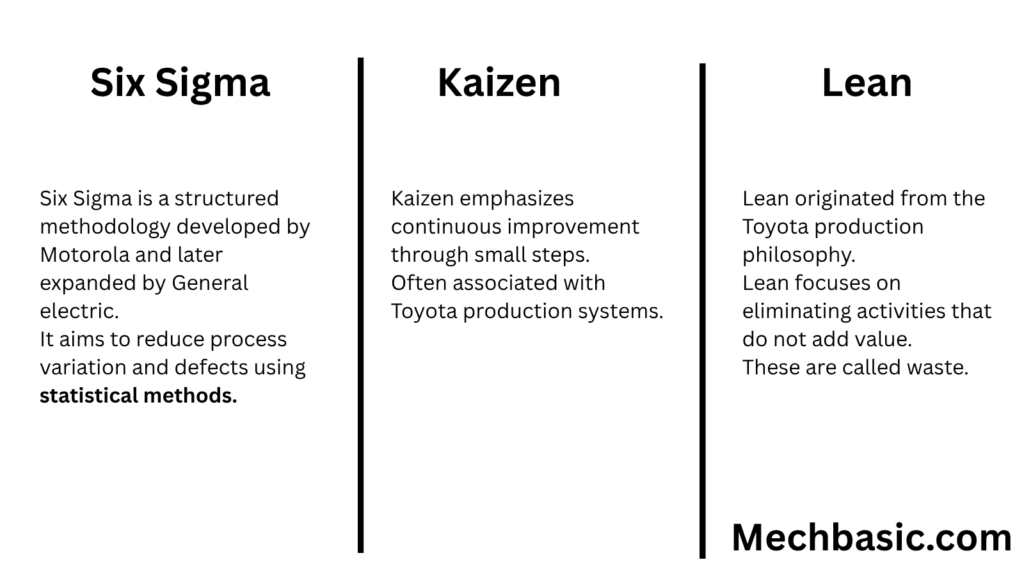
Six Sigma is a structured methodology developed by Motorola and later expanded by General electric.
It aims to reduce process variation and defects using statistical methods.
Main objective
Reduce defects to approximately:
3.4 defects per million opportunities
Core methodology
DMAIC:
- Define
- Measure
- Analyze
- Improve
- Control
Characteristics
- Data intensive
- Statistical approach
- Project-based
- Structured process
- Strong measurement focus
Tools used
- Control charts
- Pareto analysis
- Hypothesis testing
- Regression analysis
- Fishbone diagrams
- Process capability studies
Strengths
- Excellent for complex problems
- Reduces variation
- Provides measurable results
Weaknesses
- Training intensive
- Can require significant resources
- Statistical concepts can be difficult
2. Kaizen
Kaizen is a Japanese philosophy.
The word means:
- Kai = change
- Zen = good
Meaning:
Change for better
Kaizen emphasizes continuous improvement through small steps.
Often associated with Toyota production systems.
Main objective
Create continuous improvement culture.
Characteristics
- Small incremental improvements
- Employee participation
- Continuous effort
- Team-oriented approach
Kaizen principles
- Improve continuously
- Eliminate waste
- Encourage teamwork
- Standardize improvements
Tools used
- 5S
- Brainstorming
- Root cause analysis
- PDCA cycle
- Suggestion systems
Strengths
- Easy implementation
- Low cost
- Builds employee engagement
Weaknesses
- Small changes may be slow
- Large problems may require other methods
3. Lean
Lean originated from the Toyota production philosophy.
Lean focuses on eliminating activities that do not add value.
These are called waste.
Main objective
Deliver value while eliminating waste.
Types of waste commonly targeted
Traditional Lean identifies:
- Overproduction
- Waiting
- Transportation
- Overprocessing
- Inventory
- Motion
- Defects
- Underutilized talent
Characteristics
- Customer-focused
- Waste reduction
- Process flow improvement
- Efficiency emphasis
Common Lean tools
- Value stream mapping
- 5S
- Kanban
- Just-in-time
- Poka-yoke
Strengths
- Faster processes
- Reduced waste
- Improved efficiency
Weaknesses
- May focus less on variation
- Aggressive waste reduction can create implementation challenges
Major differences
| Feature | Six Sigma | Kaizen | Lean |
|---|---|---|---|
| Main focus | Reduce variation and defects | Continuous improvement | Eliminate waste |
| Goal | Improve quality | Ongoing improvement | Improve efficiency |
| Improvement style | Project-based | Small continuous steps | Process redesign |
| Data usage | Very high | Moderate | Moderate |
| Statistics | Extensive | Limited | Limited |
| Employee involvement | Project teams | Entire workforce | Teams and management |
| Speed | Moderate | Continuous | Often rapid |
| Training requirement | High | Lower | Moderate |
Example comparison
Suppose a factory has delayed deliveries.
Six Sigma approach
Analyze:
- Defect data
- Process variation
- Root causes
Use statistics for solutions.
Kaizen approach
Employees suggest small improvements daily.
Examples:
- Better workplace arrangement
- Improved communication
Lean approach
Remove waste such as:
- Unnecessary movement
- Excess inventory
- Waiting time
Lean Six Sigma
Many organizations combine Lean and Six Sigma.
Lean Six Sigma combines:
Lean:
- Waste reduction
with Six Sigma:
- Defect reduction
Benefits:
- Faster processes
- Better quality
- Reduced costs
Applications
Used in:
- Manufacturing
- Healthcare
- Banking
- Logistics
- IT
- Retail
- Supply chains
Which one should be used?
Use Six Sigma when:
- Variation is high
- Statistical analysis is needed
- Defects are costly
Use Kaizen when:
- Continuous improvement culture is desired
- Small improvements are sufficient
Use Lean when:
- Waste reduction is the priority
- Process flow is inefficient
Conclusion
Six Sigma, Kaizen, and Lean are complementary rather than competing approaches. Six Sigma focuses on reducing defects and variation, Kaizen focuses on continuous incremental improvement, and Lean focuses on eliminating waste. Organizations often integrate these approaches to achieve better quality, efficiency, and productivity.
Other courses:





