
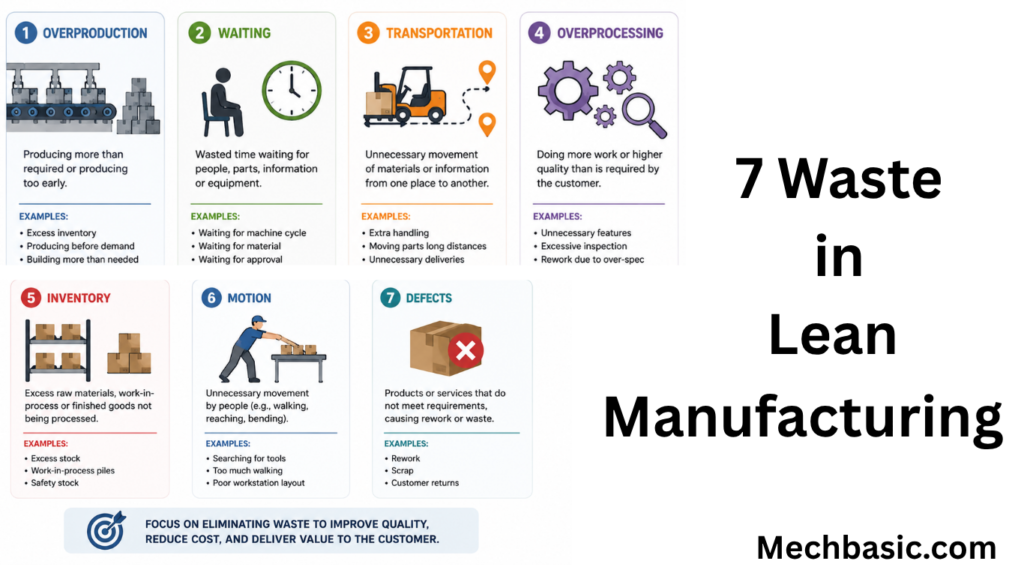
The 7 wastes in Lean are Transportation, Inventory, Motion, Waiting, Overproduction, Overprocessing, and Defects (TIMWOOD).
These wastes reduce efficiency and increase costs in a process.
Lean aims to identify and eliminate them to improve productivity.
In this article:
What are 7 wastes in lean Manufacturing?
The 7 wastes in Lean are categories of activities that consume resources but do not add value for the customer. Lean aims to identify and eliminate these wastes to improve efficiency, productivity, quality, and process flow.
These wastes originated from the Toyota Production System and are often remembered by the acronym:
TIMWOOD
- T – Transportation
- I – Inventory
- M – Motion
- W – Waiting
- O – Overproduction
- O – Overprocessing
- D – Defects
Eliminating these wastes helps organizations reduce cost and improve customer value.
1. Transportation Waste
Transportation waste refers to unnecessary movement of materials, products, tools, or information from one location to another.
Transportation itself usually does not increase value.
Examples
- Moving materials between distant workstations
- Excessive handling of products
- Unnecessary shipping steps
- Multiple storage transfers
Problems created
- Increased handling cost
- Longer production time
- Damage risk
- Delays
Reduction methods
- Improve plant layout
- Keep workstations closer
- Optimize material flow
2. Inventory Waste
Inventory waste is having more materials, parts, or products than necessary.
Excess inventory ties up resources.
Examples
- Large raw material stock
- Excess work-in-progress
- Unsold finished goods
Problems created
- Storage cost
- Hidden defects
- Obsolescence risk
- Reduced cash flow
Reduction methods
- Just-in-time systems
- Better forecasting
- Improved scheduling
3. Motion Waste
Motion waste is unnecessary movement of people or equipment during work.
Unlike transportation waste, this focuses on movement by workers.
Examples
- Excessive walking
- Reaching repeatedly
- Searching for tools
- Bending unnecessarily
Problems created
- Worker fatigue
- Longer cycle time
- Lower productivity
- Injury risk
Reduction methods
- Workplace organization
- Ergonomic design
- 5S implementation
4. Waiting Waste
Waiting waste occurs when people, machines, or materials remain idle while waiting for the next process step.
Examples
- Machine downtime
- Waiting for approvals
- Waiting for materials
- Delayed information
Problems created
- Increased lead time
- Lower productivity
- Production delays
Reduction methods
- Improve scheduling
- Balance workloads
- Reduce bottlenecks
5. Overproduction Waste
Overproduction means producing more than needed or earlier than needed.
This is often considered the most serious waste because it creates other wastes.
Examples
- Producing extra products
- Manufacturing before demand exists
- Creating unnecessary reports
Problems created
- Excess inventory
- Storage cost
- Hidden defects
- Resource waste
Reduction methods
- Produce according to demand
- Pull systems
- Better planning
6. Overprocessing Waste
Overprocessing means performing more work than customers actually require.
Examples
- Excess polishing
- Duplicate approvals
- Unnecessary inspections
- Excessive documentation
Problems created
- Increased cost
- Additional labor
- Longer processing time
Reduction methods
- Simplify processes
- Understand customer requirements
- Remove unnecessary steps
7. Defects Waste
Defects are products or services that fail to meet specifications.
Defects often create rework and customer dissatisfaction.
Examples
- Damaged products
- Incorrect dimensions
- Software errors
- Incorrect documentation
Problems created
- Rework cost
- Scrap cost
- Customer complaints
- Lost reputation
Reduction methods
- Root cause analysis
- Process control
- Training
- Error-proofing techniques
Summary table
| Waste | Description |
|---|---|
| Transportation | Unnecessary movement of materials |
| Inventory | Excess materials or products |
| Motion | Unnecessary worker movement |
| Waiting | Idle time |
| Overproduction | Producing too much or too early |
| Overprocessing | Doing more than needed |
| Defects | Errors requiring correction |
Why the 7 wastes matter
Eliminating wastes provides:
- Lower cost
- Faster production
- Better quality
- Improved productivity
- Reduced lead time
- Better customer satisfaction
Expanded concept: 8th waste
Many organizations later added:
Unused employee talent
Examples:
- Ignoring employee ideas
- Underutilizing skills
This creates the 8 wastes of Lean.
Conclusion
The 7 wastes of Lean (TIMWOOD) identify non-value-added activities that reduce efficiency. By recognizing and eliminating transportation, inventory, motion, waiting, overproduction, overprocessing, and defects, organizations can create faster, leaner, and more customer-focused processes.
Other courses:





