
Thawing means warming frozen material or food to return it to a normal state.
Tempering is a heat treatment process used to improve the toughness of hardened metals.
Thawing is used in food processing, while tempering is used in metallurgy.
In this article:
What’s the difference between thawing and tempering?
Thawing and tempering are completely different processes used in different fields. They are often confused because both involve changes caused by temperature, but their purpose, materials, and results are very different.
- Thawing → commonly used for frozen food or materials
- Tempering → commonly used in metallurgy and heat treatment of metals
Basic definitions
Thawing
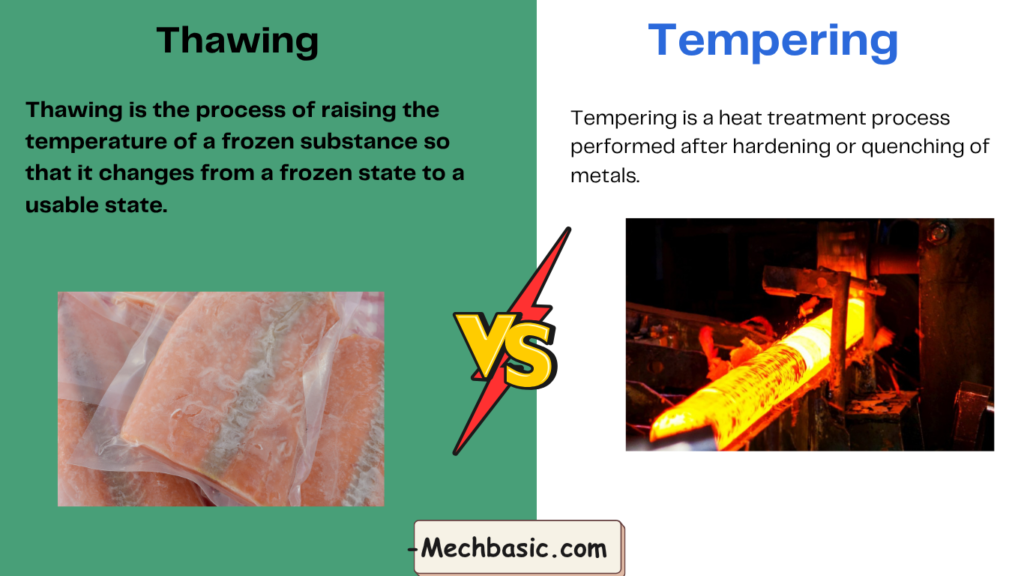
Thawing is the process of raising the temperature of a frozen substance so that it changes from a frozen state to a usable state.
Example:
Frozen meat is thawed before cooking.
Tempering
Tempering is a heat treatment process performed after hardening or quenching of metals.
It involves reheating hardened steel to a temperature below its critical temperature and then cooling it.
Purpose:
Reduce brittleness and improve toughness.
Main objective
Thawing
Goal:
- Return frozen material to normal condition
- Make it ready for use
- Prevent damage caused by freezing
Tempering
Goal:
- Reduce internal stresses
- Reduce brittleness
- Improve toughness
- Improve ductility
Materials involved
Thawing
Usually applied to:
- Food products
- Frozen chemicals
- Biological materials
- Water-based materials
Examples:
- Meat
- Vegetables
- Frozen medicine samples
Tempering
Applied to:
- Steel
- Metal alloys
- Heat-treated machine parts
Examples:
- Gears
- Tools
- Springs
- Shafts
Process description
Thawing process
Frozen material absorbs heat.
Temperature rises above freezing point.
Ice crystals melt.
State changes:
Frozen → soft/unfrozen
Example
Frozen chicken:
- Remove from freezer
- Keep at room temperature or refrigerator
- Ice melts
- Product becomes usable
Tempering process
After quenching:
- Harden steel
- Reheat below critical temperature
- Hold for specific time
- Cool
This modifies microstructure.
Temperature range
Thawing
Usually:
From below 0°C to above freezing temperature
Depends on material.
Tempering
Usually:
Approximately:
150–650°C
Depends on required properties.
Structural changes
Thawing
Physical change only:
- Ice melts
- Material softens
No metallurgical transformation.
Tempering
Microstructural changes occur:
Martensite transforms into tempered structures.
Properties change significantly.
Effect on properties
Thawing
Effects:
- Restores usability
- Improves handling
Tempering
Effects:
- Reduced brittleness
- Increased toughness
- Reduced residual stress
- Improved ductility
Industries where used
Thawing
Industries:
- Food processing
- Pharmaceuticals
- Laboratories
- Biotechnology
Tempering
Industries:
- Manufacturing
- Automotive
- Aerospace
- Tool making
Examples
Thawing example
Frozen fish thawed before cooking.
Tempering example
A quenched gear is tempered to prevent cracking.
Comparison table
| Feature | Thawing | Tempering |
|---|---|---|
| Meaning | Unfreezing material | Heat treatment of hardened metals |
| Purpose | Restore usability | Reduce brittleness |
| Material | Frozen products | Metals |
| Temperature | Around freezing point | 150–650°C |
| Structural change | Physical | Metallurgical |
| Main effect | Melting | Property improvement |
| Typical use | Food | Engineering |
Common confusion
People sometimes mistakenly say “tempering food” when they mean thawing, or “thawing steel” instead of tempering steel.
In metallurgy:
The correct term is tempering.
In frozen material handling:
The correct term is thawing.
Conclusion
Thawing and tempering are entirely different processes. Thawing restores frozen materials by warming them above freezing, while tempering is a metallurgical heat treatment used to improve the mechanical properties of hardened metals by reducing brittleness and increasing toughness.
Other courses:





