
Wet quenching uses liquids such as water, oil, or brine to cool the heated metal rapidly.
Dry quenching uses air or gas as the cooling medium.
Wet quenching provides faster cooling, while dry quenching reduces the risk of cracking and distortion.
In this article:
- Wet Quenching vs Dry Quenching
- Basic Definitions
- Principle of Operation
- Cooling Rate
- Effect on Hardness
- Risk of Cracking
- Distortion and Warping
- Surface Quality
- Equipment Required
- Applications
- Example 1: Water Quenching (Wet)
- Example 2: Air Hardening Tool Steel (Dry)
- Environmental Considerations
- Advantages and Disadvantages
- Comparison Table
- Which Is Better?
- Conclusion
Wet Quenching vs Dry Quenching
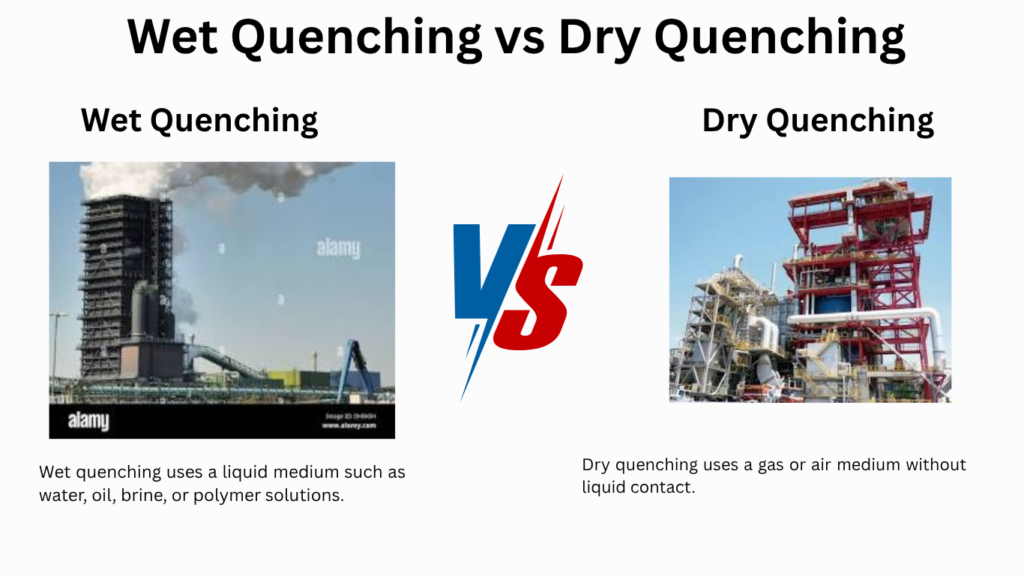
Wet quenching and dry quenching are two methods used to cool heated metals after heat treatment. The main difference is the cooling medium used.
- Wet quenching uses a liquid medium such as water, oil, brine, or polymer solutions.
- Dry quenching uses a gas or air medium without liquid contact.
Both methods are used to alter the microstructure and mechanical properties of metals, but they differ significantly in cooling rate, hardness achieved, distortion, and applications.
Basic Definitions
Wet Quenching
Wet quenching involves immersing a heated metal directly into a liquid quenching medium.
Common media:
- Water
- Brine (salt water)
- Oil
- Polymer solutions
The liquid rapidly extracts heat from the metal.
Dry Quenching
Dry quenching cools the heated metal using gases instead of liquids.
Common media:
- Still air
- Forced air
- Nitrogen
- Argon
- Helium
No liquid comes into contact with the metal.
Principle of Operation
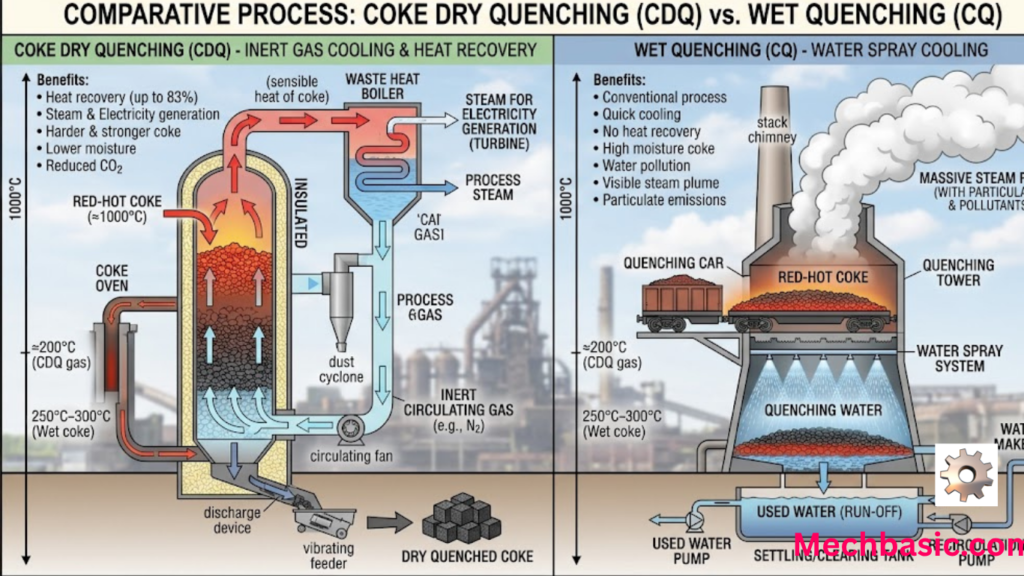
Wet Quenching
The hot metal transfers heat to the liquid.
Cooling occurs through:
- Vapor blanket stage
- Boiling stage
- Convection stage
This results in rapid cooling.
Dry Quenching
Heat is removed through:
- Convection
- Radiation
- Gas flow
Cooling is slower and more uniform.
Cooling Rate
This is the biggest difference.
Wet Quenching
Very fast cooling.
Typical order:
Brine → Water → Polymer → Oil
Fast cooling promotes martensite formation.
Dry Quenching
Much slower cooling.
Typical order:
Helium → Nitrogen → Forced Air → Still Air
Cooling is gradual and controlled.
Effect on Hardness
Wet Quenching
Produces:
- Higher hardness
- More martensite
Suitable for steels requiring maximum hardening.
Dry Quenching
Produces:
- Lower hardness (for most steels)
- Reduced thermal stresses
Used when extreme hardness is not the primary goal.
Risk of Cracking
Wet Quenching
Rapid cooling creates:
- High thermal stress
- High residual stress
Result:
- Greater cracking risk
Dry Quenching
Gradual cooling reduces stress.
Result:
- Much lower cracking risk
Distortion and Warping
Wet Quenching
Uneven cooling may cause:
- Warping
- Bending
- Dimensional changes
Especially in complex parts.
Dry Quenching
More uniform cooling.
Results:
- Better dimensional stability
- Less distortion
Surface Quality
Wet Quenching
May cause:
- Oxidation
- Staining
- Oil residue
- Corrosion (water-based media)
Dry Quenching
Often provides:
- Cleaner surfaces
- Better finish
- Less contamination
Especially in vacuum heat treatment.
Equipment Required
Wet Quenching
Requires:
- Quench tank
- Agitation system
- Cooling fluid
- Filtration system
Dry Quenching
Requires:
- Controlled atmosphere furnace
- Gas circulation system
- Vacuum furnace (in some cases)
Applications
Wet Quenching Applications
Common for:
- Carbon steels
- Medium-carbon steels
- Gears
- Shafts
- Springs
- Cutting tools
Dry Quenching Applications
Common for:
- Tool steels
- Aerospace components
- Precision parts
- Stainless steels
- High-alloy steels
Example 1: Water Quenching (Wet)
A steel chisel is:
- Heated to about 850°C
- Removed from furnace
- Immersed in water
Result:
- Very high hardness
- Increased brittleness
- Usually followed by tempering
Example 2: Air Hardening Tool Steel (Dry)
An air-hardening tool steel is:
- Heated to hardening temperature
- Removed from furnace
- Cooled in still air or forced air
Result:
- Adequate hardness
- Minimal distortion
- Lower cracking risk
Environmental Considerations
Wet Quenching
Potential issues:
- Oil disposal
- Water contamination
- Smoke generation
Dry Quenching
Generally:
- Cleaner process
- Lower contamination
- Reduced waste fluids
Advantages and Disadvantages
Wet Quenching
Advantages
- Very high cooling rate
- Maximum hardness
- Lower equipment cost
Disadvantages
- Cracking risk
- Distortion
- Residue and contamination
Dry Quenching
Advantages
- Minimal distortion
- Cleaner process
- Better dimensional accuracy
Disadvantages
- Slower cooling
- Higher equipment cost
- May not harden some steels sufficiently
Comparison Table
| Feature | Wet Quenching | Dry Quenching |
|---|---|---|
| Cooling medium | Liquid | Gas/Air |
| Cooling speed | Fast | Slow |
| Hardness achieved | Higher | Moderate |
| Cracking risk | High | Low |
| Distortion | Higher | Lower |
| Surface cleanliness | Lower | Better |
| Equipment cost | Lower | Higher |
| Suitable for | Carbon steels | Alloy and precision steels |
Which Is Better?
Choose Wet Quenching When:
- Maximum hardness is required
- Carbon steels are used
- Cost is important
Choose Dry Quenching When:
- Precision is critical
- Distortion must be minimized
- High-alloy or air-hardening steels are used
Conclusion
Wet quenching uses liquids such as water, oil, or brine to cool metals rapidly, producing high hardness but increasing the risk of cracking and distortion. Dry quenching uses air or gases to cool metals more slowly, resulting in better dimensional stability, cleaner surfaces, and lower stress. The choice depends on the material, desired hardness, component geometry, and performance requirements.
Other courses:





