
Water quenching cools metal faster and produces higher hardness.
Oil quenching cools more slowly, reducing the risk of cracking and distortion.
The better choice depends on the steel type and the desired properties.
In this article:
Is Water or Oil Better for Quenching?
Water and oil each have advantages and disadvantages, and the better choice depends on:
- Steel type
- Part size and shape
- Required hardness
- Risk of distortion
- Risk of cracking
In general:
- Water quenching provides faster cooling and higher hardness.
- Oil quenching provides more uniform cooling with lower risk of cracking and distortion.
For many engineering components, oil is often preferred because it offers a better balance of hardness and toughness.
Basic Difference
Both water and oil are used to rapidly cool hot steel after heating it to the austenitizing temperature.
The main difference is the cooling rate.
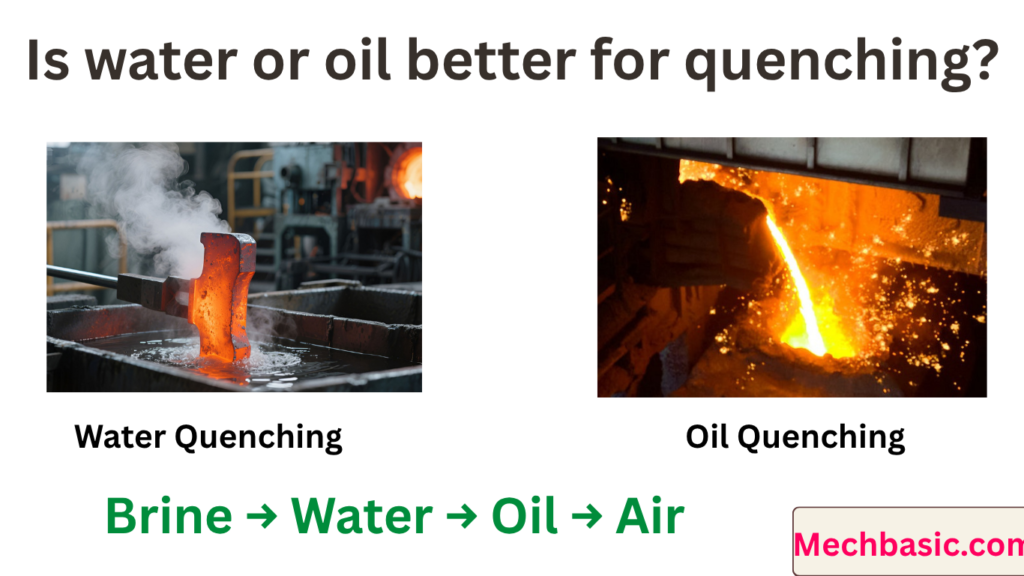
Cooling Speed Ranking
Brine → Water → Oil → Air
Water removes heat faster than oil.
Water Quenching
Water is one of the oldest and most common quenching media.
How it works
The heated steel is immersed in water.
The water rapidly extracts heat from the metal.
This rapid cooling promotes the formation of martensite, a very hard microstructure.
Advantages of Water Quenching
1. Faster Cooling
Water removes heat much faster than oil.
Benefit:
- Higher hardness potential
2. Low Cost
Water is:
- Cheap
- Easily available
3. Suitable for Carbon Steels
Many plain carbon steels respond well to water quenching.
4. Short Processing Time
Rapid cooling reduces quenching time.
Disadvantages of Water Quenching
1. Higher Cracking Risk
Rapid cooling creates large thermal stresses.
This can lead to:
- Surface cracks
- Internal cracks
2. Greater Distortion
Uneven cooling can cause:
- Warping
- Bending
- Dimensional changes
3. Thermal Shock
Sudden temperature changes can damage complex components.
4. Less Suitable for Alloy Steels
Many alloy steels harden sufficiently without such aggressive cooling.
Oil Quenching
Oil is widely used in modern heat treatment.
The cooling rate is slower and more controlled.
Advantages of Oil Quenching
1. Reduced Cracking
Slower cooling produces lower thermal stresses.
Benefit:
- Less cracking
2. Less Distortion
Oil cools more uniformly.
Result:
- Better dimensional accuracy
3. Better for Alloy Steels
Many alloy steels are designed specifically for oil quenching.
4. Improved Surface Quality
Less severe cooling often produces better finishes.
Disadvantages of Oil Quenching
1. Slower Cooling
May not provide enough cooling for some low-carbon steels.
2. Higher Cost
Oil requires:
- Purchase
- Maintenance
- Replacement
3. Fire Hazard
Hot oil can ignite if improperly handled.
4. Smoke and Fumes
Ventilation is required.
Comparison Table
| Feature | Water Quenching | Oil Quenching |
|---|---|---|
| Cooling speed | Very high | Moderate |
| Hardness potential | Very high | High |
| Cracking risk | High | Low |
| Distortion | High | Low |
| Cost | Very low | Higher |
| Fire risk | None | Present |
| Surface quality | Moderate | Better |
| Suitable steels | Carbon steels | Alloy steels |
Which Gives More Hardness?
Water generally produces:
- Faster cooling
- More martensite
- Higher hardness
Example:
A medium-carbon steel may become slightly harder in water than in oil.
However, excessive hardness is not always desirable because brittleness increases.
Which Gives Less Distortion?
Oil is better.
Reasons:
- Slower cooling
- More uniform heat removal
- Lower thermal stress
This is important for:
- Gears
- Shafts
- Precision tools
Example 1: Steel Knife
Water Quenching
Advantages:
- Very hard blade
Disadvantages:
- Higher chance of cracking
Oil Quenching
Advantages:
- Hard blade
- Lower cracking risk
Result:
Most modern knife makers prefer oil.
Example 2: Gear
A gear requires:
- Hard teeth
- Dimensional accuracy
Oil quenching is usually preferred because:
- Distortion is minimized
- Hardness remains sufficient
Example 3: Plain Carbon Steel Tool
For some carbon steel tools:
Water quenching may be chosen because:
- Maximum hardness is needed
Why Engineers Often Prefer Oil
Although water cools faster, many industrial components require:
- Reliability
- Toughness
- Dimensional stability
Oil provides these benefits.
Therefore, many gears, shafts, bearings, and machine parts are oil-quenched.
Summary
Choose Water When:
- Maximum hardness is needed
- Steel requires rapid cooling
- Distortion is less critical
Choose Oil When:
- Cracking must be minimized
- Precision is important
- Alloy steels are used
- Balanced properties are required
Conclusion
For maximum hardness, water is better because it cools steel faster.
For most engineering applications, oil is generally better because it reduces cracking, minimizes distortion, and provides a better balance between hardness and toughness.
In modern manufacturing, oil quenching is often preferred for gears, shafts, tools, bearings, and alloy-steel components, while water quenching is mainly used when very rapid cooling and maximum hardness are required.
Other courses:





