
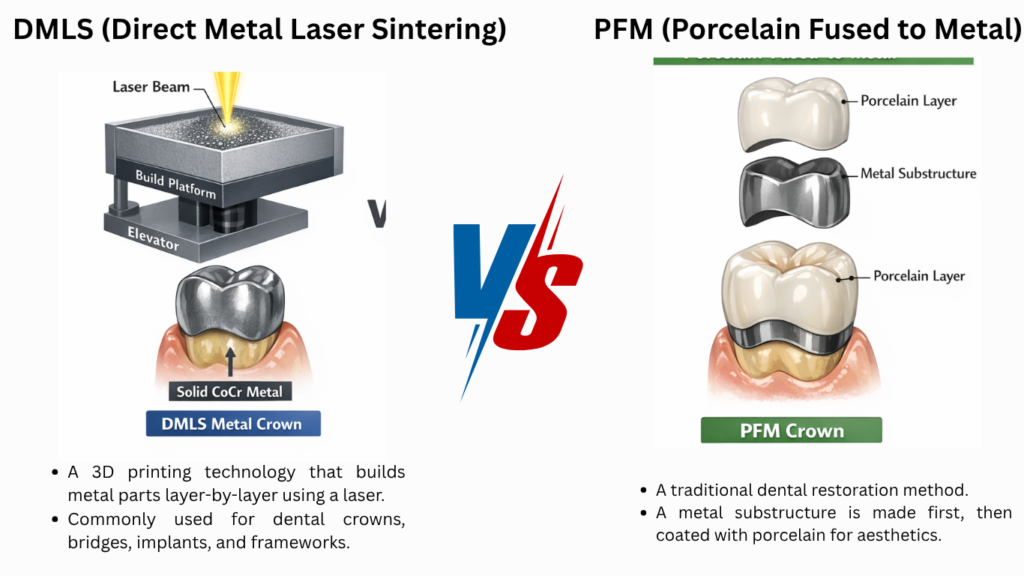
DMLS vs PFM (Porcelain-Fused-to-Metal):
- DMLS is better for precision, strength, and modern digital workflows.
- PFM is more affordable and widely used but less aesthetic and slightly bulkier.
- Overall, DMLS is preferred for advanced, high-quality restorations, while PFM suits budget cases.
In this article:
Which is better DMLS or PFM?
Comparing DMLS (Direct Metal Laser Sintering) and PFM (Porcelain Fused to Metal) isn’t about one being universally “better”—they serve different purposes, especially in dentistry and manufacturing. The right choice depends on what you need: strength, aesthetics, cost, or precision.
Definition
DMLS (Direct Metal Laser Sintering)
- A 3D printing technology that builds metal parts layer-by-layer using a laser.
- Commonly used for dental crowns, bridges, implants, and frameworks.
PFM (Porcelain Fused to Metal)
- A traditional dental restoration method.
- A metal substructure is made first, then coated with porcelain for aesthetics.
1. Strength & Durability
DMLS
- Very high strength due to uniform metal structure.
- No weak bonding layer.
- Resistant to fracture and fatigue.
PFM
- Strong metal core, but:
- Porcelain layer can chip or crack over time.
✅ Better: DMLS (more durable overall)
2. Aesthetics (Appearance)
DMLS
- Pure metal (unless layered with ceramic later).
- Not very aesthetic by itself.
PFM
- Tooth-colored porcelain gives a natural look.
- Widely used for visible teeth.
✅ Better: PFM (much more natural-looking)
3. Precision & Fit
DMLS
- CAD/CAM based → extremely accurate.
- Better marginal fit → reduces gaps and infection risk.
PFM
- Depends on manual lab work.
- Slight chances of human error.
✅ Better: DMLS (higher precision)
4. Manufacturing Process
DMLS
- Fully digital workflow.
- Faster once system is set up.
- Less manual labor.
PFM
- Multi-step process:
- Casting metal
- Applying porcelain
- Firing in furnace
- Time-consuming.
✅ Better: DMLS (faster and automated)
5. Cost
DMLS
- High initial cost (machines, technology).
- Can be expensive for patients.
PFM
- More affordable.
- Widely available.
✅ Better: PFM (cost-effective)
6. Biocompatibility
DMLS
- Uses high-quality alloys (e.g., cobalt-chromium, titanium).
- Good tissue compatibility.
PFM
- Also biocompatible, but:
- Some alloys may cause allergies in rare cases.
⚖️ Tie (both are generally safe)
7. Customization & Complexity
DMLS
- Can produce complex geometries.
- Ideal for implant frameworks and advanced cases.
PFM
- Limited by manual fabrication techniques.
✅ Better: DMLS (more design freedom)
8. Maintenance & Longevity
DMLS
- Less prone to chipping.
- Longer lifespan.
PFM
- Porcelain may wear or chip.
- May need repair/replacement.
Better: DMLS
Summary
| Criteria | Winner |
|---|---|
| Strength | DMLS |
| Aesthetics | PFM |
| Precision | DMLS |
| Cost | PFM |
| Speed | DMLS |
| Longevity | DMLS |
Conclusion
- Choose DMLS if you want:
- High strength
- Precision fit
- Long-lasting restoration
- Advanced/custom designs
- Choose PFM if you want:
- Better aesthetics (natural tooth look)
- Lower cost
- Proven traditional method
- DMLS = Strength + Technology
- PFM = Appearance + Affordability
Other courses:





