
FFF (Fused Filament Fabrication) is a 3D printing process where a thermoplastic filament is melted and deposited layer by layer.
The material is extruded through a heated nozzle to build the object from a digital model.
It is one of the most common and affordable additive manufacturing methods.
In this article:
What is FFF in Additive Manufacturing?
FFF (Fused Filament Fabrication) is one of the most common additive manufacturing (3D printing) processes where a thermoplastic filament is melted and deposited layer by layer to build a 3D object.
👉 It is also known as FDM (Fused Deposition Modeling) (FDM is the trademarked name, FFF is the general term).
Definition
👉 FFF is an additive manufacturing process in which a thermoplastic filament is heated, extruded through a nozzle, and deposited layer by layer to form a 3D part.
Working Principle of FFF
FFF works on the principle of:
👉 melting → extrusion → layer-by-layer solidification
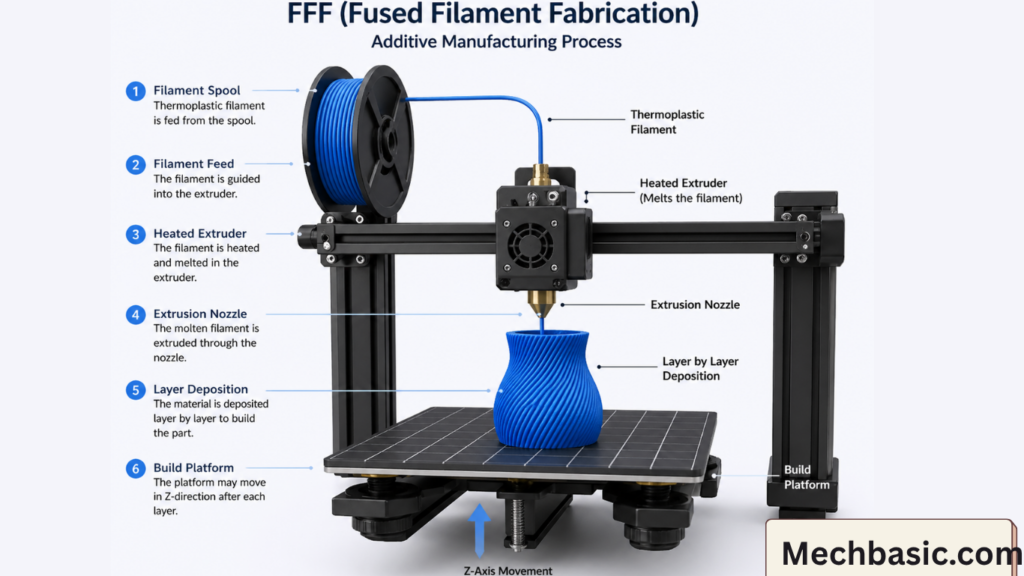
Step-by-Step Process
1. CAD Model Creation
- A 3D model is designed using CAD software
2. Slicing
- Model is divided into thin layers
- Toolpath is generated for printing
3. Filament Feeding
- Thermoplastic filament is fed into the printer
- Usually in spool form
4. Heating and Melting
- Filament is heated in an extruder nozzle
- It becomes semi-liquid
5. Extrusion and Deposition
- Melted material is pushed through the nozzle
- Deposited on the build platform layer by layer
6. Layer Bonding
- Each layer fuses with the previous layer
- Cooling solidifies the structure
7. Post Processing
- Support removal
- Surface finishing
- Polishing (if needed)
Materials Used in FFF
Thermoplastics
- PLA (Polylactic Acid)
- ABS (Acrylonitrile Butadiene Styrene)
- PETG
- Nylon
Composite Filaments
- Carbon fiber reinforced polymers
- Glass fiber reinforced plastics
Key Components of FFF Printer
- Filament spool
- Extruder (heats and pushes material)
- Nozzle
- Heated build plate
- Motion system (X, Y, Z axes)
Advantages of FFF
1. Low Cost
- Cheapest 3D printing technology
2. Easy to Use
- Simple operation and maintenance
3. Wide Material Availability
- Many thermoplastics available
4. Rapid Prototyping
- Fast design-to-product process
5. Minimal Waste
- Only required material is used
Disadvantages of FFF
1. Lower Strength (Layer Weakness)
- Layers may separate under stress
2. Surface Roughness
- Visible layer lines
3. Limited Accuracy
- Less precise than laser-based methods
4. Slow for Large Parts
- Layer-by-layer process takes time
5. Limited Material Strength
- Only thermoplastics (not high-performance metals)
Applications of FFF
Prototyping
- Design testing models
Education
- Engineering labs and learning models
Household Products
- Toys, holders, tools
Industrial Use
- Jigs and fixtures
- Custom parts
FFF vs FDM
| Feature | FFF | FDM |
|---|---|---|
| Name | General term | Trademark (Stratasys) |
| Principle | Same | Same |
| Material | Thermoplastics | Thermoplastics |
| Use | Open-source printers | Industrial printers |
Summary:
👉 FFF is the simplest and most widely used 3D printing technology, ideal for:
- Low-cost manufacturing
- Prototyping
- Educational use
Conclusion:
Fused Filament Fabrication (FFF) is an additive manufacturing process in which a thermoplastic filament is heated and extruded through a nozzle to build a part layer by layer. It is widely used for prototyping due to its low cost and simplicity.
Other courses:





