
The seven main types of additive manufacturing are vat photopolymerization, material extrusion, and material jetting.
Other types include powder bed fusion, binder jetting, and directed energy deposition.
Sheet lamination is also a category used for building parts layer by layer.
In this article:
Additive Manufacturing (AM) is a group of processes where a part is built layer by layer from a digital (CAD) model. The commonly accepted classification (ASTM F2792 standard) defines 7 main types of additive manufacturing processes.
7 Types of Additive Manufacturing
1. Vat Photopolymerization (VPP)
Principle
- Liquid photopolymer resin is hardened using UV light or laser
How it works
- A laser or projector selectively cures liquid resin layer by layer
Materials
- Photopolymer resins (plastic-like materials)
Applications
- Dental models
- Jewelry
- Prototypes
Key feature
👉 Very high surface finish and accuracy
2. Material Jetting (MJ)
Principle
- Droplets of liquid material are jet-sprayed and solidified
How it works
- Like an inkjet printer, but 3D
Materials
- Photopolymers
- Waxes
Applications
- Multi-color prototypes
- Medical models
Key feature
👉 Can print multiple materials at once
3. Binder Jetting (BJ)
Principle
- Liquid binder is sprayed onto powder layers to glue particles together
How it works
- Powder spread → binder printed → layers bonded
Materials
- Metals
- Sand
- Ceramics
Applications
- Metal parts (after sintering)
- Sand molds for casting
Key feature
👉 No heat required during printing stage
4. Powder Bed Fusion (PBF)
Principle
- Powder is selectively melted or sintered using a laser/electron beam
How it works
- Thin powder layer → laser melts selected areas → repeat
Materials
- Metals (steel, titanium, aluminium)
- Polymers (in SLS)
Applications
- Aerospace components
- Medical implants
Key feature
👉 Produces high-strength functional metal parts
5. Material Extrusion (ME)
Principle
- Material is melted and extruded through a nozzle
How it works
- Filament is heated → deposited layer by layer
Materials
- PLA, ABS plastics
- Composite filaments
Applications
- Low-cost 3D printing
- Prototyping
Key feature
👉 Most common desktop 3D printing method
6. Directed Energy Deposition (DED)
Principle
- Material is fed and melted using laser, plasma, or electron beam
How it works
- Metal powder or wire is deposited while energy source melts it
Materials
- Metals only (steel, titanium, nickel alloys)
Applications
- Repairing turbine blades
- Aerospace parts
- Large metal structures
Key feature
👉 Used for repair and large-scale metal deposition
7. Sheet Lamination (SL)
Principle
- Sheets of material are bonded and cut layer by layer
How it works
- Sheets are stacked → glued or welded → cut to shape
Materials
- Paper
- Plastic sheets
- Metal foils
Applications
- Low-cost prototypes
- Large models
Key feature
👉 Fast and low-cost but lower accuracy
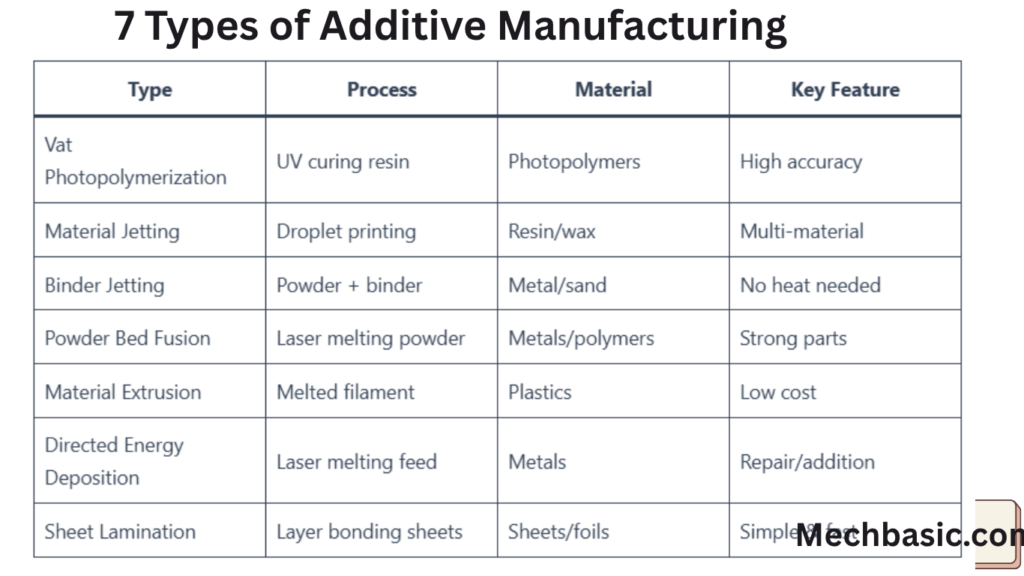
Summary Table
| Type | Process | Material | Key Feature |
|---|---|---|---|
| Vat Photopolymerization | UV curing resin | Photopolymers | High accuracy |
| Material Jetting | Droplet printing | Resin/wax | Multi-material |
| Binder Jetting | Powder + binder | Metal/sand | No heat needed |
| Powder Bed Fusion | Laser melting powder | Metals/polymers | Strong parts |
| Material Extrusion | Melted filament | Plastics | Low cost |
| Directed Energy Deposition | Laser melting feed | Metals | Repair/addition |
| Sheet Lamination | Layer bonding sheets | Sheets/foils | Simple & fast |
Summary:
👉 The 7 types of additive manufacturing differ mainly in:
- Material form (powder, liquid, wire, sheet)
- Energy source (laser, heat, binder, UV light)
- Application (prototype vs functional parts)
Conclusion:
The seven types of additive manufacturing are vat photopolymerization, material jetting, binder jetting, powder bed fusion, material extrusion, directed energy deposition, and sheet lamination, each differing in material form and processing method.
Other courses:





