
The sintering temperature is usually below the melting point of the metal being used.
For most metals, it is typically about 70% to 90% of their melting temperature.
The exact temperature depends on the material and desired properties of the final product.
In this article:
Temperature in Sintering (Powder Metallurgy)
In sintering, temperature is the most critical factor because it controls how strongly metal powder particles bond together, how much densification occurs, and the final properties of the component.
What is Sintering Temperature?
👉 Sintering temperature is the temperature at which a compacted powder is heated (below its melting point) to enable diffusion bonding between particles.
Typical Sintering Temperature Range
Sintering is always done below melting point of the material.
General rule:
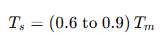
T_s = (0.6 \text{ to } 0.9) T_m
Where:
- Ts = Sintering temperature (the temperature you heat the compacted powder to)
- Tm = Melting point of the metal (in absolute temperature, usually Kelvin)
Why Below Melting Point?
- Prevents full melting
- Ensures solid-state diffusion bonding
- Maintains shape of the compact
- Avoids collapse of structure
What Happens at Sintering Temperature?
1. Atomic Activation
- Atoms gain energy and start moving
- Diffusion begins across particle boundaries
2. Neck Formation
- Particles form bonding bridges (necks)
- Strength starts increasing
3. Densification
- Voids reduce
- Material becomes more compact
4. Strength Increase
- Mechanical strength increases significantly
Effect of Temperature Levels
1. Too Low Temperature
- ❌ Poor diffusion
- ❌ Weak bonding
- ❌ High porosity
- 👉 Result: weak product
2. Optimum Temperature (Ideal)
- ✅ Good diffusion
- ✅ Strong bonding
- ✅ High density
- 👉 Best mechanical properties
3. Too High Temperature
- ❌ Excess grain growth
- ❌ Distortion of shape
- ❌ Possible partial melting
- 👉 Poor dimensional accuracy
Typical Sintering Temperatures (Examples)
| Material | Sintering Temperature |
|---|---|
| Iron | ~1100–1200°C |
| Copper | ~800–900°C |
| Aluminium | ~500–600°C |
| Tungsten | ~2000°C (very high) |
Role of Temperature-Controlled Atmosphere
Sintering is done in controlled environments:
- Hydrogen
- Nitrogen
- Argon
- Vacuum
👉 Prevents:
- Oxidation
- Contamination
Summary
👉 Temperature in sintering controls:
- Diffusion rate
- Bond strength
- Density
- Final mechanical properties
✔ Higher temperature → stronger bonding (up to limit)
❌ Too high → distortion and defects
❌ Too low → weak product
Conclusion:
The temperature in sintering is the controlled heating temperature below the melting point of the metal (usually 0.6–0.9 Tm) at which diffusion bonding occurs between powder particles, increasing strength and density of the compact.
Other courses:





