
Common defects in powder metallurgy include porosity due to incomplete compaction or sintering.
Cracks and distortion can occur during pressing or heating stages.
Non-uniform density and contamination may also reduce strength and quality.
In this article:
In powder metallurgy (PM), defects arise mainly during powder preparation, compaction, and sintering. These defects can affect strength, density, surface finish, and dimensional accuracy of the final product.
Common Defects in Powder Metallurgy
1. Porosity (Most Common Defect)
What it is
- Presence of voids or pores inside the material
Causes
- Incomplete compaction
- Insufficient sintering
Effects
- Reduced strength
- Lower fatigue resistance
- Leakage in pressure components
Key Insight
👉 Porosity is the most critical defect in PM
2. Density Variation
What it is
- Uneven density throughout the component
Causes
- Non-uniform pressure during compaction
- Complex shapes
Effects
- Weak zones
- Uneven mechanical properties
3. Cracks (Green or Sintering Cracks)
Types
Green Cracks
- Occur in the compact before sintering
Sintering Cracks
- Occur during heating
Causes
- Excessive pressure
- Rapid heating or cooling
- Improper handling
Effects
- Component failure
4. Lamination
What it is
- Formation of layers or cracks parallel to pressing direction
Causes
- Air trapped between powder layers
- Poor die filling
Effects
- Weak bonding between layers
- Reduced strength
5. Inclusions and Contamination
What it is
- Presence of foreign particles
Causes
- Impure powders
- Dirty equipment
Effects
- Weak spots
- Reduced mechanical properties
6. Incomplete Sintering
What it is
- Particles not fully bonded
Causes
- Low sintering temperature
- Insufficient time
Effects
- Poor strength
- High porosity
7. Dimensional Inaccuracy
What it is
- Deviation from required size/shape
Causes
- Uneven shrinkage during sintering
- Tool wear
Effects
- Assembly problems
8. Surface Defects
Types
- Rough surface
- Pits or cracks
Causes
- Poor powder quality
- Improper lubrication
Effects
- Poor finish
- Reduced wear resistance
9. Ejection Cracks
What it is
- Cracks formed during removal from die
Causes
- High friction
- Insufficient lubrication
Effects
- Structural weakness
10. Oxidation
What it is
- Formation of oxide layers on particles
Causes
- Exposure to air during processing
Effects
- Poor bonding
- Reduced strength
Summary Table
| Defect | Main Cause | Effect |
|---|---|---|
| Porosity | Incomplete compaction | Weakness |
| Density variation | Uneven pressure | Weak zones |
| Cracks | Stress/thermal issues | Failure |
| Lamination | Air entrapment | Layer separation |
| Inclusions | Contamination | Weak spots |
| Incomplete sintering | Low temperature/time | Poor bonding |
| Dimensional error | Shrinkage/tool wear | Misfit |
| Surface defects | Poor powder/lubrication | Rough finish |
| Ejection cracks | High friction | Damage |
| Oxidation | Air exposure | Weak bonding |
Summary:
👉 Most PM defects are related to:
- Porosity
- Improper compaction
- Poor sintering control
Conclusion:
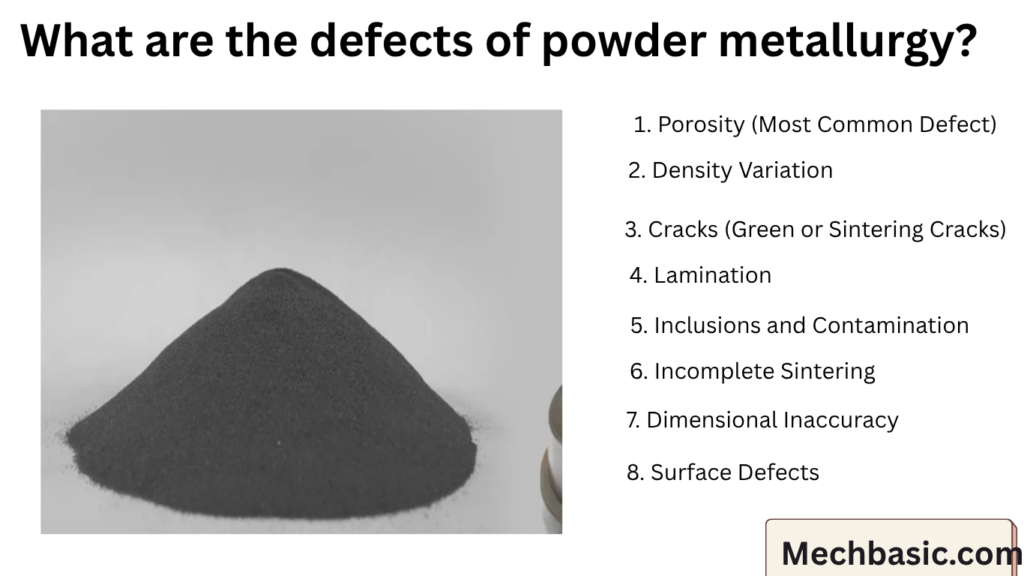
Common defects in powder metallurgy include porosity, density variation, cracks, lamination, inclusions, incomplete sintering, dimensional inaccuracies, and surface defects.
Other courses:





