
Welded joints are generally stronger than riveted joints when done properly.
They create a continuous bond without holes, giving higher strength.
Rivets are preferred where flexibility, fatigue resistance, and easy inspection are needed.
In this article:
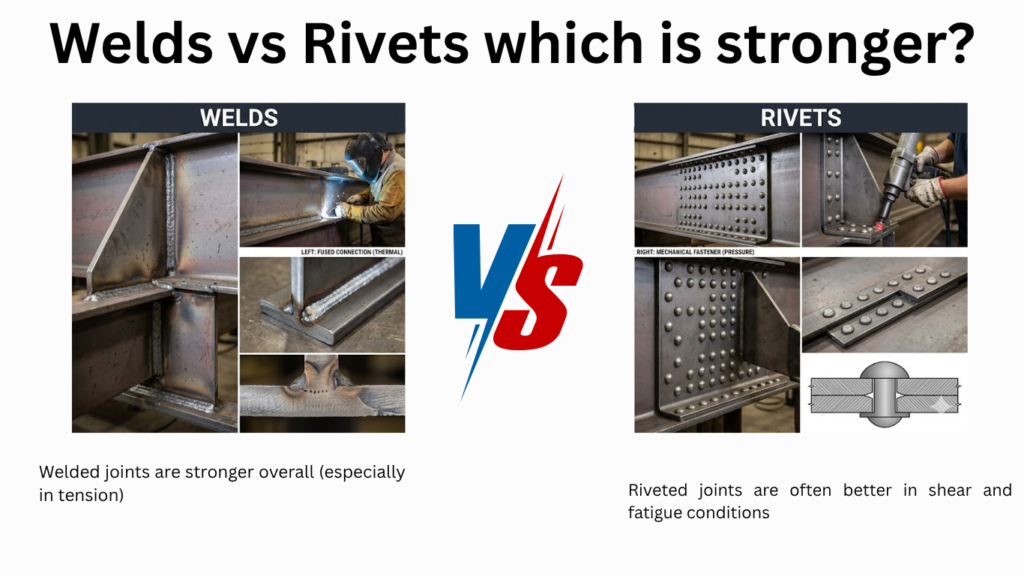
👉 Welded joints are stronger overall (especially in tension)
👉 Riveted joints are often better in shear and fatigue conditions
Let’s break it down clearly.
Welding vs Riveting — Strength Comparison
1. Tensile Strength (Pulling Force)
Welding — Stronger
- Forms a continuous joint (like one piece of metal)
- No holes → no reduction in cross-section
- Can reach strength equal to or greater than base metal
👉 Used where maximum strength is required
🔩 Riveting — Weaker in Tension
- Holes reduce material strength
- Rivets can fail by pull-out or head failure
✅ Winner in tension: Welding
2. Shear Strength (Sideways Force)
Rivets — Very Strong
- Specifically designed for shear loads
- Solid body resists sideways forces effectively
Welding — Strong but Variable
- Depends on weld quality
- Poor welds can fail in shear
✅ Winner in shear: Slight edge to rivets (more reliable)
3. Fatigue Strength (Repeated Loading)
Rivets — Better
- Multiple rivets distribute load
- Cracks grow slowly and are localized
Welding — Weaker in Fatigue
- Stress concentrates at weld joints
- Cracks can spread quickly
✅ Winner in fatigue: Rivets
4. Reliability and Failure Behavior
Rivets
- Fail gradually
- One rivet failure doesn’t cause total collapse
Welding
- Failure can be sudden and catastrophic
- Crack can propagate across the joint
5. Effect of Heat
Welding
- Heat can:
- Weaken material
- Create residual stresses
Riveting
- No heat → material properties unchanged
6. Weight and Efficiency
Welding
- No extra fasteners → lighter in many cases
Riveting
- Adds weight due to rivets and overlapping plates
Overall Comparison
| Property | Welding 🔥 | Riveting 🔩 |
|---|---|---|
| Tensile Strength | ⭐⭐⭐⭐⭐ (Highest) | ⭐⭐⭐ |
| Shear Strength | ⭐⭐⭐⭐ | ⭐⭐⭐⭐⭐ |
| Fatigue Resistance | ⭐⭐ | ⭐⭐⭐⭐⭐ |
| Reliability | Medium (depends on weld) | Very high |
| Weight | Lighter | Heavier |
| Failure Type | Sudden | Gradual |
👉 Welding is stronger in terms of maximum strength (tension and rigidity)
👉 Riveting is stronger in real-world durability (fatigue, vibration, safety)
Real-World Examples
- Bridges & heavy structures → Welding (high strength needed)
- Aircraft → Riveting (fatigue + safety critical)
Summary:
- 🔥 Welding = Maximum strength (one solid piece)
- 🔩 Riveting = Maximum reliability (many fasteners sharing load)
Conclusion
Welded joints are stronger in tension, while riveted joints perform better in shear and fatigue. The choice depends on application requirements.
Other courses:





