What is the difference between brazing and soldering?

What is the difference between brazing and soldering?

The main difference between brazing and soldering is temperature and joint strength:

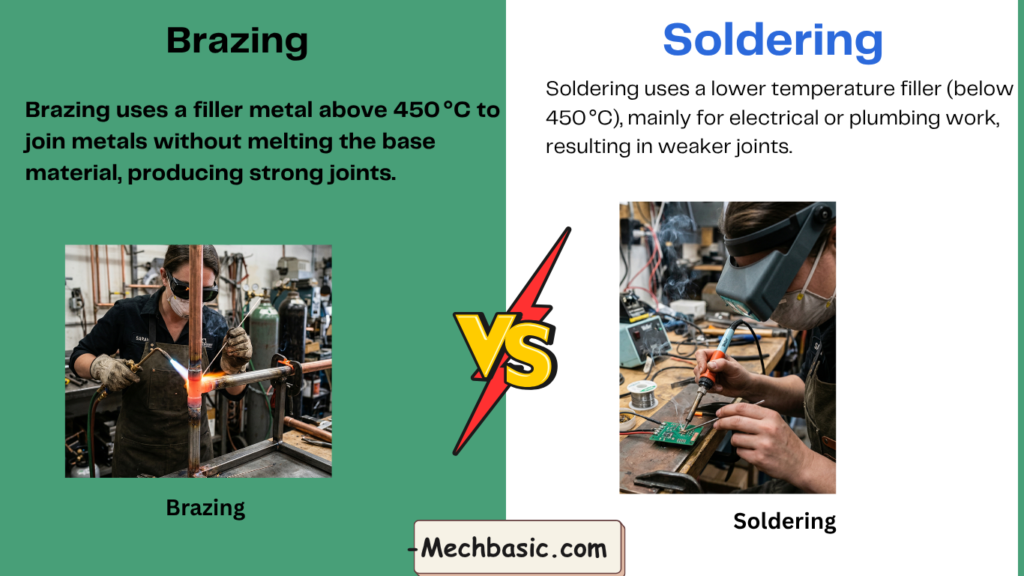
  • Brazing uses a filler metal above 450 °C to join metals without melting the base material, producing strong joints.
  • Soldering uses a lower temperature filler (below 450 °C), mainly for electrical or plumbing work, resulting in weaker joints.
    Brazing is suitable for structural applications, while soldering is ideal for delicate or low-stress connections.


10 Differences Between Brazing Vs Soldering:

Here’s a detailed explanation of the differences between brazing and soldering, covering principles, temperature, materials, bonding mechanism, applications, and advantages:


1. Definition

ProcessDefinition
BrazingA metal joining process where a filler metal melts and flows into the joint by capillary action without melting the base metals. Occurs at high temperatures (>450°C / 840°F).
SolderingA low-temperature joining process where a filler metal (solder) melts and joins metals without melting the base metals. Occurs at low temperatures (<450°C / 840°F).

Key difference: Temperature of operation. Brazing is high temperature; soldering is low temperature.


2. Temperature Range

ProcessTypical Temperature
Brazing450–1200°C (840–2190°F)
Soldering180–450°C (356–840°F)
  • Soldering is suitable for delicate or heat-sensitive components.
  • Brazing requires higher temperature metals and flux control.

3. Filler Materials

ProcessCommon FillersMelting Point
BrazingCopper, silver alloys, aluminum alloys, nickel alloysAbove 450°C
SolderingLead-tin alloys, tin-silver, tin-copper, rosin-core solderBelow 450°C
  • Brazing alloys are stronger and harder, suitable for load-bearing joints.
  • Soldering alloys are soft and malleable, suitable for electrical connections and plumbing.

4. Bonding Mechanism

ProcessMechanism
BrazingFiller melts and flows into the joint via capillary action, creating a strong metallurgical bond without melting base metals.
SolderingFiller melts and wets the base metals, forming a bond mainly by adhesion, not strong enough for high-stress applications.
  • Brazed joints can handle mechanical stress, soldered joints are mainly electrical or fluid-tight connections.

5. Strength of Joint

ProcessJoint Strength
BrazingModerate to high; can approach the strength of base metals depending on filler
SolderingLow; mainly for electrical conductivity or sealing, not structural loads
  • Example: Copper pipes in plumbing are often brazed for strength; electrical wires are soldered for conductivity.

6. Surface Preparation

ProcessRequirement
BrazingClean, oxide-free surfaces; flux usually required
SolderingMinimal cleaning; rosin-core solder often sufficient
  • Brazing requires more careful cleaning for strong metallurgical bonds.

7. Applications

ProcessCommon Uses
BrazingHVAC tubing, automotive components, aerospace parts, jewelry, thin sheet metal assemblies
SolderingElectronics, circuit boards, electrical wiring, plumbing for low-pressure applications, jewelry (soft solder)
  • Brazing is chosen for mechanical strength, soldering for electrical or sealing purposes.

8. Heat Distortion

ProcessDistortion
BrazingMinimal, but higher than soldering due to elevated temperature
SolderingVery low; safe for heat-sensitive components

9. Equipment Required

ProcessTypical Equipment
BrazingTorch, furnace, induction heater, flux, filler rods
SolderingSoldering iron, solder wire, flux (often rosin-based)

10. Advantages and Disadvantages

FeatureBrazingSoldering
TemperatureHigh (>450°C)Low (<450°C)
Joint StrengthModerate to highLow
Base Metal DistortionMinimalVery low
Dissimilar MetalsEasily joinedCan join, but thermal expansion may affect quality
ApplicationsLoad-bearing, structuralElectrical, plumbing, delicate components
Filler Metal CostHigherLower
Flux RequirementYesOften built-in (rosin-core)

Conclusion:

  1. Brazing uses higher temperatures than soldering, creating stronger, load-bearing joints.
  2. Soldering is low-temperature, suitable for electrical, plumbing, or delicate assemblies.
  3. Brazing joins metals metallurgically via capillary action; soldering relies mainly on adhesion.
  4. Choice depends on temperature sensitivity, mechanical strength, and application requirements.

Other courses:

Leave a Comment

Your email address will not be published. Required fields are marked *

Follow by Email
Pinterest
fb-share-icon
WhatsApp
Scroll to Top