Brazing vs Welding-10 Differences you need to know

Brazing vs Welding-10 Differences you need to know

Brazing and welding are both metal-joining processes but differ significantly:

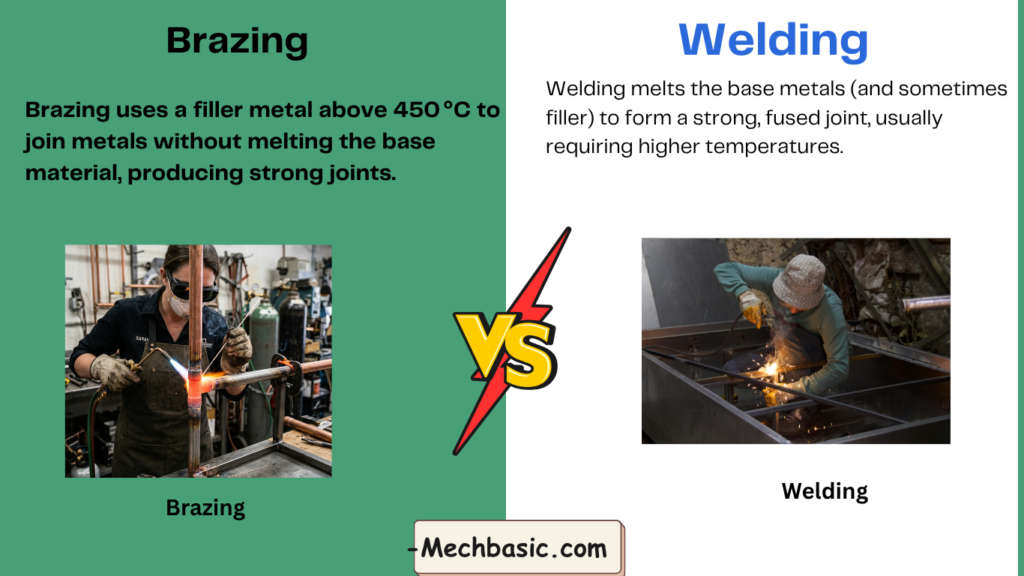
  • Brazing joins metals using a melted filler without melting the base metals; it produces less heat and minimal distortion.
  • Welding melts the base metals (and sometimes filler) to form a strong, fused joint, usually requiring higher temperatures.
    Brazing is better for delicate or thin materials, while welding is stronger and suited for structural applications.

Brazing vs Welding-10 Differences you need to know

Here’s a comprehensive comparison of brazing vs welding, covering principles, processes, materials, advantages, disadvantages, and applications:


1. Definition

ProcessDescription
BrazingA joining process where two or more metals are joined by a molten filler metal, which has a lower melting point than the base metals. Base metals do not melt.
WeldingA joining process where base metals are melted, often with a filler metal, to create a continuous metallurgical bond.

Key difference: Brazing does not melt the base metals, welding does.


2. Temperature Range

ProcessTemperature
Brazing450–1200°C (840–2190°F), depending on filler alloy
WeldingOften >1200°C (melting temperature of base metals, varies with type)

3. Materials Used

ProcessCommon MaterialsFiller Materials
BrazingSteel, stainless steel, copper, aluminum, brassCopper alloys, silver alloys, aluminum alloys
WeldingSteel, stainless steel, aluminum, titanium, nickel alloysFiller wire/rod similar to base metal
  • Brazing can join dissimilar metals easily.
  • Welding usually prefers similar metals for full-strength joints.

4. Mechanism of Bonding

ProcessBonding Mechanism
BrazingFiller metal melts and flows via capillary action into the joint, solidifies to form a bond. Base metals remain solid.
WeldingBase metals melt and fuse, sometimes with filler. Solidification creates a continuous metallurgical joint.

5. Joint Strength

ProcessStrength
BrazingModerate to high, usually stronger than soldering, but often weaker than welding for high-stress applications.
WeldingVery high, often equal to or stronger than the base metal. Ideal for structural applications.

6. Heat and Distortion

ProcessHeat InputDistortion
BrazingLocalized, lower heatMinimal; ideal for delicate parts
WeldingHigh heatSignificant risk of warping, especially in thin sheets

7. Surface Preparation

ProcessRequirements
BrazingSurfaces must be clean, oxide-free; flux often required
WeldingSurfaces should be clean but welding can often handle minor surface contamination

8. Thickness Limitations

ProcessTypical Range
BrazingThin sheets or small joints; effective for gaps 0.03–0.5 mm
WeldingCan join thin or thick materials; no strict limitation on thickness

9. Appearance of Joint

ProcessAppearance
BrazingSmooth, neat, minimal discoloration; filler visible in joint
WeldingContinuous bead; may require grinding/cleaning; some spatter possible

10. Equipment

ProcessTypical Equipment
BrazingTorch, furnace, induction heater, flux, filler rods
WeldingArc/MIG/TIG welding machine, electrodes or filler wire, shielding gas for some processes

11. Applications

ProcessCommon Uses
BrazingHVAC tubing, radiators, jewelry, electronics, thin sheet metal assemblies, dissimilar metals
WeldingStructural steel, pipelines, automotive chassis, heavy machinery, aerospace components

12. Advantages vs Disadvantages

FeatureBrazingWelding
Base Metal IntegrityNot melted; minimal distortionMelted; can warp/thin metals
Joint StrengthModerateHigh, sometimes stronger than base metal
Dissimilar MetalsEasily joinedDifficult, often requires special techniques
Surface FinishNeat, smoothMay need cleaning/grinding
Equipment CostLower for small operationsHigher (machines, shielding gases, electrodes)
Production SpeedModerateHigh for automated processes
Heat-Affected ZoneSmallLarger; may affect mechanical properties

13. Summary Table: Brazing vs Welding

AspectBrazingWelding
Base MetalNot meltedMelted
Filler MetalRequiredOptional
Temperature450–1200°C>1200°C (depends on metal)
Heat DistortionMinimalSignificant
Joint StrengthModerateVery high
Dissimilar MetalsEasyDifficult
Surface PreparationClean, flux requiredClean, minor prep sufficient
EquipmentTorch, furnace, inductionArc, MIG, TIG, etc.
ApplicationsHVAC, electronics, jewelryStructural, automotive, pipelines

Conclusion:

  1. Brazing is best for delicate parts, thin sheets, or joining dissimilar metals, with minimal heat distortion.
  2. Welding is best for high-strength, structural joints where base metal fusion is required.
  3. Choice depends on material, thickness, strength requirement, and production volume.
  4. Brazing and welding are complementary: brazing for precision and aesthetics, welding for strength and durability.

Other courses:

Leave a Comment

Your email address will not be published. Required fields are marked *

Follow by Email
Pinterest
fb-share-icon
WhatsApp
Scroll to Top