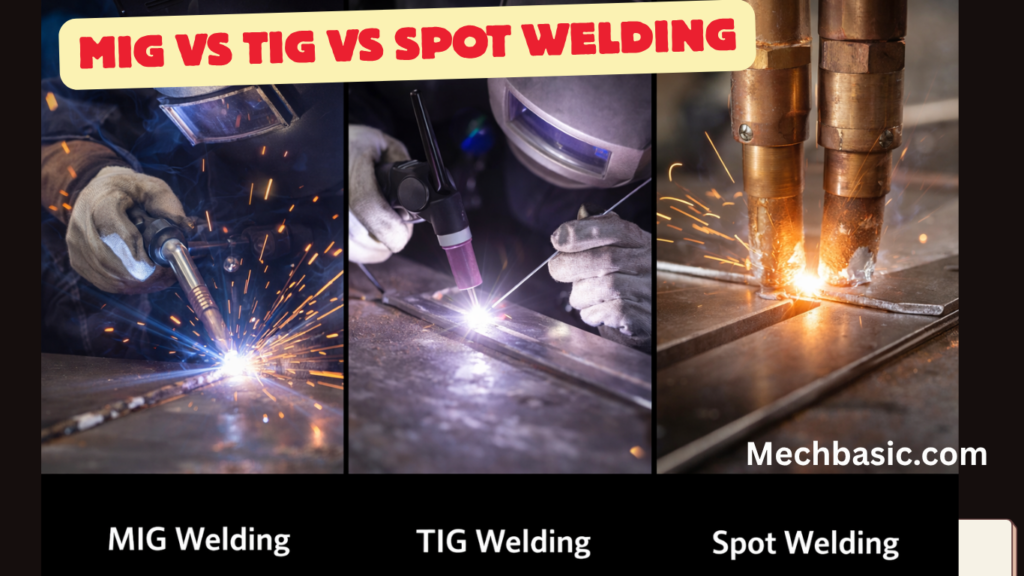
Here’s a concise comparison of MIG, TIG, and spot welding:
MIG welding uses a continuous wire electrode and shielding gas for fast, easy welds; ideal for thicker metals and production work.
TIG welding uses a non-consumable tungsten electrode and argon gas for precise, clean welds; best for thin metals and critical joints.
Spot welding fuses metal sheets at small points using electric current; mainly used in automotive and sheet metal fabrication for quick, strong joints.
MIG vs TIG vs Spot Welding-Differences you need to know
Here’s a comprehensive, detailed comparison of MIG, TIG, and Spot welding, covering principles, equipment, advantages, disadvantages, and applications. This will give you a clear understanding of the strengths and weaknesses of each method.
1. Overview of Each Welding Process
Welding Type
Full Name
Principle
Electrode
Shielding
Typical Use
MIG
Metal Inert Gas Welding / GMAW
Continuous arc melts a consumable wire electrode to join metals
Consumable wire
Inert gas (argon or argon/CO₂ mix)
General fabrication, automotive, structural steel
TIG
Tungsten Inert Gas Welding / GTAW
Arc melts base metal; filler rod added manually
Non-consumable tungsten
Inert gas (argon, helium)
Precision welding, thin metals, exotic alloys
Spot
Resistance Spot Welding
Electrical resistance generates heat at localized contact points
None (current flows through base metal)
None (uses electrode pressure)
Automotive panels, thin metal sheets, appliances
2. Working Principles
MIG Welding
Continuous wire electrode fed through a gun.
Electric arc melts the wire and base metal.
Inert gas protects the weld from oxidation.
Suitable for medium thickness metals and continuous beads.
TIG Welding
Non-consumable tungsten electrode creates an arc.
Filler rod added manually for material deposition.
Shielding gas prevents contamination.
Very precise and clean; suitable for thin metals and high-quality welds.
Spot Welding
High current passes through electrodes pressing two metal sheets together.
Heat generated by electrical resistance melts small “spots” to join the sheets.
No filler metal or shielding gas needed.
Typically used for thin sheet metals (0.5–3 mm).
3. Equipment Required
Feature
MIG
TIG
Spot
Power Source
DC (DCEN), constant voltage
DC or AC
High-current, low-voltage transformer
Electrode
Consumable wire
Non-consumable tungsten
None (current flows through sheets)
Shielding
Gas (argon, argon/CO₂)
Gas (argon, helium)
None; pressure applied by electrodes
Torch
Wire-fed gun
Manual torch
Electrodes (copper alloy)
Filler Material
Built into wire
Optional rod fed by hand
Not used
Automation
Semi/fully automatic possible
Manual, precision-based
Often robotic/automatic in production lines
4. Advantages
Feature
MIG
TIG
Spot
Ease of Use
Beginner-friendly
High skill required
Medium (automated or semi-automatic)
Speed
Fast
Slow
Very fast (seconds per spot)
Weld Quality
Good, moderate finish
Excellent, very precise, minimal spatter
Strong localized welds, clean
Metal Types
Steel, aluminum, stainless
Steel, aluminum, titanium, copper
Thin steel and aluminum sheets
Thickness Range
Thin to medium
Thin to medium
Very thin sheets (0.5–3 mm)
Automation
Possible
Hard to automate
Easily automated (robots in auto industry)
5. Disadvantages
Feature
MIG
TIG
Spot
Cost
Moderate equipment cost
Expensive equipment, argon gas
Equipment specialized, electrode wear
Skill Required
Moderate
High
Moderate
Speed
Fast but less precise
Slow
Very fast but limited to small welds
Environmental Limitations
Shielding gas affected by wind
Shielding gas affected by wind, very slow
Limited to sheet thickness, no continuous welds
Material Limitations
Very thin metals risk burn-through
Very thick metals require multiple passes
Only thin sheets; not suitable for thick plates
6. Applications
Welding Type
Typical Applications
MIG
Automotive body frames, structural steel, furniture, pipelines, general fabrication