
Spot welding is a resistance welding process used to join two or more metal sheets at small, localized points.
It works by passing an electric current through the metal, generating heat at the contact point to fuse the materials.
Spot welding is commonly used in automotive manufacturing and sheet metal fabrication for fast, strong joints.
In this article:
Spot welding :
Here’s a detailed explanation of spot welding, including its principle, equipment, advantages, disadvantages, and applications:
1. Definition
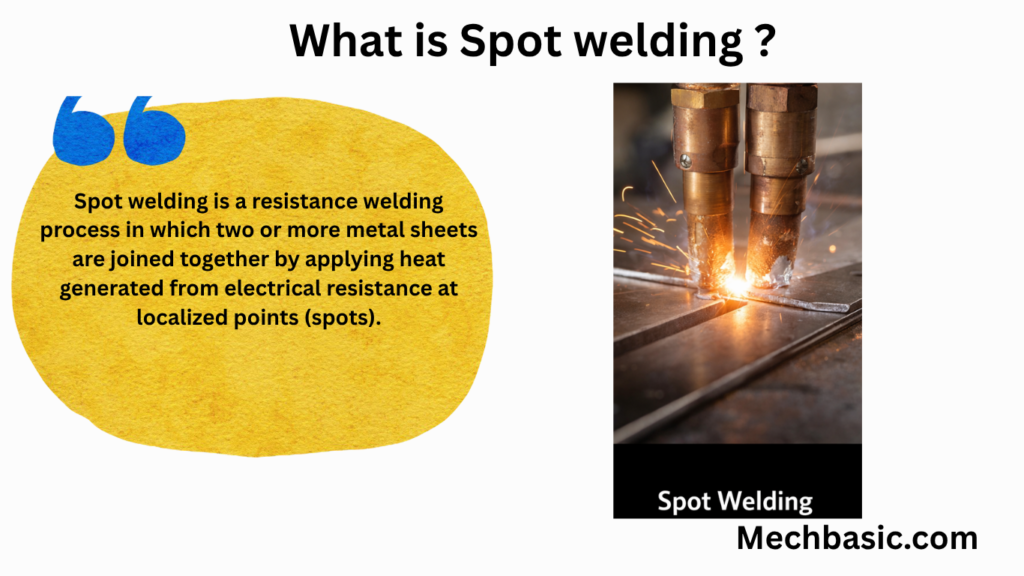
Spot welding is a resistance welding process in which two or more metal sheets are joined together by applying heat generated from electrical resistance at localized points (spots).
- Typically used for thin sheets of metal.
- No filler material is required; the weld is made by melting and fusing the metal at the contact points.
2. Working Principle
Spot welding relies on resistance heating:
- Metal Sheets Placement
- Two metal sheets are placed between electrodes.
- Current Application
- A high-amperage electric current passes through the electrodes and the contact point.
- Resistance at the interface produces intense heat, melting the metal locally.
- Pressure Application
- Electrodes also apply mechanical pressure to hold the sheets together.
- This pressure ensures proper fusion and formation of the weld nugget.
- Cooling
- Current is turned off but pressure remains for a short time to solidify the molten spot, creating a strong joint.
The result is a small, circular weld called a weld nugget, which holds the sheets together.
3. Equipment Used
- Spot Welding Machine
- Can be manual, semi-automatic, or robotic.
- Electrodes
- Typically made of copper alloys due to high conductivity and heat resistance.
- Power Source
- High-current, low-voltage transformer.
- Pressure Mechanism
- Hydraulic or pneumatic systems apply consistent pressure.
- Cooling System
- Electrodes are water-cooled to prevent overheating.
4. Parameters Affecting Spot Welding
| Parameter | Effect on Weld |
|---|---|
| Current (amperage) | Higher current → faster heating, larger weld nugget; too high → burns through metal |
| Electrode Force | Too little → weak weld; too much → metal expulsion |
| Welding Time | Short → insufficient fusion; long → metal expulsion and distortion |
| Sheet Thickness | Thicker sheets require higher current and longer welding time |
| Electrode Size | Larger electrodes → larger weld area, smaller current density |
5. Advantages of Spot Welding
- Fast Process – welds multiple points in seconds.
- No Filler Material Needed – metal is fused directly.
- Clean & Minimal Finish – no slag, no spatter.
- Automatable – widely used in robotic production lines.
- Energy Efficient – heat localized to small spots.
- Good for Thin Sheets – ideal for 0.5–3 mm sheet metals.
6. Disadvantages of Spot Welding
- Limited to Thin Sheets – ineffective for thick materials (>3–4 mm).
- Limited Weld Size – only small localized weld nuggets; not suitable for continuous joints.
- Electrode Wear – copper electrodes degrade over time.
- Surface Preparation Required – coatings, rust, or paint can reduce weld quality.
- Not for Structural Heavy Loads – weld strength is localized, not continuous.
- Requires Proper Pressure and Current Control – mistakes can lead to weak welds or burn-through.
7. Applications of Spot Welding
- Automobile Industry – car body panels, chassis sheets.
- Appliances – metal cabinets for refrigerators, washing machines.
- Electronics – battery tab connections, sheet metal housings.
- Aerospace and Manufacturing – thin aluminum and steel sheet assemblies.
- Metal Furniture – frames, panels, and enclosures.
8. Spot Welding vs. Other Welding Methods
| Feature | Spot Welding | MIG Welding | TIG Welding |
|---|---|---|---|
| Sheet Thickness | Thin sheets (0.5–3 mm) | Thin to medium | Thin to medium |
| Filler Material | Not required | Required | Optional |
| Weld Type | Localized nugget | Continuous bead | Continuous bead |
| Speed | Very fast | Fast | Slow |
| Automation | Easy | Moderate | Hard |
| Applications | Automotive panels | General fabrication | Precision/aesthetic welding |
Summary
- Spot welding is a resistance-based welding method ideal for thin sheet metals, producing strong weld nuggets at localized points.
- Strengths: fast, clean, automatable, no filler needed.
- Limitations: limited thickness, small weld size, requires precise control.
- Main Use: automotive, appliances, electronics, and sheet metal fabrication.
Other courses:





