
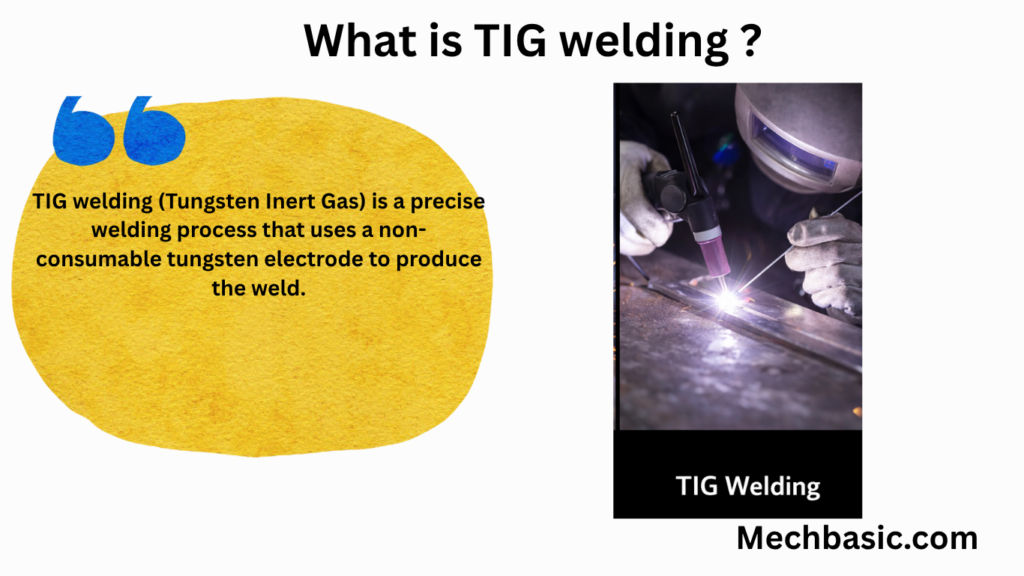
TIG welding (Tungsten Inert Gas) is a precise welding process that uses a non-consumable tungsten electrode to produce the weld.
An inert gas, usually argon, shields the weld area from contamination, allowing clean and strong joints.
TIG welding is ideal for thin metals, critical welds, and materials like stainless steel and aluminum.
In this article:
Tig welding :
Here’s a comprehensive explanation of TIG welding (Tungsten Inert Gas Welding), also known as GTAW (Gas Tungsten Arc Welding), covering principles, equipment, advantages, disadvantages, and applications.
1. Definition
TIG welding (GTAW) is a welding process that uses a non-consumable tungsten electrode to produce an electric arc, which melts the base metal. A shielding gas (usually argon or helium) protects the weld pool from atmospheric contamination.
- Unlike MIG welding, the filler metal (if needed) is added manually by the welder.
- TIG welding is known for high-quality, precise, and clean welds.
2. How TIG Welding Works
- Arc Formation
- A power source provides DC or AC current.
- DC is used for steel, stainless steel, copper.
- AC is used for aluminum and magnesium (helps remove the oxide layer).
- An arc is struck between the tungsten electrode and the base metal.
- A power source provides DC or AC current.
- Heat Generation
- The arc produces intense heat (up to 6,000–20,000°C) to melt the metal locally.
- Shielding
- Inert gas (argon or helium) flows from the torch to protect the molten weld pool from oxygen and nitrogen.
- Filler Metal (Optional)
- For many welds, the welder adds a separate filler rod to the molten pool.
- The process is hand-fed, allowing precise control over bead size and penetration.
- Solidification
- The molten weld pool cools and solidifies, forming a clean, strong joint.
3. Equipment Required
- TIG Welding Machine / Power Source – AC or DC output depending on metal.
- Tungsten Electrode – non-consumable, shapes vary (pointed, balled).
- Torch – directs the electrode and shielding gas to the weld.
- Shielding Gas Cylinder – typically argon, sometimes helium or mixes.
- Filler Rod – optional, manually fed.
- Ground Clamp – completes the electric circuit.
- PPE – welding helmet with appropriate lens, gloves, flame-resistant clothing.
4. Current and Polarity in TIG Welding
| Metal | Current Type | Polarity | Purpose |
|---|---|---|---|
| Steel / Stainless | DC | Electrode Negative (DCEN) | Deep penetration, stable arc |
| Aluminum / Magnesium | AC | Alternating | Cleans oxide layer, prevents burn-through |
| Thin metals | Low DC | DCEN | Precision welding without overheating |
5. Advantages of TIG Welding
- High Precision & Control – weld pool can be manipulated for very detailed work.
- Clean, High-Quality Welds – minimal spatter, slag-free.
- Thin Metals – excellent for metals as thin as 0.5 mm.
- Exotic Metals – works with aluminum, magnesium, copper, titanium, and nickel alloys.
- Aesthetically Superior Welds – smooth beads, visually appealing.
- No Flux Required – gas shielding prevents contamination.
6. Disadvantages of TIG Welding
- Slow Process – low deposition rate; not ideal for large, high-volume jobs.
- Skill-Intensive – requires coordination for torch, filler rod, and foot pedal (current control).
- Expensive Equipment – power source and gas cylinder cost more than MIG or stick welding.
- Limited for Very Thick Metals – requires multiple passes or preheating.
- Outdoor Limitations – shielding gas can be disturbed by wind.
7. Applications of TIG Welding
- Aerospace – precision aluminum or titanium parts.
- Automotive – custom exhaust systems, frames, roll cages.
- Shipbuilding – aluminum and stainless steel components.
- Food & Beverage Equipment – stainless steel tanks and piping.
- Art and Sculpture – high-quality visible welds.
- Pipelines – high-precision stainless steel or nickel alloys.
8. TIG vs MIG Summary
| Feature | TIG Welding | MIG Welding |
|---|---|---|
| Electrode | Non-consumable tungsten | Consumable wire |
| Shielding | Argon / helium | Argon / CO₂ or mix |
| Weld Quality | Very high, precise, clean | Good, less precise |
| Speed | Slow | Fast |
| Skill Required | High | Moderate |
| Metal Thickness | Very thin to medium | Thin to medium/thick |
| Aesthetics | Excellent | Good |
| Applications | Aerospace, thin metals, exotic alloys | General fabrication, automotive, structural steel |
Summary
- TIG welding is a high-precision, clean, and versatile welding process, ideal for thin metals and exotic alloys.
- Best for: aluminum, magnesium, stainless steel, titanium, and visible high-quality welds.
- Limitations: slower and more skill-intensive than MIG, not ideal for high-volume production.
Other courses:





