
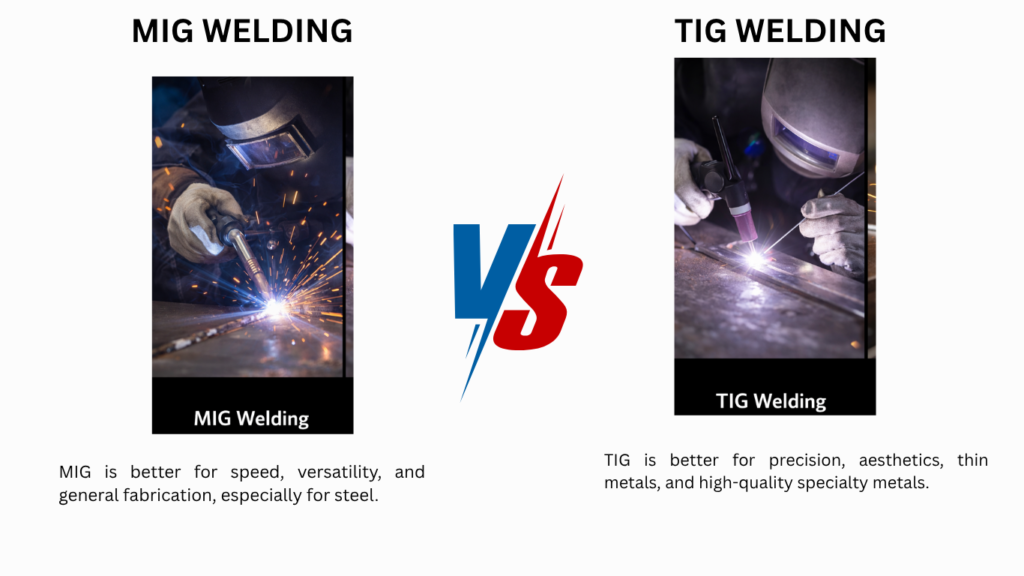
MIG and TIG welding each have strengths, so “better” depends on the application.
MIG welding is faster, easier to learn, and ideal for thicker materials and high-production work.
TIG welding offers more precision, cleaner welds, and is better for thin materials or critical joints.
In short, MIG is best for speed and volume, TIG for accuracy and aesthetics.
In this article:
MIG Vs TIG Welding :
The choice between MIG (Metal Inert Gas) and TIG (Tungsten Inert Gas) welding depends on metal type, precision required, speed, and skill level. Both are widely used, but they have distinct advantages and limitations. Let’s break it down in detail.
1. Overview of MIG vs TIG Welding
| Feature | MIG Welding (GMAW) | TIG Welding (GTAW) |
|---|---|---|
| Electrode | Consumable wire | Non-consumable tungsten |
| Shielding | Gas (argon or argon/CO₂ mix) | Inert gas (argon or helium) |
| Skill Required | Beginner-friendly | Requires high skill |
| Welding Speed | Fast | Slower |
| Weld Appearance | Moderate finish, minimal spatter | Very clean, precise, visually appealing |
| Material Thickness | Thin to medium, some thick | Very thin to medium |
| Metals | Steel, stainless steel, aluminum | Steel, stainless steel, aluminum, copper, exotic alloys |
| Positions | Flat, horizontal, vertical, overhead | Mostly flat and horizontal; vertical/overhead possible but slower |
| Applications | Automotive, fabrication, repair | Aerospace, piping, high-quality projects |
2. Advantages of MIG Welding
- Ease of Use – simpler to learn, good for beginners.
- High Speed – continuous wire feed allows faster welding.
- Good Penetration – suitable for thicker metals (up to ~20 mm in one pass).
- Versatile – can weld steel, stainless steel, and aluminum with proper wire and gas.
- Less Cleanup – minimal slag to remove compared to stick welding.
- Cost-effective for Production – ideal for mass production and repetitive jobs.
3. Advantages of TIG Welding
- Precision & Control – weld pool and arc are easy to manipulate for exacting applications.
- High-Quality Welds – clean, smooth beads with minimal spatter.
- Thin Metals – excellent for welding very thin metals without burn-through.
- Exotic Metals – works well on aluminum, magnesium, copper, and specialty alloys.
- Aesthetics – TIG welds are visually superior, often used where appearance matters.
- No Slag – the weld is clean and requires minimal post-weld finishing.
4. Disadvantages of MIG Welding
- Not as precise as TIG.
- Limited control on very thin metals (risk of burn-through).
- Outdoor welding can be difficult due to shielding gas disturbance by wind.
- Weld appearance is less visually perfect.
5. Disadvantages of TIG Welding
- Slow process – lower deposition rate, not ideal for high-volume production.
- Requires high skill and practice to master.
- Equipment is more expensive and complex.
- Less suitable for very thick metals without multiple passes.
6. Applications: When to Use Which
| Scenario | Preferred Welding |
|---|---|
| High-volume production, automotive panels | MIG |
| Heavy structural steel | MIG |
| Thin aluminum sheets, aerospace, piping | TIG |
| Decorative or visible welds | TIG |
| Exotic alloys or high-precision parts | TIG |
| Outdoor projects with wind | MIG with flux-cored wire |
7. Key Differences in Arc & Current
- MIG welding uses DCEN (electrode negative) with continuous wire feed, providing stable arc and fast welding.
- TIG welding uses DC or AC, depending on the metal:
- DC for steel/stainless
- AC for aluminum/magnesium (helps remove oxide layer)
- TIG requires filler metal to be manually fed by hand, offering precise control.
8. Which is Better?
It depends on your priorities:
| Priority | Best Choice | Reason |
|---|---|---|
| Speed and production | MIG | Continuous wire feed, faster deposition |
| Precision and appearance | TIG | Cleaner, controlled welds, no spatter |
| Thick metals | MIG | Good penetration, less skill required |
| Thin metals or exotic alloys | TIG | Avoids burn-through, works with aluminum/magnesium |
| Beginners | MIG | Easier to learn and control |
Bottom line:
- MIG is better for speed, versatility, and general fabrication, especially for steel.
- TIG is better for precision, aesthetics, thin metals, and high-quality specialty metals.
Other courses:





