
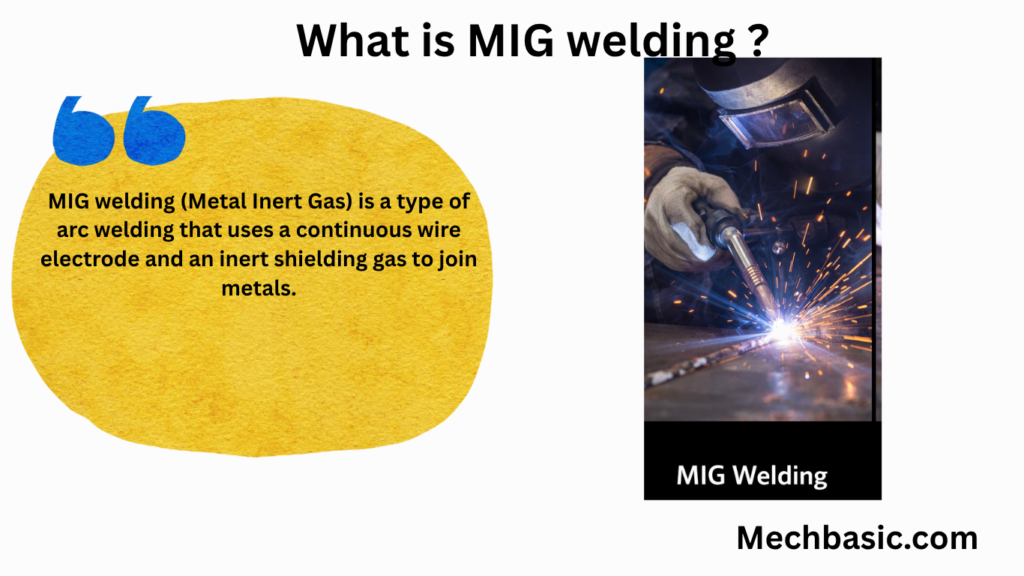
MIG welding (Metal Inert Gas) is a type of arc welding that uses a continuous wire electrode and an inert shielding gas to join metals.
The electrode melts and fuses the workpiece while the gas protects the weld from contamination.
It is popular for its speed, ease of use, and clean, strong welds on metals like steel, aluminum, and stainless steel.
In this article:
MIG welding-Everything you need to know
Here’s a detailed breakdown of MIG welding, covering its principles, equipment, advantages, disadvantages, and applications.
1. Definition
MIG Welding (Metal Inert Gas Welding), also called GMAW – Gas Metal Arc Welding, is a welding process where a continuous consumable wire electrode is fed through a welding gun, and a shielding gas protects the molten weld pool from atmospheric contamination.
- The process uses an electric arc between the electrode and base metal to generate heat.
- MIG welding is known for being fast, clean, and relatively easy to learn compared to stick welding (SMAW).
2. How MIG Welding Works
- Power Supply & Arc Formation
- The welding machine provides DC current (mostly DCEN – Direct Current Electrode Negative).
- An arc forms between the electrode wire and the base metal.
- Wire Feed & Melting
- The consumable wire electrode is continuously fed into the weld pool.
- Heat melts both the wire and the base metal to form the joint.
- Shielding Gas Protection
- Inert gases like argon or argon/CO₂ mixtures shield the molten metal from oxygen and nitrogen.
- This prevents oxidation, porosity, and weak welds.
- Solidification
- The molten weld pool cools and solidifies, forming a strong, uniform joint.
3. Equipment Used in MIG Welding
- MIG Welding Machine / Power Source – provides adjustable DC output.
- Wire Feeder – continuously feeds the electrode wire.
- Welding Gun / Torch – directs the wire and gas to the weld area.
- Shielding Gas Cylinder – usually argon, CO₂, or a mix.
- Ground Clamp – completes the electrical circuit.
- Personal Protective Equipment (PPE) – welding helmet, gloves, flame-resistant clothing.
4. Process Characteristics
- Current: DC (most commonly DCEN)
- Polarity: Electrode negative for deep penetration
- Electrode: Continuous consumable wire
- Shielding: Gas (argon, CO₂, or mixtures)
- Metal Thickness: Suitable for thin to medium metals (0.5 mm to 20 mm), thicker metals may need multiple passes.
5. Advantages of MIG Welding
- Ease of Use – beginner-friendly; less skill needed than TIG or stick welding.
- High Welding Speed – continuous wire feed allows faster welding.
- Clean Welds – minimal slag, easier post-weld cleanup.
- Versatile – works on steel, stainless steel, and aluminum with proper gas/wire.
- Good Penetration and Strength – produces strong joints for structural applications.
- Can Weld in Multiple Positions – flat, horizontal, vertical, and overhead with proper setup.
6. Disadvantages of MIG Welding
- Requires shielding gas, making it less suitable for windy or outdoor environments.
- Less effective on dirty, rusty, or oily metals – surface must be clean.
- Equipment is more complex and expensive than SMAW (stick welding).
- Limited thickness range; very thick metals may need multi-pass welding.
- Fume hazards – metal fumes and CO₂ require ventilation.
7. Applications of MIG Welding
- Automotive industry – chassis, body panels, exhaust systems.
- Construction & Fabrication – structural steel, metal frames, tanks.
- Shipbuilding – hulls and decks.
- Aerospace & Manufacturing – aluminum components, machinery.
- Repair and maintenance – general metal repair jobs.
8. MIG vs Other Welding Processes
| Feature | MIG Welding | Stick Welding (SMAW) | TIG Welding (GTAW) |
|---|---|---|---|
| Electrode | Continuous wire | Consumable stick | Non-consumable tungsten |
| Shielding | Gas | Flux coating | Gas |
| Ease of Use | Beginner-friendly | Moderate skill | Requires high skill |
| Cleanliness | Clean weld, minimal slag | Slag must be chipped | Very clean weld |
| Speed | Fast | Moderate | Slow |
| Metals | Steel, stainless, aluminum | Steel, cast iron | Steel, stainless, aluminum, copper |
Summary
- MIG welding (GMAW) is a fast, versatile, and clean welding process using a continuous wire and inert gas.
- DCEN is standard, giving deep penetration and stable arc.
- Best for: steel, stainless steel, aluminum (with proper gas), sheet metal, and structural fabrication.
- Limitations: outdoor welding in wind, very dirty metals, very thick plates.
Other courses:





