
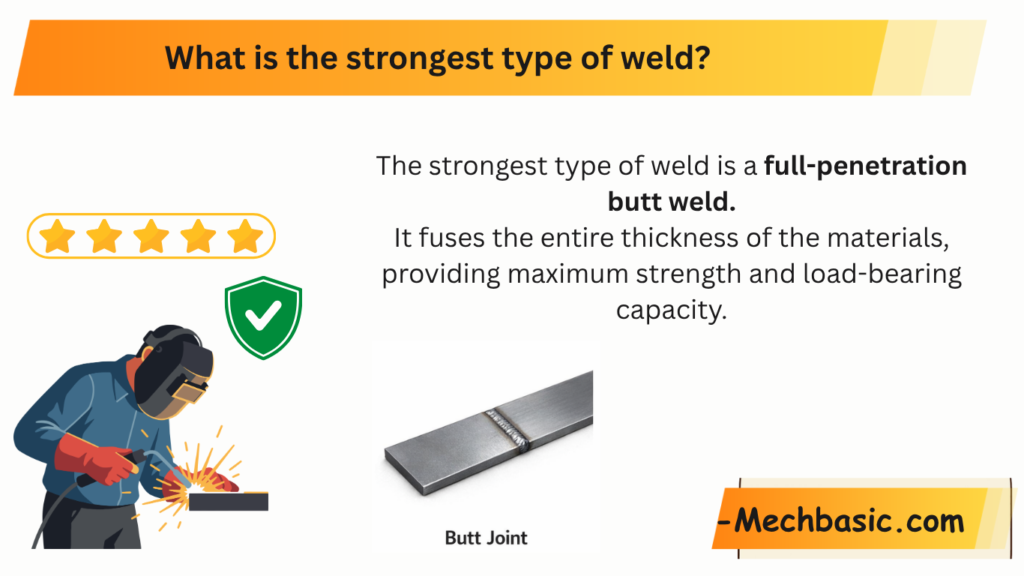
The strongest type of weld is a full-penetration butt weld.
It fuses the entire thickness of the materials, providing maximum strength and load-bearing capacity.
This weld is preferred in critical structures like pressure vessels, pipelines, and heavy machinery.
In this article:
What is the strongest type of weld?
The strongest type of weld is generally considered the full-penetration butt weld, but the answer depends on how “strength” is defined: tensile strength, fatigue resistance, or load-bearing capacity. Let’s go step by step.
1. Types of Welds
Here are the main weld types and their relative strength:
| Weld Type | Description | Strength Notes |
|---|---|---|
| Butt Weld (Full Penetration) | Two pieces joined end-to-end so the weld penetrates the full thickness of the material. | Usually stronger than the base metal, can carry almost 100% of the parent metal’s tensile load if done correctly. |
| Fillet Weld | Joins two pieces at right angles (e.g., T-joint, lap). | Less strong than full-penetration butt welds because only part of the cross-section carries load. |
| Groove Weld | A type of butt weld with a groove prepared for penetration (V, U, J shapes). | Strength depends on groove design; full-penetration grooves are very strong. |
| Lap or Spot Weld | Overlapping thin sheets joined locally. | Weakest under tensile loads; mainly used for sheet metal fabrication. |
2. Why Full-Penetration Butt Welds Are Strongest
a) Complete Fusion
- The weld metal fully fuses with the base metal across the entire thickness.
- No internal voids or weak zones.
- Result: the joint can approach or even exceed the base metal strength.
b) Stress Distribution
- Load flows smoothly through the weld because the cross-section is continuous.
- Minimal stress concentration at edges compared to fillet or lap welds.
c) Good Fatigue Resistance
- No abrupt geometry changes → fewer crack initiation points.
- Especially important in structural or pressure vessel applications.
d) Alignment with Base Metal
- Butt welds keep the pieces in-line, which avoids bending stresses that can weaken the joint.
3. Additional Factors That Maximize Strength
Even the strongest weld can be compromised if not executed properly. To maximize strength:
- Proper Material Preparation
- Clean surfaces, beveled edges for thicker materials.
- Correct Welding Process
- Shielded Metal Arc Welding (SMAW), Gas Tungsten Arc Welding (GTAW/TIG), or Gas Metal Arc Welding (GMAW/MIG) are often used.
- Adequate Penetration and Size
- Full-penetration, proper weld bead size, and multiple passes for thick materials.
- Post-Weld Treatment
- Stress relief, peening, or controlled cooling can prevent residual stresses that weaken welds.
4. Comparison With Other Strong Welds
- Fillet welds: Only carry a fraction of the load due to the triangular cross-section; more prone to stress concentration.
- Lap welds and spot welds: Highly localized; weak in tension or bending.
- Plug welds: Used to join overlapping sheets; generally weaker than full-penetration butt welds.
Summary
Strongest Weld: Full-Penetration Butt Weld
- Strength: Equal to or exceeds base metal
- Advantages: Uniform stress distribution, excellent fatigue resistance
- Applications: Pressure vessels, pipelines, structural steel, high-load components
Other courses:





