
WPS (Welding Procedure Specification) is a document that provides detailed instructions on how to perform a weld.
PQR (Procedure Qualification Record) is a record that proves the WPS produces a sound and acceptable weld.
Together, they ensure welding quality, consistency, and compliance with standards.
In this article:
PQR and WPS are very important terms in welding, especially in industrial and certification contexts. They ensure that welding is done correctly, safely, and with consistent quality.
Let’s understand both in detail.
1. What is WPS (Welding Procedure Specification)?
Definition
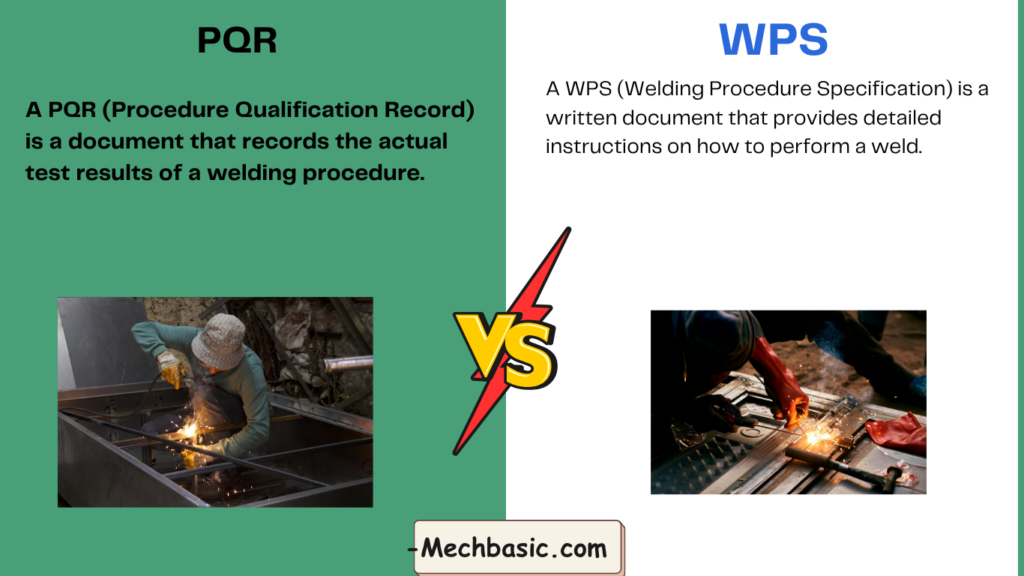
A WPS (Welding Procedure Specification) is a written document that provides detailed instructions on how to perform a weld.
👉 It tells the welder what to do and how to do it.
Contents of WPS
A typical WPS includes:
- Type of welding process (MIG, TIG, Arc, etc.)
- Base metal (material to be welded)
- Filler material (electrode/rod)
- Welding position (1G, 2G, etc.)
- Current type (AC/DC) and settings
- Voltage and travel speed
- Preheat and post-heat temperature
- Shielding gas (if used)
Purpose of WPS
- Ensures uniform welding quality
- Provides standard procedure for welders
- Reduces errors and defects
- Required for industrial and code-based work
2. What is PQR (Procedure Qualification Record)?
Definition
A PQR (Procedure Qualification Record) is a document that records the actual test results of a welding procedure.
👉 It proves that the welding method described in WPS actually works.
Contents of PQR
- Actual welding parameters used
- Test specimen details
- Mechanical test results:
- Tensile test
- Bend test
- Impact test
- Observations and inspection results
Purpose of PQR
- Validates the WPS
- Ensures weld strength and quality
- Acts as evidence for certification
3. Relationship Between WPS and PQR
- PQR is created first (by testing)
- WPS is written based on PQR results
Simple Flow:
- Perform test welding
- Record results → PQR
- Prepare procedure → WPS
- Use WPS in actual production
4. Differences Between PQR and WPS
| Feature | WPS | PQR |
|---|---|---|
| Purpose | Instruction document | Test record |
| Type | Guideline | Proof |
| Used by | Welders | Inspectors/engineers |
| Nature | Theoretical + practical | Fully practical |
| Creation | Based on PQR | Based on testing |
5. Importance in Industry
- Required in:
- Oil & gas industries
- Pressure vessels
- Pipelines
- Structural fabrication
- Follow standards like:
- ASME
- AWS
- ISO
Summary:
- WPS = “What to do”
- PQR = “Proof it works”
Conclusion:
- WPS → written welding instructions
- PQR → record of tested welding results
- PQR validates WPS
- Both are essential for quality assurance and certification
Other courses:





