
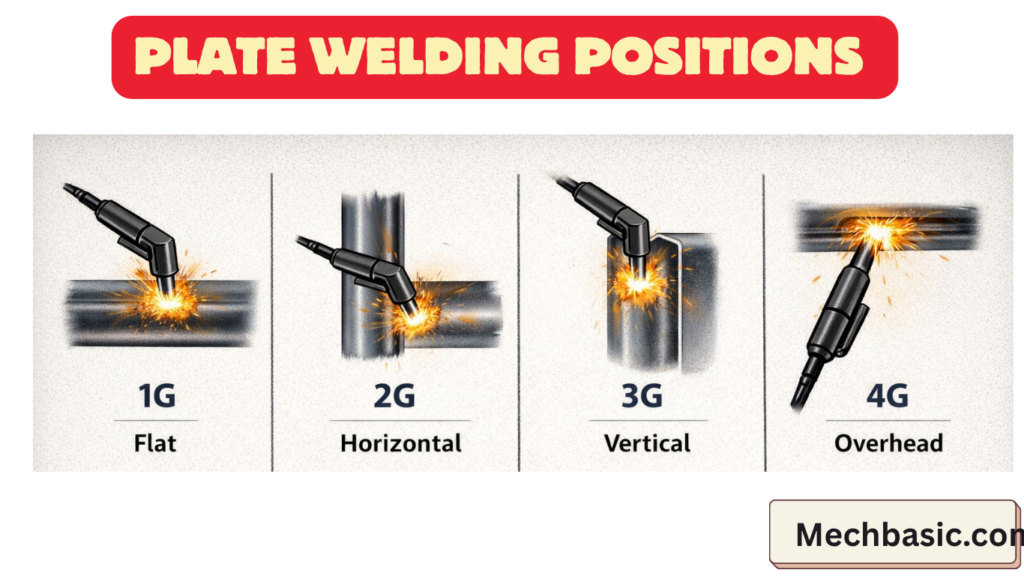
Plate welding positions (1G–4G) describe the orientation of the weld on flat plates during welding.
1G is flat, 2G is horizontal, 3G is vertical, and 4G is overhead position.
These positions affect weld quality, difficulty level, and the welder’s technique.
In this article:
Plate Welding Positions (1G-4G)
Plate welding positions (1G–4G) refer to groove weld positions on flat plates, based on how the plate is oriented and how the weld is applied. These are fundamental in welding training and certification.
Let’s go through each position in detail.
What does “G” mean?
- G = Groove weld
- Used when two plates are joined with a groove (V, U, or square groove)
1. 1G Position (Flat Position)
Definition
Welding is performed on a horizontal plate, with the weld deposited from the top side.
Orientation
- Plate lies flat (horizontal)
- Welding is done downward from above
Characteristics
- Molten metal flows easily into the joint
- Gravity helps the weld pool
Advantages
- Easiest position
- Good penetration
- High-quality weld
- Suitable for beginners
Applications
- Basic welding practice
- Fabrication of flat structures
2. 2G Position (Horizontal Position)
Definition
Welding is performed on a vertical plate, with the weld axis horizontal.
Orientation
- Plate is vertical
- Welding is done sideways (horizontal line)
Characteristics
- Molten metal tends to flow downward due to gravity
- Requires control of weld pool
Challenges
- Uneven bead formation
- Risk of sagging
Applications
- Structural welding
- Shipbuilding
3. 3G Position (Vertical Position)
Definition
Welding is performed on a vertical plate, and the weld progresses vertically.
Orientation
- Plate is vertical
- Welding direction:
- Upward (Vertical Up)
- Downward (Vertical Down)
Characteristics
🔹 Vertical Up (3G-Up)
- Better penetration
- Stronger weld
- Slower process
🔹 Vertical Down (3G-Down)
- Faster welding
- Less penetration
- Used for thin materials
Challenges
- Gravity pulls molten metal downward
- Requires high skill
Applications
- Construction
- Heavy fabrication
4. 4G Position (Overhead Position)
Definition
Welding is performed from the underside of a horizontal plate.
Orientation
- Plate is horizontal
- Welding is done from below (overhead)
Characteristics
- Molten metal tends to fall due to gravity
- Requires precise control
Challenges
- Most difficult plate welding position
- Risk of weld spatter falling
- Needs high skill and safety precautions
Applications
- Repair work
- Structural welding in confined spaces
Comparison of Plate Welding Positions
| Position | Plate Orientation | Welding Direction | Difficulty |
|---|---|---|---|
| 1G | Horizontal | Downward (top) | Easy |
| 2G | Vertical | Horizontal | Medium |
| 3G | Vertical | Vertical (up/down) | Hard |
| 4G | Horizontal | Overhead | Very hard |
Summary
- 1G → Flat (easiest)
- 2G → Side (horizontal weld)
- 3G → Vertical
- 4G → Overhead (hardest)
Conclusion
- Plate welding positions (1G–4G) are based on plate orientation
- Difficulty increases from 1G → 4G
- 3G and 4G require skilled welders
- Widely used in certification tests and industries
Other courses:





