
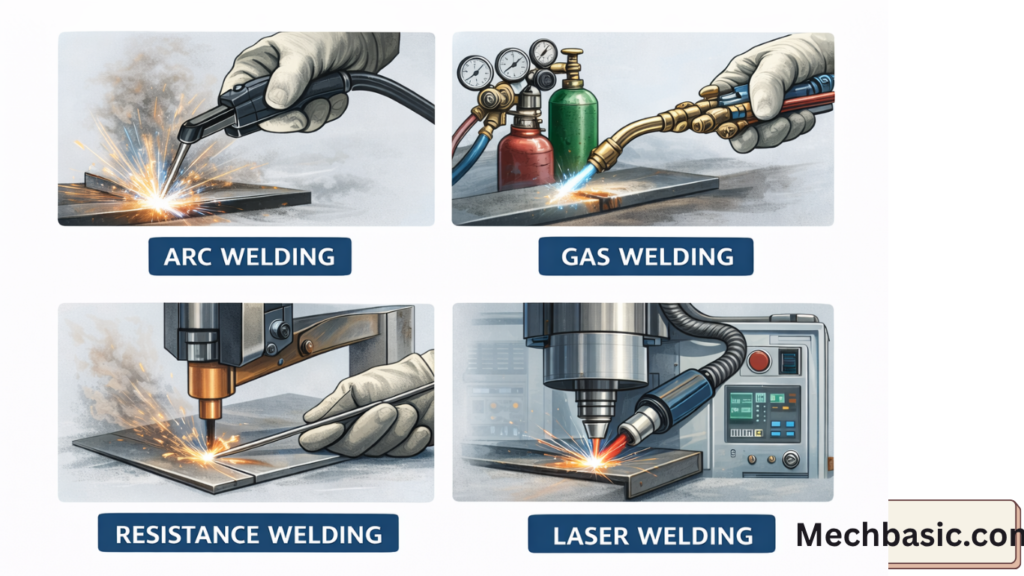
Four common types of welding are arc welding, gas welding, resistance welding, and laser welding.
Arc welding uses an electric arc, gas welding uses flame, resistance welding uses pressure and current, and laser welding uses a focused light beam.
Each type is chosen based on material, thickness, and required precision.
In this article:
1. Gas Welding (Oxy-Acetylene Welding)
Definition
Gas welding uses a flame produced by burning a fuel gas (acetylene) with oxygen to melt and join metals.
Working Principle
- Oxygen + acetylene → high-temperature flame (~3200°C)
- Flame melts base metal and filler rod
- Molten metal solidifies to form joint
Equipment
- Gas cylinders (oxygen & acetylene)
- Pressure regulators
- Welding torch
- Filler rod
Advantages
- Simple and portable
- Low cost
- No electricity required
Disadvantages
- Slow process
- Lower strength compared to arc welding
Applications
- Repair work
- Thin metal sheets
- Plumbing
2. Arc Welding
Definition
Arc welding uses electric arc heat between electrode and workpiece to melt and join metals.
Working Principle
- Electric current creates an arc
- Temperature reaches ~6000°C
- Metal melts and fuses
Types
- Shielded Metal Arc Welding (SMAW)
- MIG (Metal Inert Gas)
- TIG (Tungsten Inert Gas)
Advantages
- High strength joints
- Fast process
- Suitable for thick materials
Disadvantages
- Requires electricity
- Needs skilled operator
Applications
- Construction
- Shipbuilding
- Heavy industries
3. Resistance Welding
Definition
Resistance welding joins metals by heat generated due to electrical resistance and pressure.
Working Principle
- Current passes through metal
- Heat generated at contact surfaces
- Pressure applied → joint formed
Types
- Spot welding
- Seam welding
Advantages
- No filler material needed
- Fast and clean
- Suitable for mass production
Disadvantages
- High equipment cost
- Limited to thin materials
Applications
- Automobile body manufacturing
- Sheet metal industries
4. Solid-State Welding (Friction Welding)
Definition
Joining of metals without melting, using pressure and mechanical energy (friction).
Working Principle
- Two surfaces rub against each other
- Heat generated by friction
- Pressure applied → bonding occurs
Advantages
- No melting → no defects like porosity
- Strong joints
- Good for dissimilar metals
Disadvantages
- Limited shapes
- Expensive machines
Applications
- Shafts and rods
- Aerospace components
- Automotive parts
Comparison Table:
| Type | Heat Source | Filler | Speed | Application |
|---|---|---|---|---|
| Gas Welding | Flame | Yes | Slow | Repair work |
| Arc Welding | Electric arc | Yes | Fast | Heavy work |
| Resistance Welding | Electrical resistance | No | Very fast | Mass production |
| Solid-State Welding | Friction/pressure | No | Medium | Precision parts |
Summary
- Gas → Flame
- Arc → Electricity
- Resistance → Current + Pressure
- Solid-state → No melting
Conclusion
- These 4 types cover:
- Fusion welding (Gas, Arc)
- Pressure welding (Resistance, Solid-state)
Other courses:





