
Welding is a fabrication process used to join metals or thermoplastics by applying heat, pressure, or both.
It melts the materials at the joint and allows them to fuse together as they cool.
Welding is widely used in construction, manufacturing, and repair work.
In this article:
Welding
Welding is one of the most important manufacturing processes used to join two or more metal parts permanently. Here’s a clear and detailed explanation suitable for study and exams.
1. What is Welding?
Definition
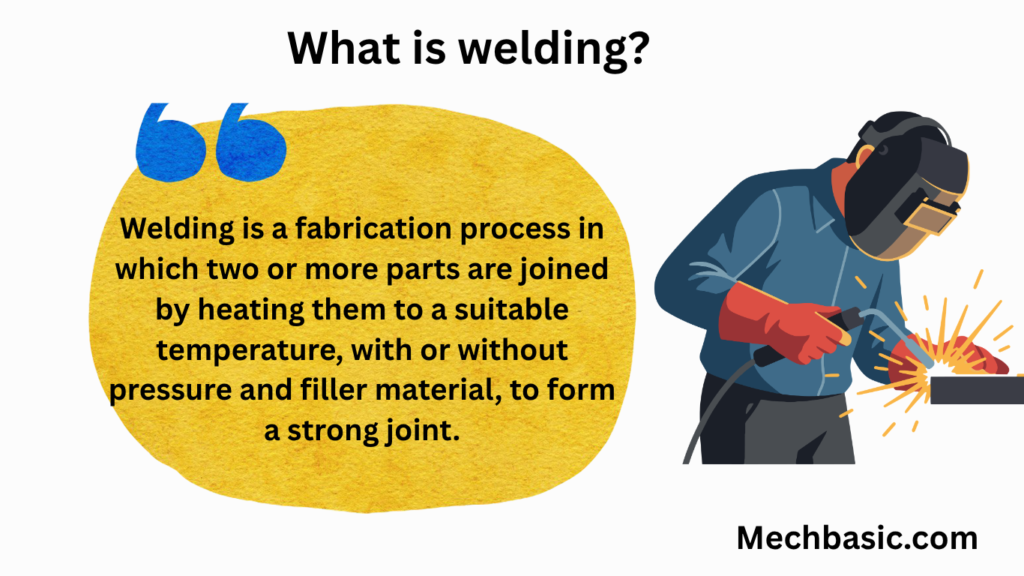
Welding is a fabrication process in which two or more parts are joined by heating them to a suitable temperature, with or without pressure and filler material, to form a strong joint.
2. Basic Principle of Welding
- Heat is applied to metal surfaces
- Metal melts at the joint
- Molten metal solidifies
- Forms a strong permanent bond
Sometimes:
- Filler material is added
- Pressure is applied (in some processes)
3. Types of Welding Processes
(A) Fusion Welding (Melting Type)
Metal is melted to form the joint.
1. Gas Welding
- Uses flame (oxygen + acetylene)
- Example: oxy-acetylene welding
2. Arc Welding
- Uses electric arc to produce heat
Common types:
- Shielded Metal Arc Welding (SMAW)
- Gas Metal Arc Welding (GMAW/MIG)
- Gas Tungsten Arc Welding (GTAW/TIG)
(B) Pressure Welding (Solid State Welding)
No melting, pressure is used.
Types:
- Forge welding
- Resistance welding
- Friction welding
(C) Resistance Welding
- Heat generated by electrical resistance
- Pressure applied
Types:
- Spot welding
- Seam welding
(D) Solid-State Welding
- No melting involved
- Atoms bond directly
Examples:
- Friction welding
- Diffusion welding
- Ultrasonic welding
4. Welding Joints
Common types of joints:
- Butt joint → end-to-end
- Lap joint → overlapping plates
- Corner joint
- Edge joint
- T-joint
5. Welding Positions
- Flat position
- Horizontal position
- Vertical position
- Overhead position
6. Equipment Used in Welding
- Power source (AC/DC)
- Electrodes or filler rods
- Welding torch or holder
- Protective equipment (helmet, gloves)
- Gas cylinders (for gas welding)
7. Advantages of Welding
- Strong permanent joints
- Lightweight structures (no bolts/rivets)
- Can join complex shapes
- Leak-proof joints possible
- Economical for many applications
8. Disadvantages
- Cannot be disassembled
- Heat affects material properties
- Requires skilled labor
- Possibility of defects (cracks, porosity)
9. Applications of Welding
- Construction (bridges, buildings)
- Shipbuilding
- Automobile industry
- Aerospace
- Pipelines
- Manufacturing industries
10. Common Welding Defects
- Cracks
- Porosity (gas holes)
- Slag inclusion
- Incomplete fusion
- Distortion
Summary
- Welding = permanent joining process using heat/pressure
- Two main types:
- Fusion welding (melting)
- Pressure welding (no melting)
- Common methods:
- Arc welding
- Gas welding
- Resistance welding
- Used widely in construction, automotive, and manufacturing
Conclusion:
- Heat + (Pressure) + Filler = Welding
- Fusion → melting
- Pressure → no melting
Other courses:





