
CNC (Computer Numerical Control) is best for precise machining operations like cutting and shaping materials.
PLC (Programmable Logic Controller) is better for controlling automated industrial processes and machinery.
Neither is “better” overall—it depends on the application, as CNC focuses on machining while PLC handles control and automation.
In this article:
CNC and PLC are not direct competitors, so asking “which is better” isn’t entirely accurate. They are designed for different purposes in automation. The right choice depends on what you want to do.
Let’s compare them clearly and in detail so you understand when each is “better.”
1. What is CNC?
Definition
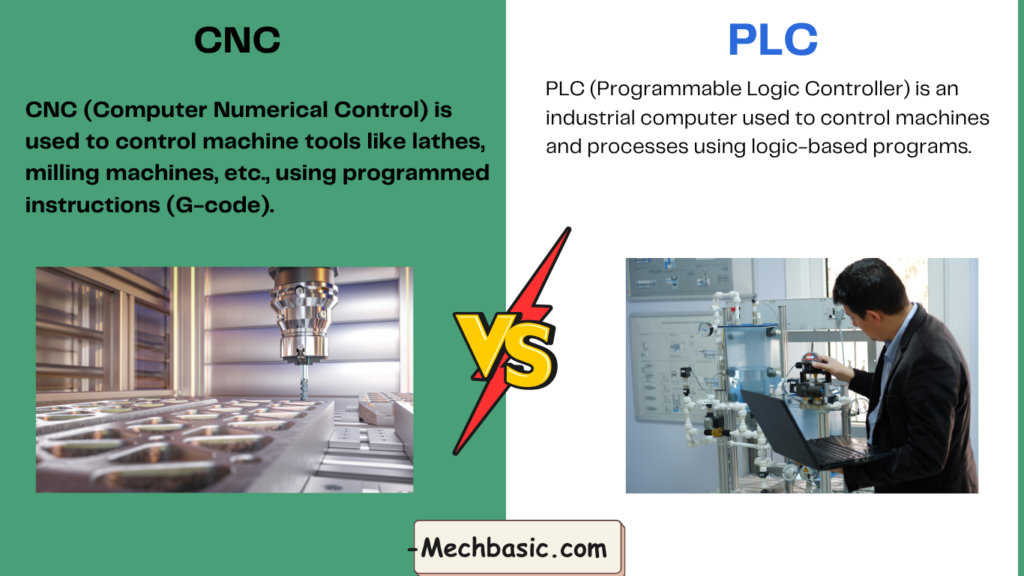
CNC (Computer Numerical Control) is used to control machine tools like lathes, milling machines, etc., using programmed instructions (G-code).
Main Purpose
Precision machining and manufacturing
2. What is PLC?
Definition
PLC (Programmable Logic Controller) is an industrial computer used to control machines and processes using logic-based programs.
Main Purpose
Automation of industrial processes
3. Key Differences Between CNC and PLC
| Feature | CNC | PLC |
|---|---|---|
| Function | Controls machine tools | Controls industrial processes |
| Programming | G-code, M-code | Ladder logic, function blocks |
| Application | Machining (cutting, drilling) | Automation (conveyors, motors) |
| Accuracy | Very high precision | Moderate (logic-based control) |
| Control Type | Motion control (continuous) | Logical control (ON/OFF) |
| Complexity | High (geometry + motion) | Moderate (logic control) |
| Speed | Slower (precise movement) | Faster (decision making) |
4. Working Difference
CNC
- Controls tool movement in X, Y, Z axes
- Follows exact coordinates
- Used for shaping material
Example:
- Turning a shaft on CNC lathe
PLC
- Controls sequence of operations
- Works on input/output signals
Example:
- Start motor when button is pressed
- Stop conveyor when sensor detects object
5. Applications
CNC Applications
- Automotive parts manufacturing
- Aerospace components
- Tool and die making
PLC Applications
- Assembly lines
- Packaging systems
- Traffic control systems
- Industrial automation
6. Advantages Comparison
CNC Advantages
- High precision
- Complex shapes possible
- Repeatability
PLC Advantages
- Flexible automation
- Easy troubleshooting
- Reliable industrial control
7. Disadvantages
CNC
- Expensive
- Requires skilled programming
- Limited to machining
PLC
- Cannot perform machining
- Less precise for motion control
Summary:
CNC is better when:
- You need precision machining
- Manufacturing complex parts
PLC is better when:
- You need automation and control systems
- Managing machines, sensors, and processes
In modern industries, CNC and PLC are often used together:
- CNC handles machining
- PLC controls:
- Loading/unloading
- Safety systems
- Automation flow
Conclusion:
- CNC and PLC serve different purposes
- CNC → best for machining and precision work
- PLC → best for automation and process control
- They are complementary, not competitors
- CNC = Cutting & shaping
- PLC = Logic & control
Other courses:





