
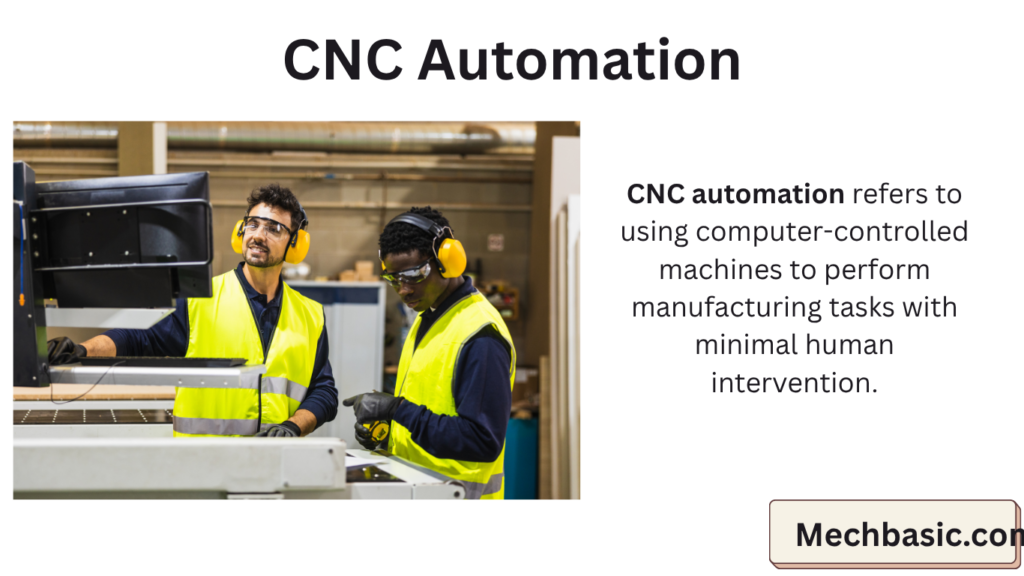
CNC automation refers to using computer-controlled machines to perform manufacturing tasks with minimal human intervention.
It integrates software, sensors, and robotics to automate operations like cutting, drilling, and tool changes.
CNC automation increases productivity, consistency, and reduces manual errors in production processes.
In this article:
CNC Automation
CNC automation is the integration of Computer Numerical Control (CNC) machines with automated systems to perform manufacturing operations with minimal human intervention. It is a key part of modern manufacturing and Industry 4.0.
Let’s go through it in a clear, detailed way.
1. What is CNC Automation?
Definition
CNC automation refers to the use of computer-controlled machines along with automatic loading, unloading, and process control systems to manufacture parts efficiently without continuous manual operation.
It combines:
- CNC machines
- Control software
- Automation systems (robots, conveyors, sensors)
2. Components of CNC Automation System
(1) CNC Machine
- CNC lathe, milling machine, machining center
- Performs actual cutting operation
(2) Machine Control Unit (MCU)
- Reads program (G-code)
- Controls machine movements
(3) Automation Devices
These reduce human involvement:
- Robotic arms → loading/unloading parts
- Conveyors → move materials
- Automatic tool changers (ATC) → change tools automatically
- Pallet systems → hold and move workpieces
(4) Drive System
- Servo motors
- Stepper motors
- Control tool and table movement
(5) Sensors & Feedback System
- Position sensors
- Temperature sensors
- Ensure accuracy and safety
(6) Software System
- CAD/CAM software
- CNC programming (G-code)
- Monitoring and control software
3. Working of CNC Automation
- Design part using CAD
- Convert to program using CAM
- Load program into CNC system
- Automation system loads raw material
- CNC machine performs machining
- Sensors monitor process
- Finished part is unloaded automatically
👉 Entire process runs with minimal human intervention
4. Types of CNC Automation
(A) Fixed Automation
- Same product produced continuously
- High production rate
- Example: mass production lines
(B) Programmable Automation
- Program can be changed
- Used for batch production
- Example: CNC machines with different part programs
(C) Flexible Automation (FMS)
- Produces different parts with minimal setup
- Highly advanced system
- Example: Flexible Manufacturing System (FMS)
5. Levels of CNC Automation
- Level 1: CNC machine only (basic automation)
- Level 2: CNC + automatic tool changer
- Level 3: CNC + robot loading/unloading
- Level 4: Fully automated system (FMS, CIM)
6. Advantages of CNC Automation
High Productivity
- Continuous operation (24/7 possible)
High Accuracy
- Computer-controlled precision
Reduced Labor Cost
- Less human involvement
Consistency
- Same quality for all parts
Safety
- Less human exposure to machines
7. Disadvantages
- High initial investment
- Requires skilled technicians
- Complex maintenance
- System failure affects production
8. Applications of CNC Automation
- Automotive manufacturing
- Aerospace industries
- Mass production industries
- Electronics manufacturing
- Medical equipment production
9. CNC Automation vs CNC Machining
| Feature | CNC Machining | CNC Automation |
|---|---|---|
| Scope | Only machining | Entire automated system |
| Human involvement | Required | Minimal |
| System | Single machine | Integrated system |
| Productivity | High | Very high |
10. Summary
- CNC automation = CNC + automation systems
- Includes robots, conveyors, ATC
- Types: Fixed, programmable, flexible
- Improves productivity, accuracy, safety
- Used in modern industries (Industry 4.0)
Other courses:





