
Beading is a sheet metal operation used to form a raised ridge (bead) on the surface of a sheet.
It is mainly done to increase stiffness and strength without increasing thickness.
Beading is commonly used in panels, ducts, and automobile body parts.
In this article:
Beading in Sheet Metal
What is Beading?
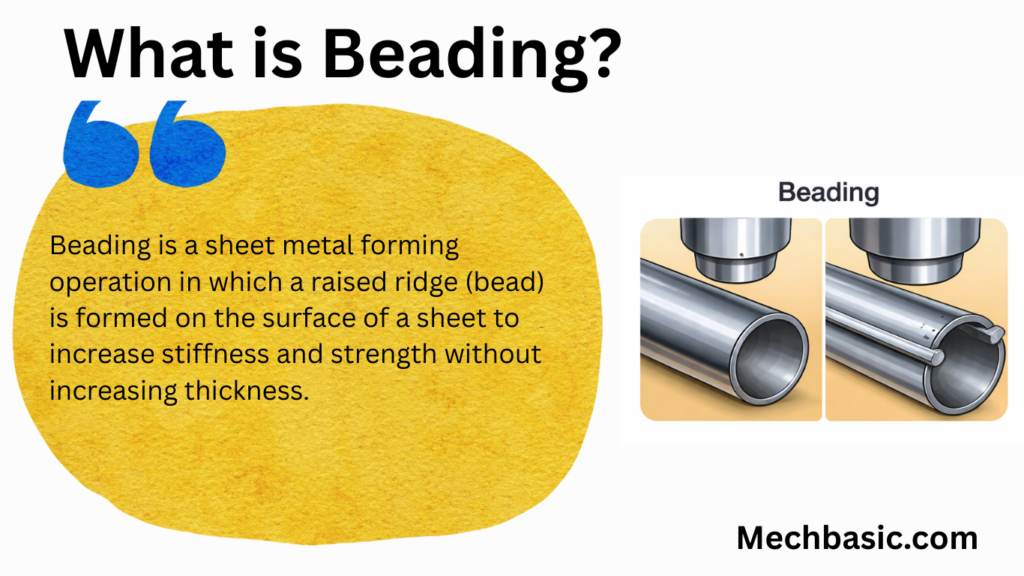
Beading is a sheet metal forming operation in which a raised ridge (bead) is formed on the surface of a sheet to increase stiffness and strength without increasing thickness.
👉 No material is removed
👉 Local plastic deformation occurs
👉 Improves rigidity and appearance
Beading is commonly used in thin sheets to prevent bending and vibration.
Working Principle
Step-by-step Process:
- The sheet is placed between beading dies or rollers.
- Pressure is applied along a straight or curved path.
- The material flows plastically.
- A raised ridge (bead) is formed.
Main Components
1. Beading Rollers / Dies
- Male and female grooves
- Shape determines bead profile
2. Press or Bead Rolling Machine
- Applies forming force
Purpose of Beading
✔ Increases stiffness
✔ Reduces vibration
✔ Prevents buckling
✔ Improves appearance
✔ Strengthens large flat panels
Important Characteristics
- Thickness remains almost constant
- Local stretching occurs
- Shape may be straight or circular
- Requires ductile material
Types of Beading
1. Straight Beading
Bead formed along straight line.
2. Circular Beading
Bead formed in circular pattern.
3. Edge Beading
Bead formed near sheet edge.
4. Decorative Beading
Used for aesthetic purposes.
Force Requirement
Force depends on:
- Sheet thickness
- Material strength
- Bead depth
- Length of bead
Greater thickness → Higher force
Applications
- Automobile body panels
- Air ducts
- Storage tanks
- Electrical enclosures
- Appliance covers
Advantages
✔ Increased rigidity without extra material
✔ Lightweight design
✔ Attractive finish
✔ Economical
Disadvantages
✖ Additional forming operation
✖ Tooling cost
✖ Limited bead depth
Beading vs Embossing
| Feature | Beading | Embossing |
|---|---|---|
| Shape | Long ridge | Pattern/design |
| Purpose | Strengthening | Decoration & stiffness |
| Area | Linear | Localized area |
Summary
- Beading is a surface strengthening operation.
- No material removal occurs.
- Used mainly to increase stiffness.
- Common in automotive panels.
- Thickness remains nearly constant.
Other courses:





