
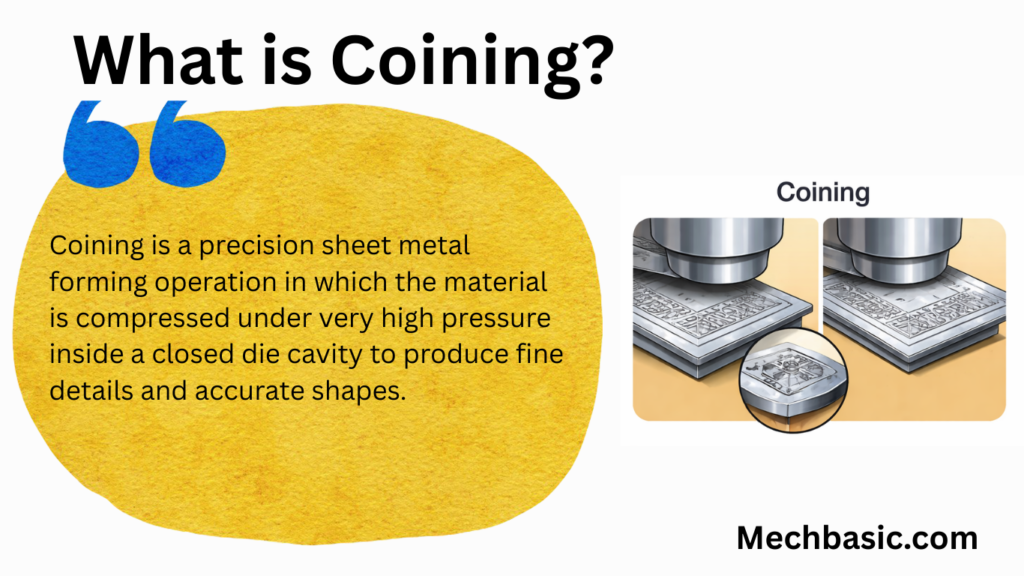
Coining is a sheet metal forming operation in which the material is compressed between a punch and die under very high pressure.
It produces fine details, sharp edges, and accurate dimensions by plastically deforming the metal.
Coining is commonly used to make coins, medals, and precision components.
In this article:
Coining in Sheet Metal
What is Coining?
Coining is a precision sheet metal forming operation in which the material is compressed under very high pressure inside a closed die cavity to produce fine details and accurate shapes.
- No material is removed
- Very high compressive force is used
- Produces sharp and accurate impressions
It is called “coining” because it is used in manufacturing coins.
Working Principle
Step-by-step Process:
- The blank is placed in a closed die cavity.
- The punch applies very high compressive force.
- Metal flows plastically into all die details.
- Final detailed impression is formed.
In coining:
- The entire material thickness is plastically deformed.
- Springback is nearly eliminated.
Main Components
1. Punch
Contains detailed design.
2. Die
Has matching cavity.
3. Press (High Capacity)
Usually mechanical or hydraulic with very high tonnage.
Characteristics of Coining
✔ Very high pressure
✔ Accurate dimensions
✔ Sharp edges and fine details
✔ Little or no springback
✔ Improves surface finish
Force Requirement
Coining requires much higher force than bending or embossing.
General idea:
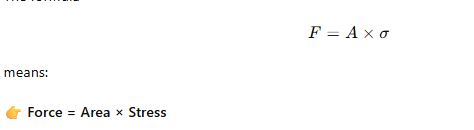
Where:
- A = Area being coined
- σ = Compressive stress
Because the whole area is plastically deformed, force is very high.
Types of Coining
1. Full Coining
Entire surface compressed.
2. Partial Coining
Only selected areas deformed.
Applications
- Coins and medals
- Electrical contacts
- Precision components
- Nameplates
- Decorative metal plates
- Watch components
Advantages
✔ High dimensional accuracy
✔ Excellent surface finish
✔ Sharp details
✔ Eliminates springback
✔ Strong and dense surface
Disadvantages
✖ Very high force required
✖ High tooling cost
✖ Limited to small parts
✖ Tool wear due to high pressure
Coining vs Embossing
| Feature | Coining | Embossing |
|---|---|---|
| Pressure | Very High | Moderate |
| Detail | Very Sharp | Shallow |
| Springback | Almost none | Slight |
| Thickness Change | Significant compression | Minimal |
Summary
- Coining is a high-pressure compression process.
- Used for precision and fine detail.
- Requires closed die.
- Eliminates springback.
- Tooling cost is high.
Other courses:





