
Embossing is a sheet metal operation used to create raised or recessed designs on a metal surface.
It is done by pressing the sheet between a matched punch and die.
Embossing improves appearance, identification, and sometimes strength of the component.
In this article:
Embossing in Sheet Metal
What is Embossing?
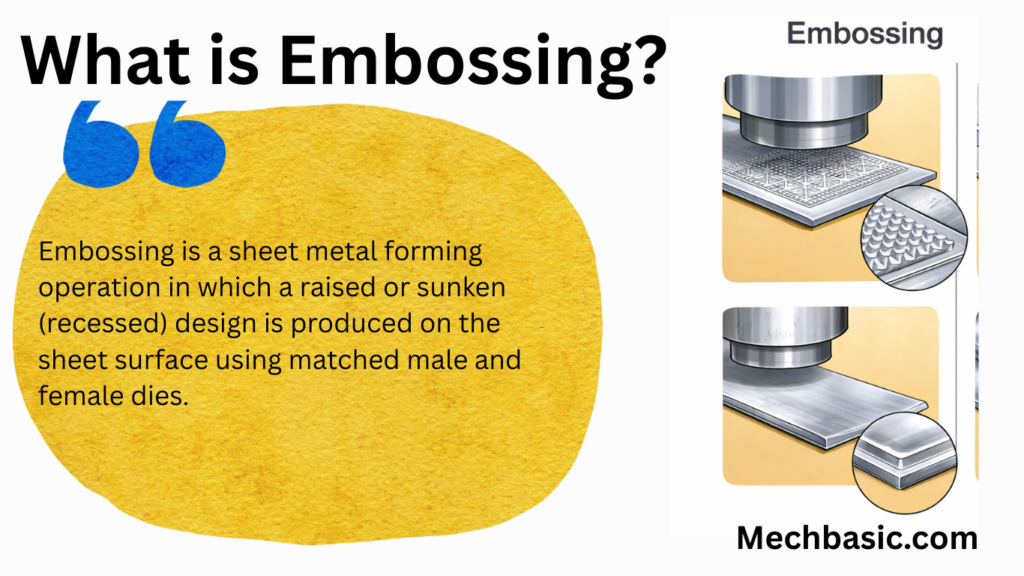
Embossing is a sheet metal forming operation in which a raised or sunken (recessed) design is produced on the sheet surface using matched male and female dies.
👉 No material is removed
👉 Thickness remains nearly constant
👉 Used for strengthening and decorative purposes
Embossing increases rigidity and improves appearance.
Working Principle
Step-by-step Process:
- Sheet is placed between male and female dies.
- Press applies compressive force.
- Material flows plastically into die cavity.
- Raised or recessed pattern is formed.
Main Components
1. Male Die (Punch)
- Produces raised portion
2. Female Die
- Contains matching cavity
3. Press Machine
- Mechanical or hydraulic
Purpose of Embossing
✔ Improves stiffness
✔ Enhances appearance
✔ Provides grip pattern
✔ Adds identification marks or logos
Important Characteristics
- Local plastic deformation
- No cutting involved
- Requires ductile material
- Pattern depth depends on pressure
Types of Embossing
1. Raised Embossing
Design projects outward.
2. Sunken Embossing
Design pressed inward.
3. Decorative Embossing
Used for artistic patterns.
4. Functional Embossing
Used for strengthening ribs.
Force Requirement
Force depends on:
- Area of embossing
- Thickness
- Material strength
- Depth of pattern
Greater depth → Higher force required
Applications
- Automobile panels
- Electrical panels
- Nameplates
- Coins and medals
- Decorative sheets
- Appliance covers
Advantages
✔ Increases rigidity without extra material
✔ Attractive appearance
✔ No material waste
✔ Low production cost for mass production
Disadvantages
✖ Limited depth
✖ Requires precise die alignment
✖ Not suitable for brittle materials
Embossing vs Coining
| Feature | Embossing | Coining |
|---|---|---|
| Depth | Shallow | Deeper |
| Force | Moderate | Very high |
| Purpose | Decoration & stiffness | Precise detail |
Summary:
- Embossing is a surface forming operation.
- No material is removed.
- Improves strength and appearance.
- Requires matched male and female dies.
- Used for both decorative and functional purposes.
Other courses:





