
Bending is a sheet metal forming operation in which the metal is plastically deformed along a straight axis to change its shape.
It is done using tools like a press brake, punch, and die.
Bending is commonly used to make brackets, channels, and enclosures.
In this article:
Bending in Sheet Metal
What is Bending?
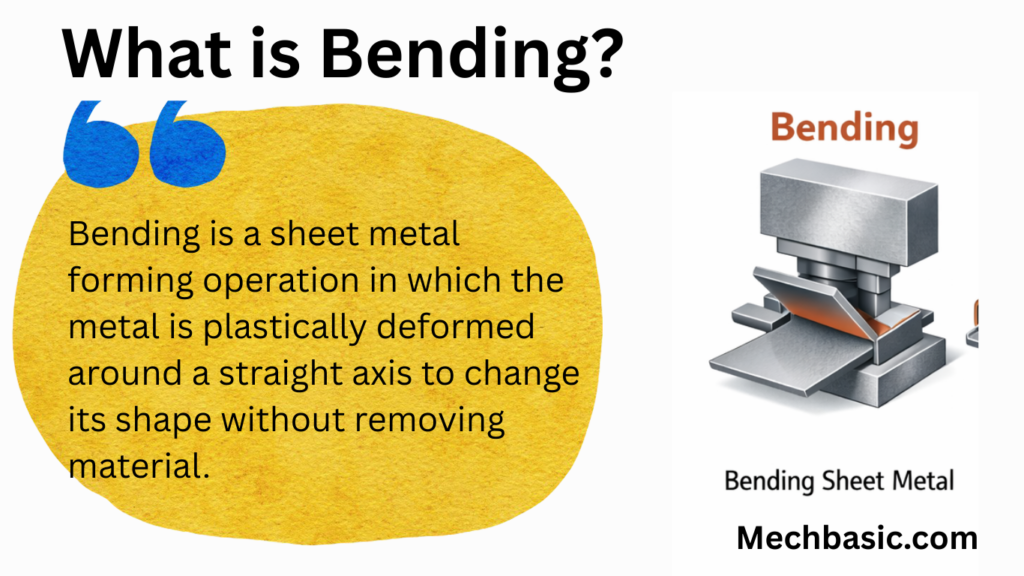
Bending is a sheet metal forming operation in which the metal is plastically deformed around a straight axis to change its shape without removing material.
👉 Thickness remains almost constant
👉 No material is cut
👉 It is a plastic deformation process
Bending is widely used to make brackets, enclosures, channels, and frames.
Working Principle
- The sheet is placed over a die.
- A punch applies force.
- The sheet bends along a straight line.
- Outer surface undergoes tension.
- Inner surface undergoes compression.
Stress Distribution in Bending
- Outer layer → Tensile stress
- Inner layer → Compressive stress
- Neutral axis → No stress
The neutral axis shifts slightly toward the inside of the bend.
Important Terms in Bending
Bend Angle (θ)
Angle through which sheet is bent.
Bend Radius (R)
Radius of inside bend.
Bend Allowance (BA)
Length of neutral axis between bend lines.
Springback
Tendency of material to return partially to original shape after unloading.
✔ More in high-strength materials
✔ Reduced by overbending
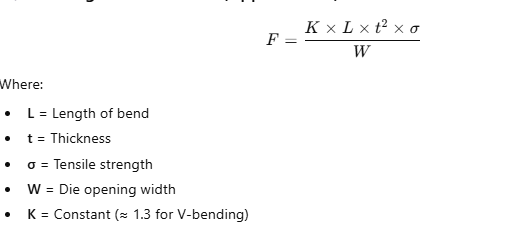
Bending Force Formula (Approximate)
Types of Bending Operations
1. V-Bending
Most common method using V-die.
2. U-Bending
Produces U-shaped section.
3. Edge Bending
Bending along sheet edge.
4. Roll Bending
Used for large radius bends (cylinders).
5. Air Bending
Punch does not fully contact die bottom.
6. Bottoming
Sheet fully pressed into die.
Machines Used
- Press brake
- Mechanical press
- Hydraulic press
- Roll bending machine
Applications
- Automobile body parts
- Electrical cabinets
- Aircraft panels
- Furniture frames
- Structural brackets
Advantages
✔ No material waste
✔ High accuracy
✔ Economical
✔ Suitable for mass production
Disadvantages
✖ Springback
✖ Cracking if bend radius too small
✖ Tool wear
Example Problem
If:
- Thickness = 3 mm
- Bend length = 200 mm
- Tensile strength = 400 MPa
Force depends on die width and constant, but increases with:
✔ Thickness²
✔ Bend length
✔ Material strength
Difference Between Bending and Shearing
| Feature | Bending | Shearing |
|---|---|---|
| Material Removal | No | Yes |
| Process Type | Forming | Cutting |
| Thickness | Constant | Separated |
Summary
- Bending is a plastic deformation process.
- Outer surface → Tension
- Inner surface → Compression
- Springback must be compensated.
- Neutral axis shifts inward.
Other courses:





