
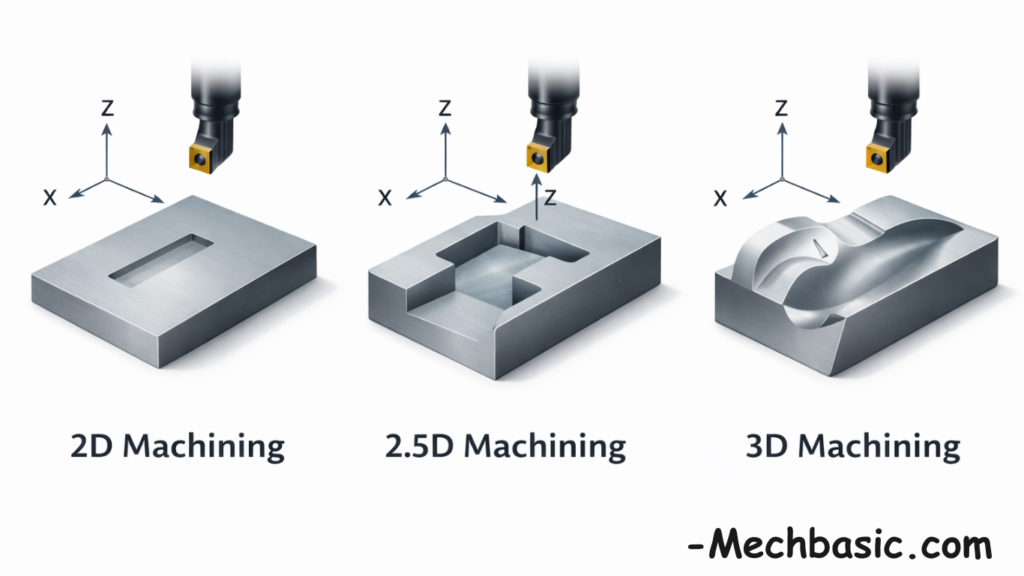
2D Machining:
In 2D machining, the cutting tool moves only in the X and Y axes. The depth (Z-axis) is fixed during the operation. It is mainly used for simple cutting profiles like flat shapes and outlines.
2.5D Machining:
In 2.5D machining, the tool moves in X and Y directions simultaneously, but the Z-axis moves step-by-step at different levels. It is commonly used for pocketing, drilling, and contouring with multiple depth levels.
3D Machining:
In 3D machining, the tool moves simultaneously in X, Y, and Z axes. This allows machining of complex curved surfaces, molds, dies, and intricate shapes.
2D = Flat cutting
2.5D = Multi-level cutting
3D = Fully contoured surface machining
In this article:
2D vs 2.5D vs 3D Machining — Detailed Comparison
CNC machining is classified into 2D, 2.5D, and 3D machining based on how the cutting tool moves along the X, Y, and Z axes.
2D Machining
Definition
In 2D machining, the tool moves only in two axes (X and Y).
The Z-axis remains constant during cutting.
Characteristics
- Flat geometry
- Single depth of cut
- Simple toolpaths
- No variation in height during operation
Examples
- Profile cutting
- Laser cutting
- Plasma cutting
- Simple engraving
- Basic contour milling
Applications
- Flat plates
- Gaskets
- Sheet metal parts
- Name plates
Advantages
- Simple programming
- Low machining cost
- Faster production
- Suitable for beginners
Limitations
- Cannot produce 3D shapes
- Limited complexity
2.5D Machining
Definition
In 2.5D machining, the tool moves in X and Y simultaneously, but Z movement occurs separately (step-by-step) — not continuously during cutting.
👉 The tool cuts at different depths, but each layer is flat.
Characteristics
- Step machining
- Multiple depth levels
- Pocketing operations
- Drilling + contouring
Examples
- Pocket milling
- Step boring
- Slot milling
- Drilling operations
- Face milling
Applications
- Molds with steps
- Mechanical components
- Machine parts
- Brackets
Advantages
- More flexible than 2D
- Moderate programming difficulty
- Efficient material removal
Limitations
- Cannot create smooth curved surfaces
- Limited surface complexity
3D Machining
Definition
In 3D machining, the tool moves simultaneously in X, Y, and Z axes.
It produces complex curved surfaces and contours.
Characteristics
- Continuous Z-axis movement
- Surface contouring
- Complex geometry
- Advanced CAM programming required
Examples
- Mold cavity machining
- Die manufacturing
- Aerospace components
- Sculptured surfaces
- Turbine blades
Applications
- Automotive molds
- Aerospace parts
- Medical implants
- Artistic sculptures
Advantages
- Produces complex shapes
- High precision
- Excellent surface finish
- Suitable for advanced manufacturing
Limitations
- Complex programming
- Higher cost
- Requires advanced machines & CAM software
Differences Table
| Feature | 2D Machining | 2.5D Machining | 3D Machining |
|---|---|---|---|
| Axis Movement | X & Y only | X & Y together, Z stepwise | X, Y & Z simultaneously |
| Surface Type | Flat | Stepped | Curved / Contoured |
| Complexity | Low | Medium | High |
| Programming | Simple | Moderate | Advanced CAM |
| Cost | Low | Medium | High |
| Example | Plate cutting | Pocket milling | Mold cavity |
- 2D → Flat shape
- 2.5D → Steps & pockets
- 3D → Smooth curved surfaces
Summary
- 2D machining involves tool movement in two axes only.
- 2.5D machining includes stepped depth machining.
- 3D machining allows simultaneous movement in all three axes.
- Used according to part complexity and manufacturing requirement.
Other courses:





