
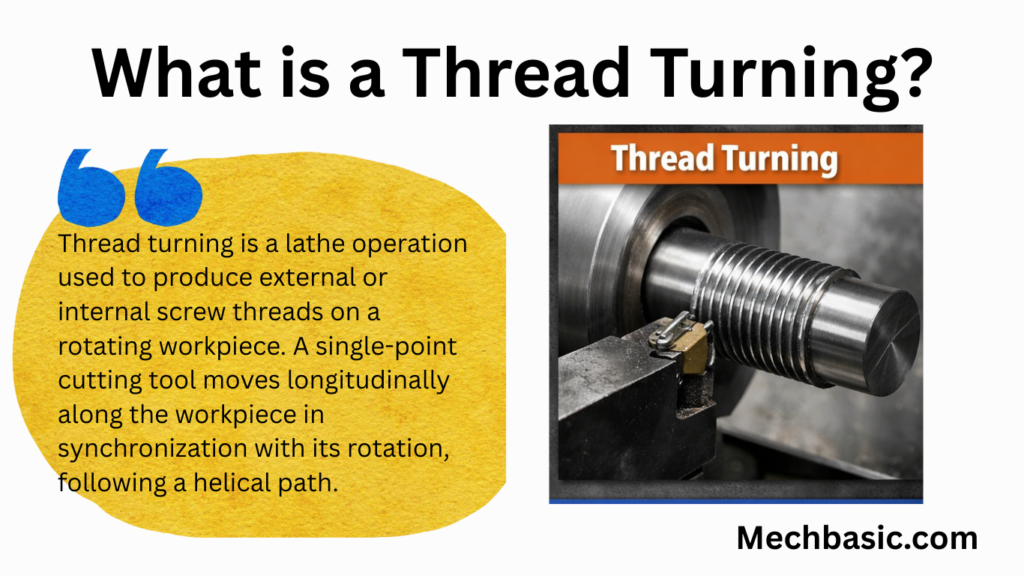
Thread turning is a lathe operation used to produce external or internal screw threads on a rotating workpiece. A single-point cutting tool moves longitudinally along the workpiece in synchronization with its rotation, following a helical path. This operation allows precise control over thread size, pitch, and form, and is commonly used for making threaded shafts, bolts, and nuts.
In this article:
- Thread Turning (Screw Cutting) on a Lathe
- 1. What is Thread Turning?
- 2. Purpose of Thread Turning
- 3. Principle of Thread Turning
- 4. Types of Threads (Lathe Cutting)
- 5. Thread Turning Tools
- 6. Thread Turning Setup
- 7. Methods of Thread Cutting
- 8. Steps in Thread Turning (Manual Lathe)
- 9. Thread Dimensions (Metric Thread)
- 10. Cutting Parameters
- 11. Common Defects & Remedies
- 12. Advantages
- 13. Limitations
- 14. Applications
- 15. Difference Between Thread Turning and Tapping
Thread Turning (Screw Cutting) on a Lathe
1. What is Thread Turning?
Thread turning, also called screw cutting, is a lathe operation used to produce helical grooves (threads) on the external or internal surface of a cylindrical workpiece using a single-point cutting tool.
2. Purpose of Thread Turning
- To produce fastening elements (bolts, screws)
- To allow assembly and disassembly
- To transmit motion or force (lead screws)
- To obtain precise mating parts
3. Principle of Thread Turning
- The workpiece rotates in the spindle.
- The threading tool is fed longitudinally, parallel to the axis.
- The lead screw drives the carriage.
- A fixed relationship between spindle speed and tool feed produces the correct pitch.
4. Types of Threads (Lathe Cutting)
a) Based on Location
- External threads – cut on outer surface
- Internal threads – cut inside a hole
b) Based on Form
- V-thread (Metric, Unified)
- Square thread
- Acme thread
- Buttress thread
- Knuckle thread
c) Based on Direction
- Right-hand thread (most common)
- Left-hand thread
5. Thread Turning Tools
- Single-Point Thread Cutting Tool
- Ground to thread profile
- HSS or carbide
- Insert Threading Tool
- Indexable carbide insert
- Used in CNC lathes
Tool angles (Metric V-thread):
- Included angle: 60°
- Clearance angle: 5°–7°
- Small nose radius for accuracy
6. Thread Turning Setup
- Work holding: 3-jaw chuck, 4-jaw chuck, or between centers
- Tool setting:
- Tool tip at center height
- Tool aligned perpendicular to work axis
- Gear train / Quick-change gearbox: Set to required pitch
- Compound rest: Set at 29° (for 60° threads)
7. Methods of Thread Cutting
a) Straight In-Feed Method
- Tool fed radially inward
- Used for coarse or short threads
b) Compound Slide Method (Most common)
- Tool fed at an angle (29°)
- Produces better finish and tool life
c) CNC Threading
- Controlled by G-codes (G76, G92)
- High accuracy and repeatability
8. Steps in Thread Turning (Manual Lathe)
- Prepare workpiece to correct diameter.
- Set threading tool at center height.
- Adjust gearbox for required pitch.
- Engage half-nut lever.
- Start lathe at low speed.
- Feed tool gradually using compound slide.
- Retract tool at thread end.
- Repeat passes until full depth achieved.
- Check thread using gauge or nut.
9. Thread Dimensions (Metric Thread)
- Pitch (P): Distance between threads
- Major diameter: Outer diameter
- Minor diameter: Root diameter
- Depth of thread: ≈ 0.613 × P (for 60° thread)
10. Cutting Parameters
- Cutting speed: Low (⅓ of turning speed)
- Feed: Equal to thread pitch
- Depth of cut: Gradual, multiple passes
- Coolant: Improves finish and tool life
11. Common Defects & Remedies
| Defect | Cause | Remedy |
|---|---|---|
| Incorrect pitch | Gearbox setting wrong | Reset gearbox |
| Poor surface finish | Blunt tool | Sharpen tool |
| Double threading | Half-nut disengaged | Keep half-nut engaged |
| Tool breakage | Excess depth of cut | Reduce in-feed |
12. Advantages
- High accuracy threads
- Suitable for large diameters
- Flexible thread profiles
13. Limitations
- Slow process
- Requires skilled operation
- Not economical for mass production
14. Applications
- Bolts and screws
- Lead screws
- Shafts and spindles
- Machine tool components
15. Difference Between Thread Turning and Tapping
| Thread Turning | Tapping |
|---|---|
| Single-point tool | Multi-point tool |
| External & internal | Mostly internal |
| High accuracy | Faster but limited size |
Other courses:





