
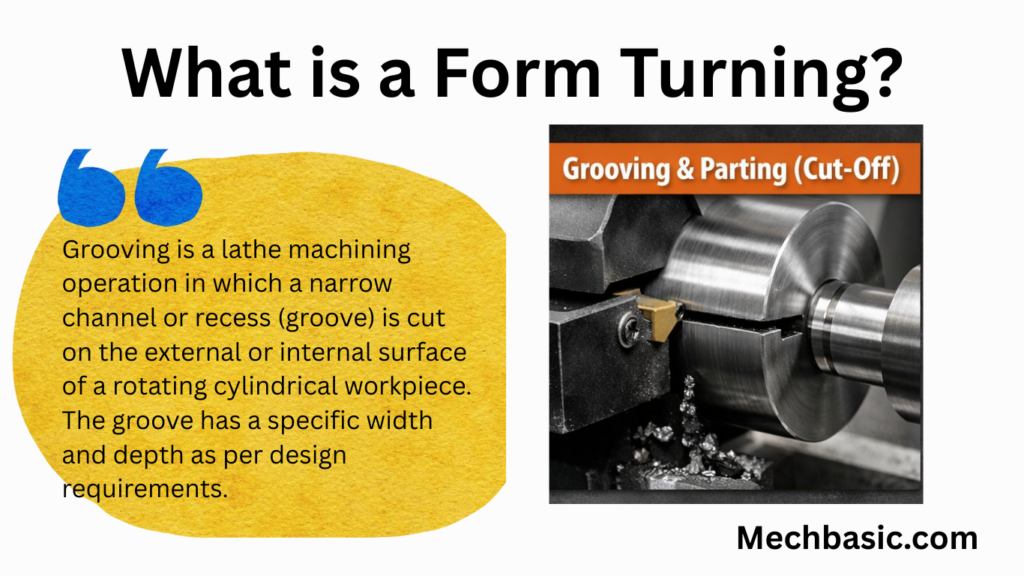
Grooving is a turning operation in which a narrow cutting tool is used to create a recessed channel or groove on the surface of a rotating workpiece. The tool is fed radially or axially to a specified depth and width.
Grooving is commonly used for producing slots for O-rings, snap rings, and clearance spaces, and it can be performed on external or internal surfaces of a component.
In this article:
- Grooving Operation in Lathe Machining
- 1. What is Grooving?
- 2. Purpose of Grooving
- 3. Principle of Grooving
- 4. Types of Grooving
- 5. Grooving Tools
- 6. Grooving Operation Setup
- 7. Steps in Grooving Operation
- 8. Cutting Parameters (Typical)
- 9. Common Problems & Remedies
- 10. Advantages
- 11. Applications
- 12. Difference Between Grooving and Parting
- 13. Safety Precautions
- Other courses:
Grooving Operation in Lathe Machining
1. What is Grooving?
Grooving is a lathe machining operation in which a narrow channel or recess (groove) is cut on the external or internal surface of a rotating cylindrical workpiece.
The groove has a specific width and depth as per design requirements.
2. Purpose of Grooving
- To provide space for O-rings, snap rings, and circlips
- To allow assembly clearance
- To form undercuts for threading operations
- To control lubrication flow
- For decorative or functional design features
3. Principle of Grooving
- The workpiece rotates in the spindle.
- The grooving tool is fed radially inward, perpendicular to the axis of rotation.
- Material is removed to create a narrow recess.
4. Types of Grooving
a) External Grooving
- Groove is cut on the outer surface
- Most common type
b) Internal Grooving
- Groove is cut inside a bore or hole
- Requires internal grooving tool
c) Face Grooving
- Groove is cut on the face of the workpiece
- Used for sealing grooves
5. Grooving Tools
- Single-Point Grooving Tool
- Narrow cutting edge
- HSS or carbide
- Form Grooving Tool
- Profile matches groove shape
- Indexable Insert Grooving Tool
- Used in CNC lathes
- High accuracy and tool life
Tool geometry:
- Tool width equals groove width
- Adequate side clearance
- Sharp cutting edge
6. Grooving Operation Setup
- Work holding: 3-jaw chuck, 4-jaw chuck, or collet
- Tool setting:
- Tool must be at center height
- Tool should be square to the workpiece
- Coolant: Essential to remove chips
7. Steps in Grooving Operation
- Mount the workpiece securely.
- Set the grooving tool at center height.
- Position the tool at the groove location.
- Start the lathe at suitable speed.
- Feed the tool radially inward slowly.
- Withdraw tool periodically to break chips.
- Reach the required groove depth.
- Retract the tool and stop the machine.
8. Cutting Parameters (Typical)
- Cutting speed: Lower than turning speed
- Feed: 0.02–0.1 mm/rev
- Depth of cut: Achieved in steps
- Coolant: Highly recommended
9. Common Problems & Remedies
| Problem | Cause | Remedy |
|---|---|---|
| Tool breakage | Excess feed, poor rigidity | Reduce feed, use rigid setup |
| Poor surface finish | Chip clogging | Use coolant, peck grooving |
| Tapered groove | Tool not square | Align tool perpendicular |
| Chatter | Long tool overhang | Reduce overhang |
10. Advantages
- Accurate groove width and depth
- Essential for sealing and retaining elements
- Suitable for manual and CNC lathes
11. Applications
- O-ring grooves
- Circlip grooves
- Piston rings
- Bearing seats
- Thread relief grooves
12. Difference Between Grooving and Parting
| Grooving | Parting |
|---|---|
| Shallow cut | Full depth cut |
| Groove remains | Workpiece separated |
| Narrow recess | Complete cut-off |
13. Safety Precautions
- Use correct tool width
- Avoid excessive feed
- Ensure proper chip removal
- Use coolant
Other courses:





